
Pitches
For the research that I am putting into these games, I also wanted to research the pitches that these games have done; these pitches are in the form of their official trailers because I think that trailers are actually pitches for the public which are the real consumers especially for indie games and their developers. A game’s trailer is supposed to show the idea to the public to generate hype for the game which will be shown to the necessary niches of people that enjoy the style of game that it shows, which will make them think about and buy the game. While Game Design Docs and overview corporate pitches are for sponsors to actually give companies the money and funds to create games, Indie developers developers will often put more effort into creating entertaining and/or trailers for the general public to see as the public will be the people who will buy the product and fund the group / developers. Even AAA companies create cinematic trailers and reveal trailers for their games to generate hype around the game to make sure that the game will succeed in sales when it releases.
Pizza Tower (2023)
Pizza tower has 2 official trailers; One for steam which is the first and older trailer being 3 years old, and a newer, more refined trailer when it was announced to be released for the Nintendo Switch, only being 1 years old (as of 26/3/26).
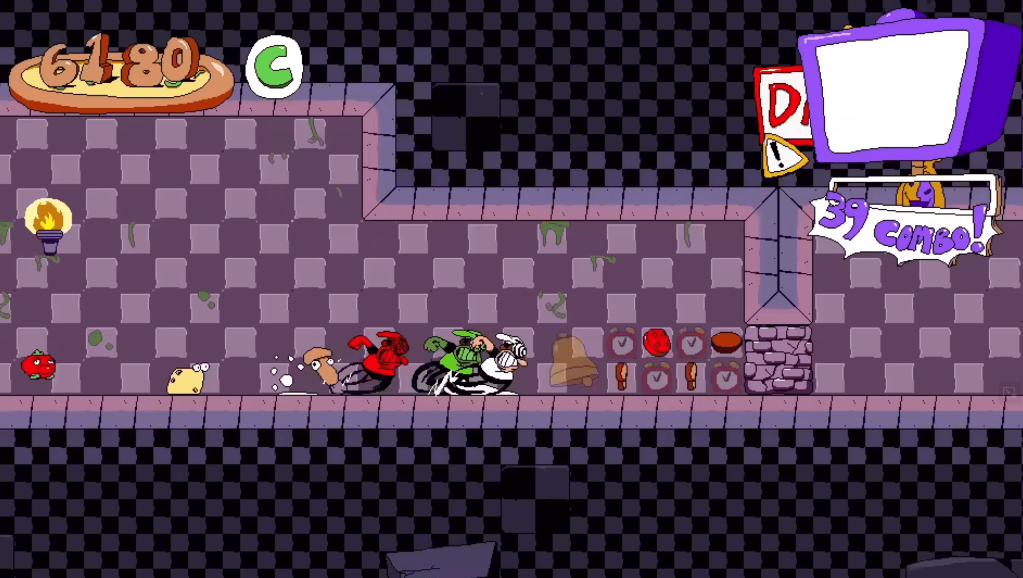
The background music for the trailer starts off very much in the background of the video, the audio being slightly edited to seem quieter and a lot more like its in the background compared to the visuals of the video and the game itself. The trailer starts off with the main character ‘Chef Peppito’ running and breaking a block and running into a wall enemy, starting a sequence within the game called a “Pizza Time”.
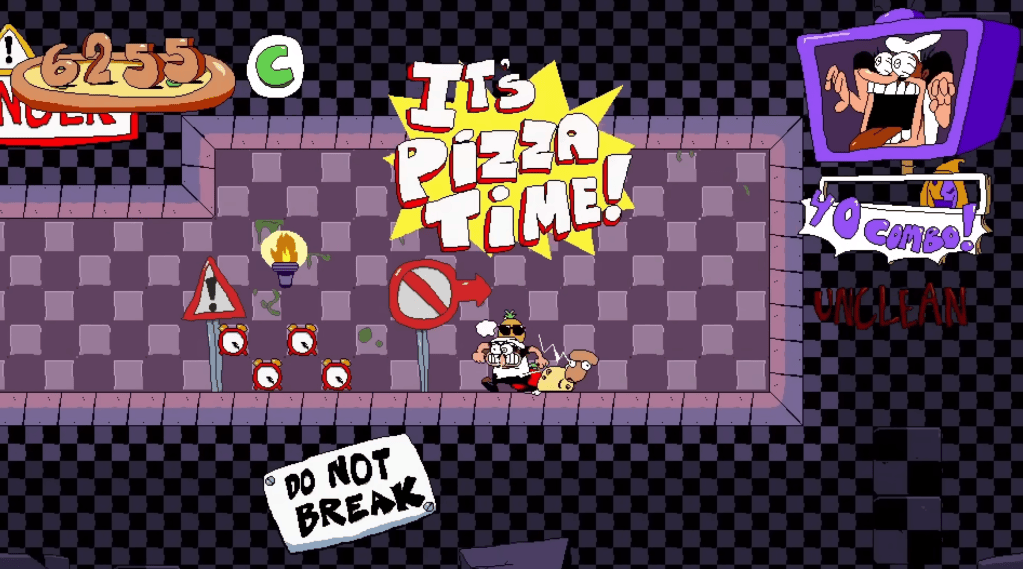
The trailer shows that the player immediately begins running back as the “Pizza Time” activates and a small timer appears at the bottom before the screen cuts to another set of gameplay.
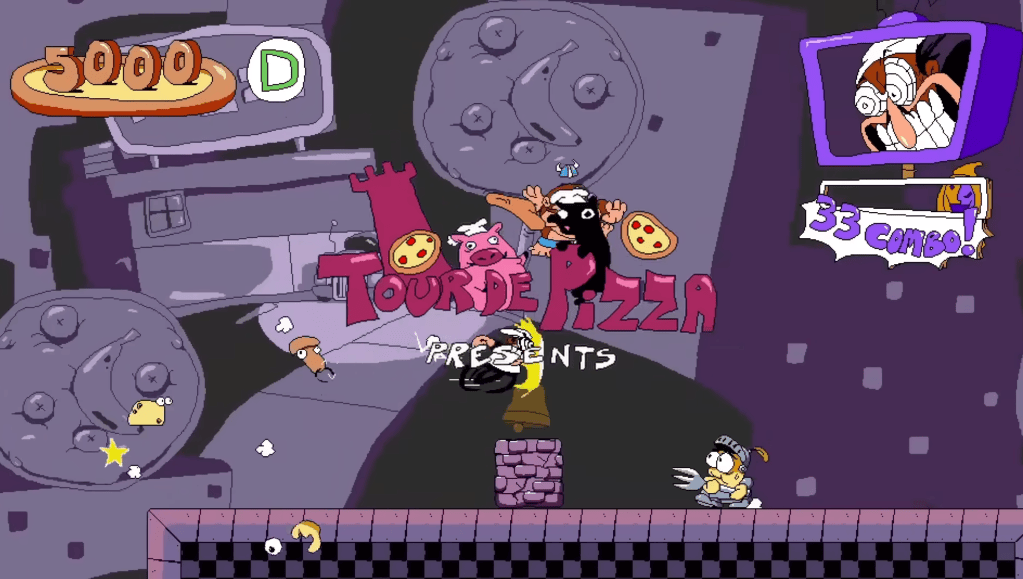
As the player is shown running across 3 different environments as the screen is shown with “Tour De Pizza Presents” Tour De Pizza being the small indie game dev studio which created the game. The player is shown as much of the gameplay as possible within this trailer as the trailer wants to interest the people who would like the gameplay of the game and are thinking about it rather than the trailer being more cinematic to interest people with the story, this was a tactical decision as the main component of the game isnt the story but rather the very simple gameplay loop of the entire game, which is what the trailer underlines.
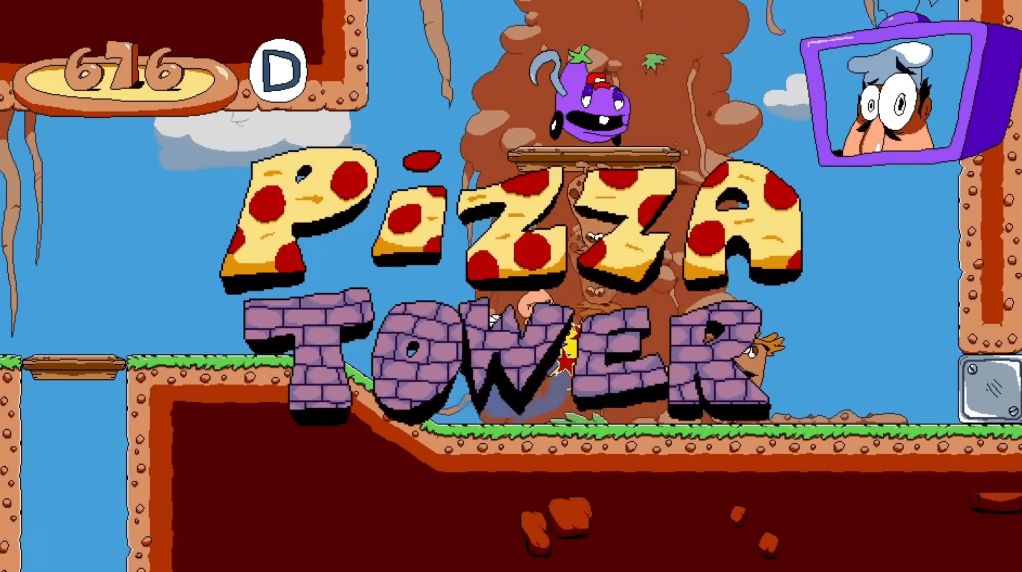
A very standard main title shot, stylised in the simple pixel art inspired by the 80s and 90s cartoons and very comedic pizza-based puns that the game keeps making.
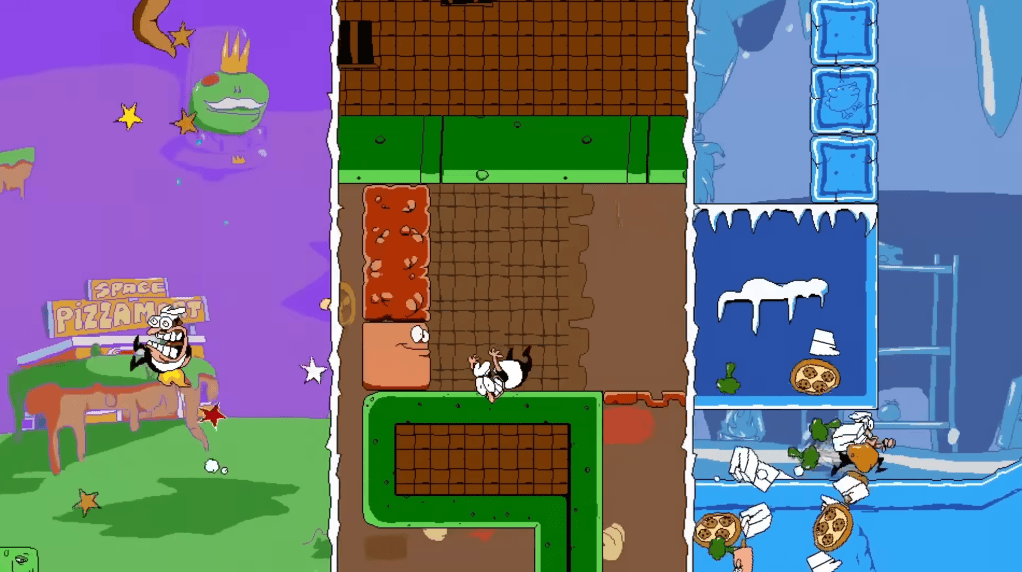
The trailer proceeds to do a 3-point shot between all of the different levels to show off the different level design of the game, this was done as to show off as much about the level design of the game as it is one of my main selling points about platformers.
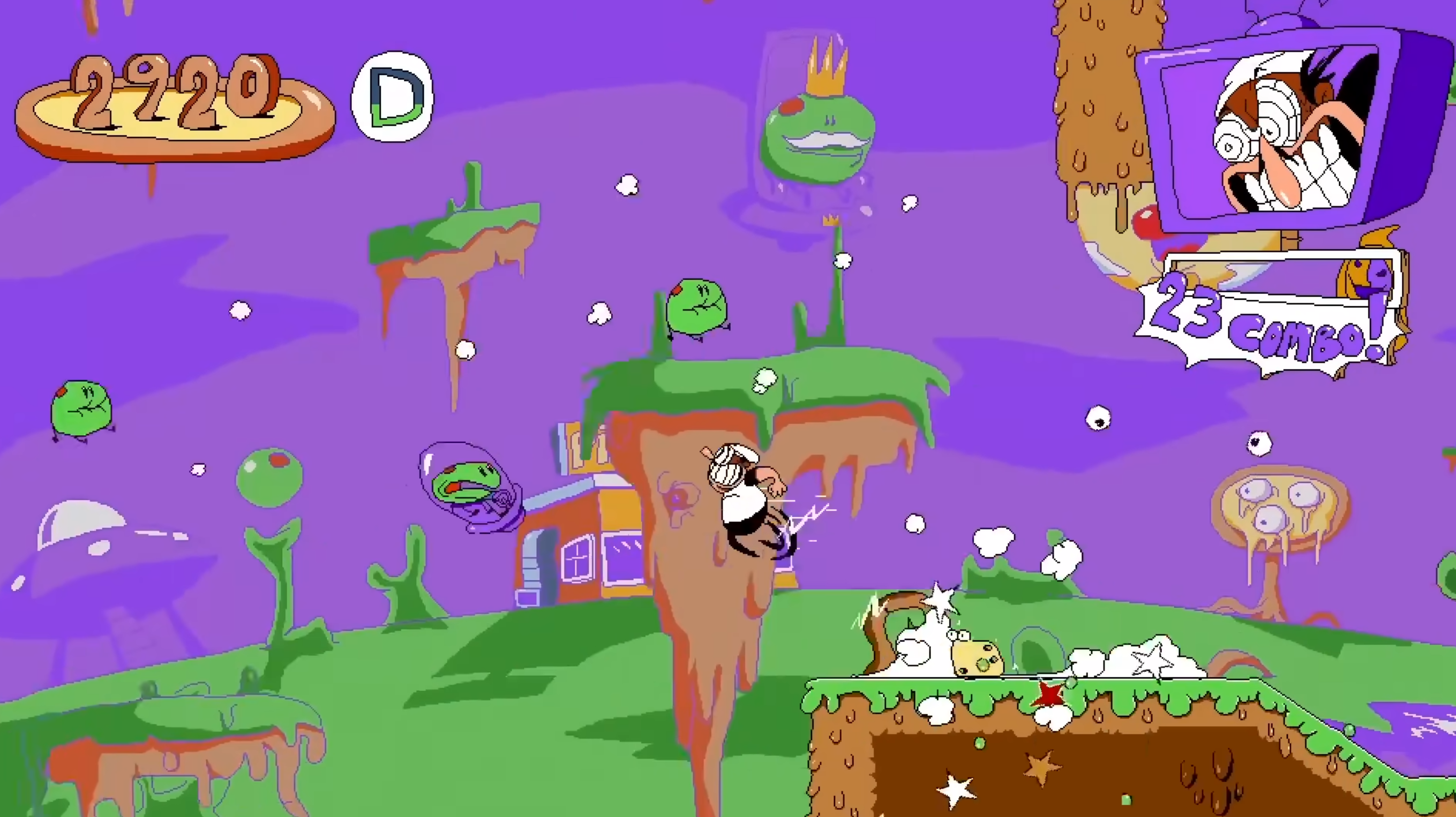
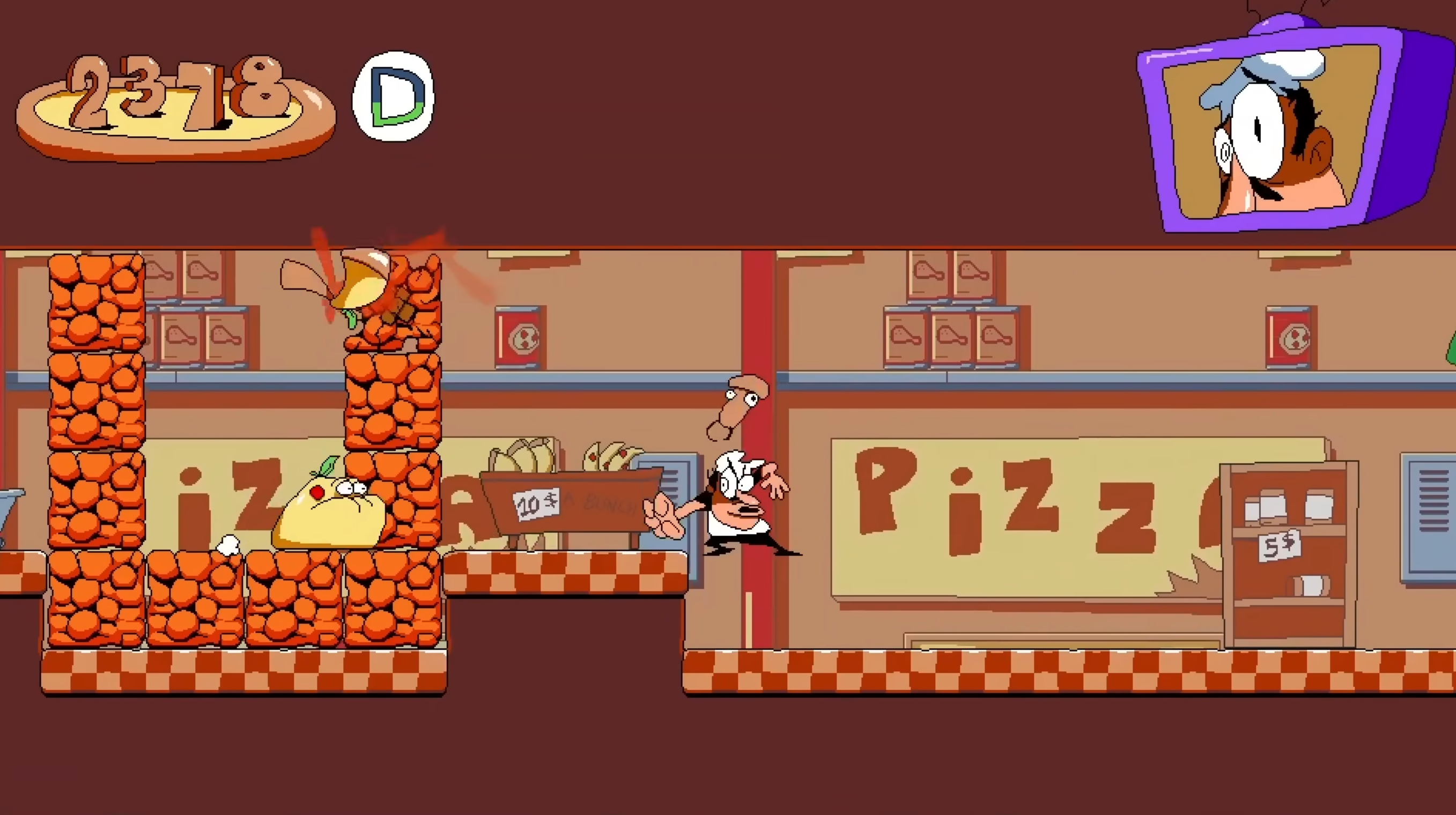
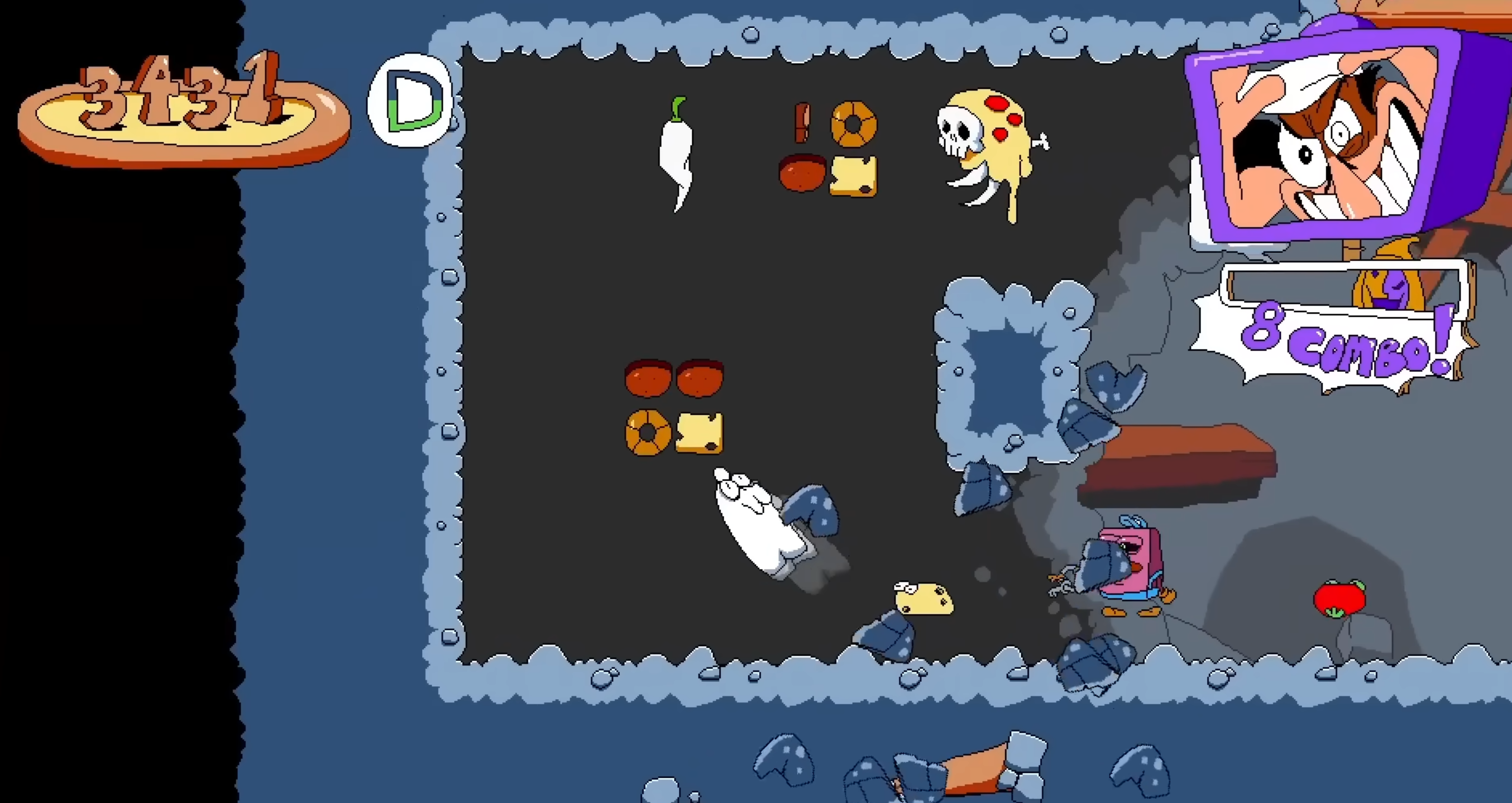
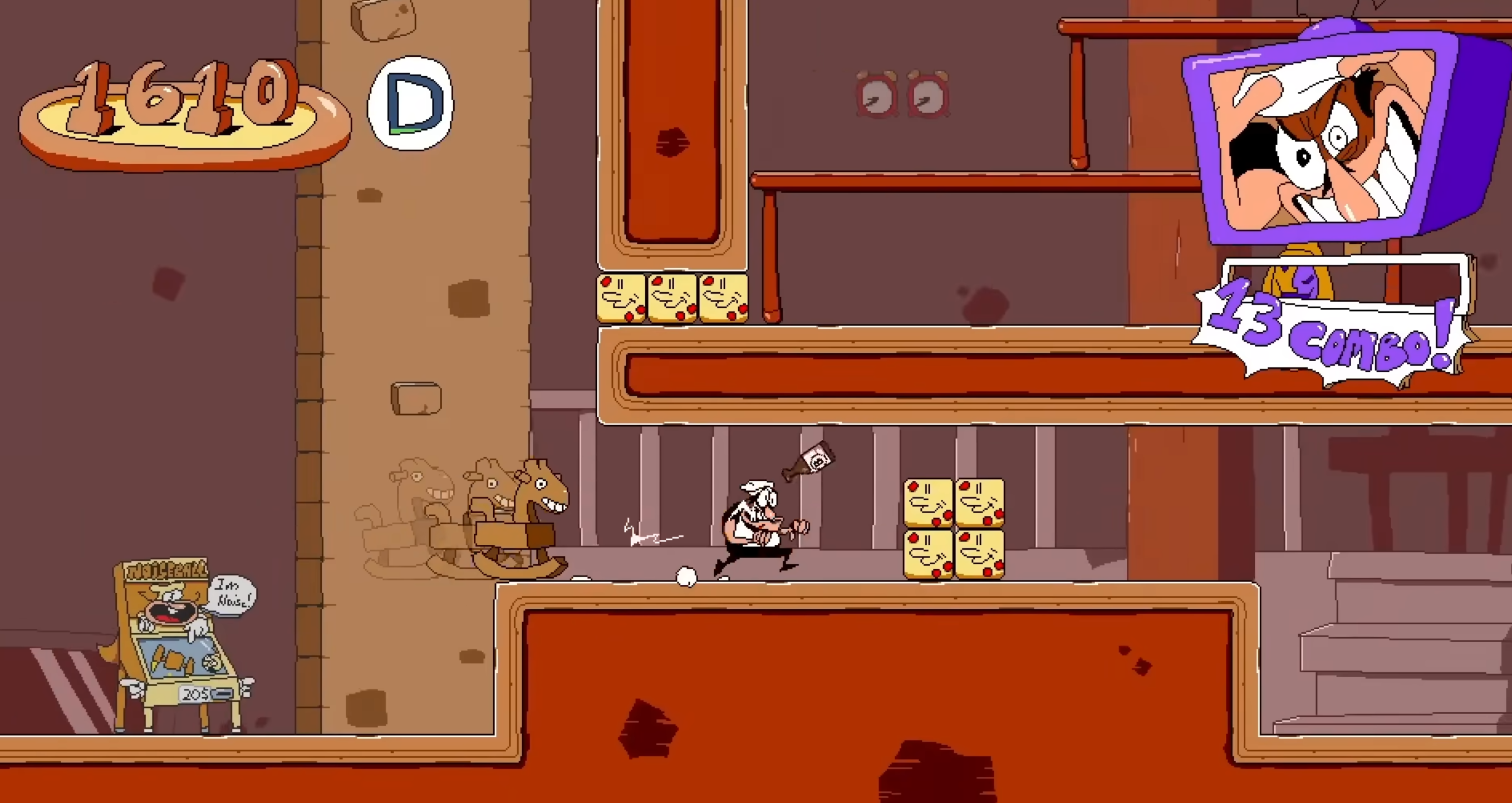
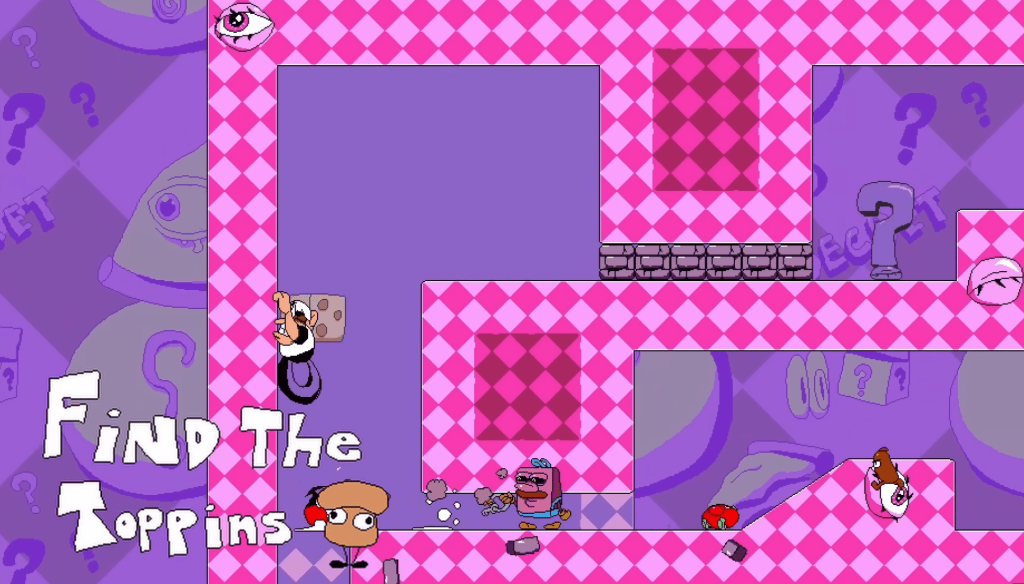
These 4 images show some running scenes in different game locales or even power ups that the player would have received for that level to get across some sections.
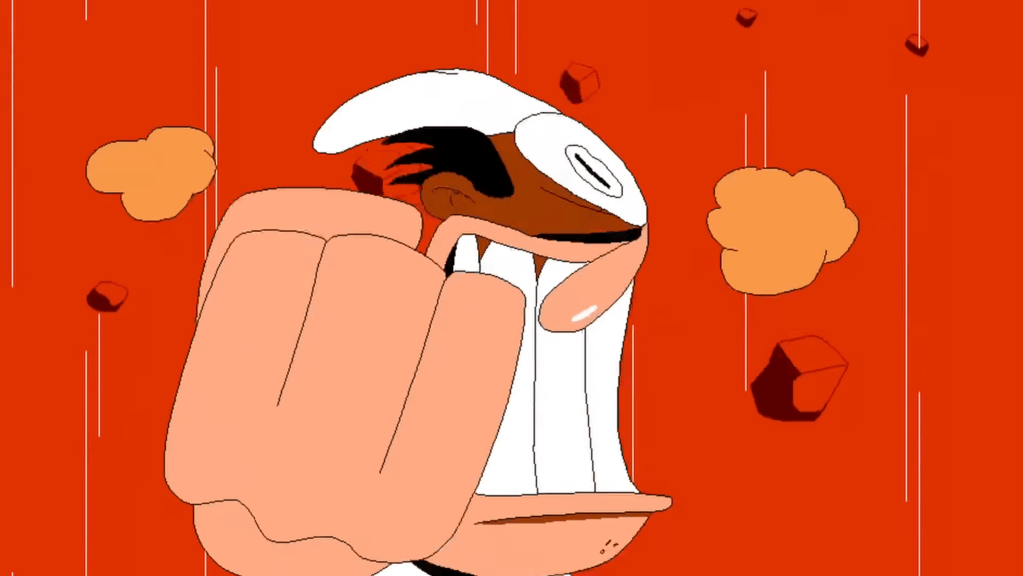
Very small custom cinematic animation shot to transition the trailer to a more faster and dramatic style with a noticeable increase in energy from the BGM used for the trailer.
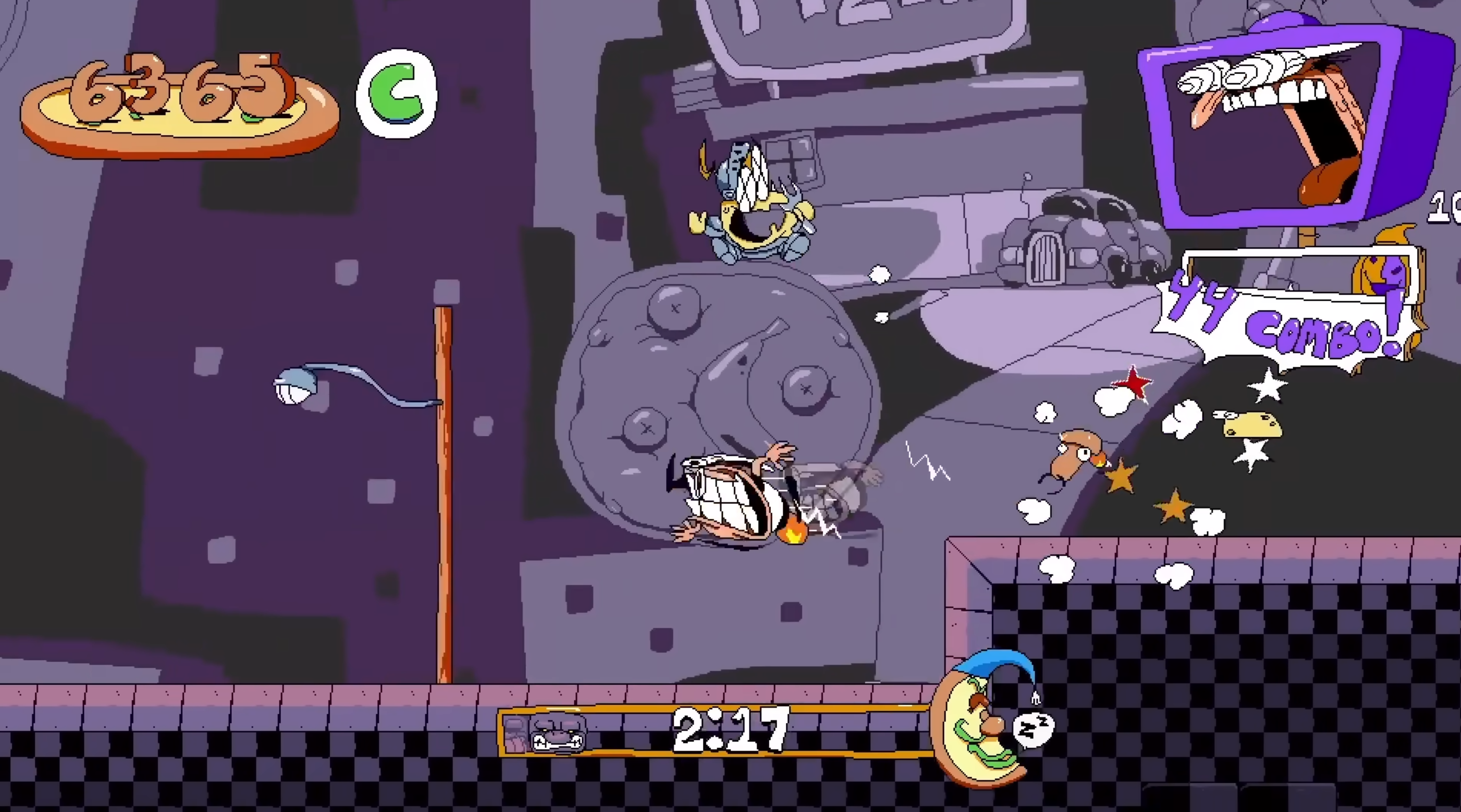
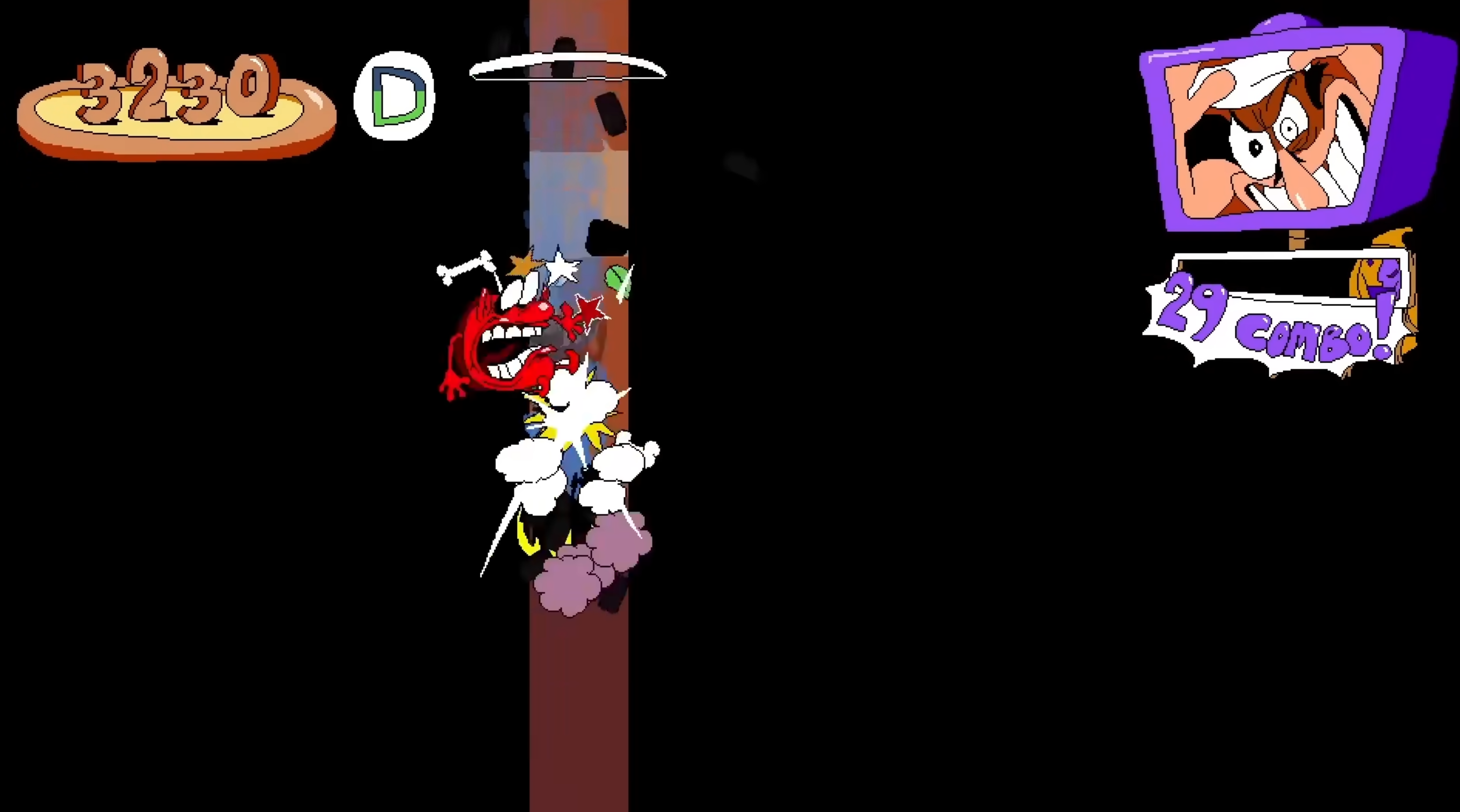
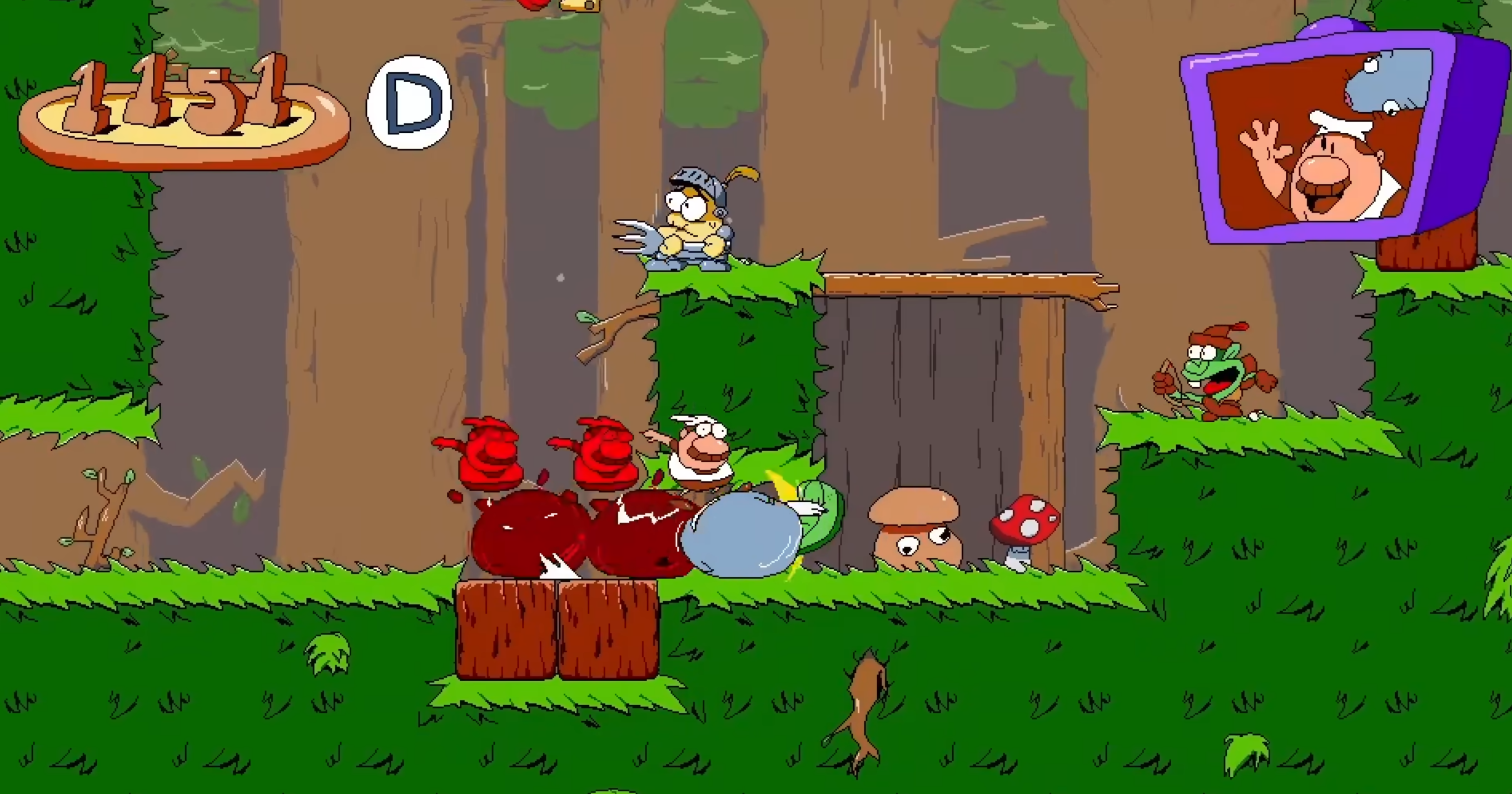
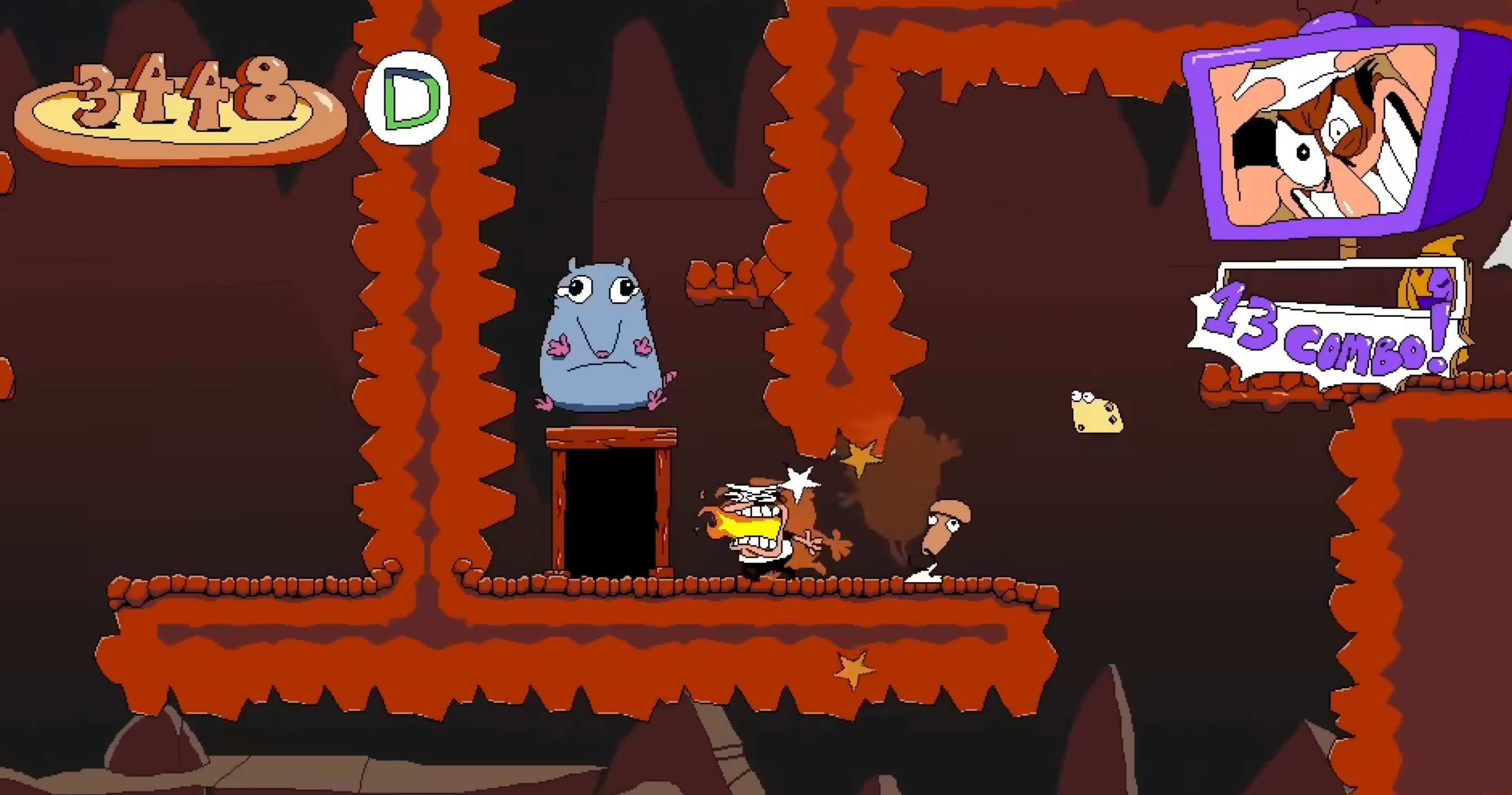
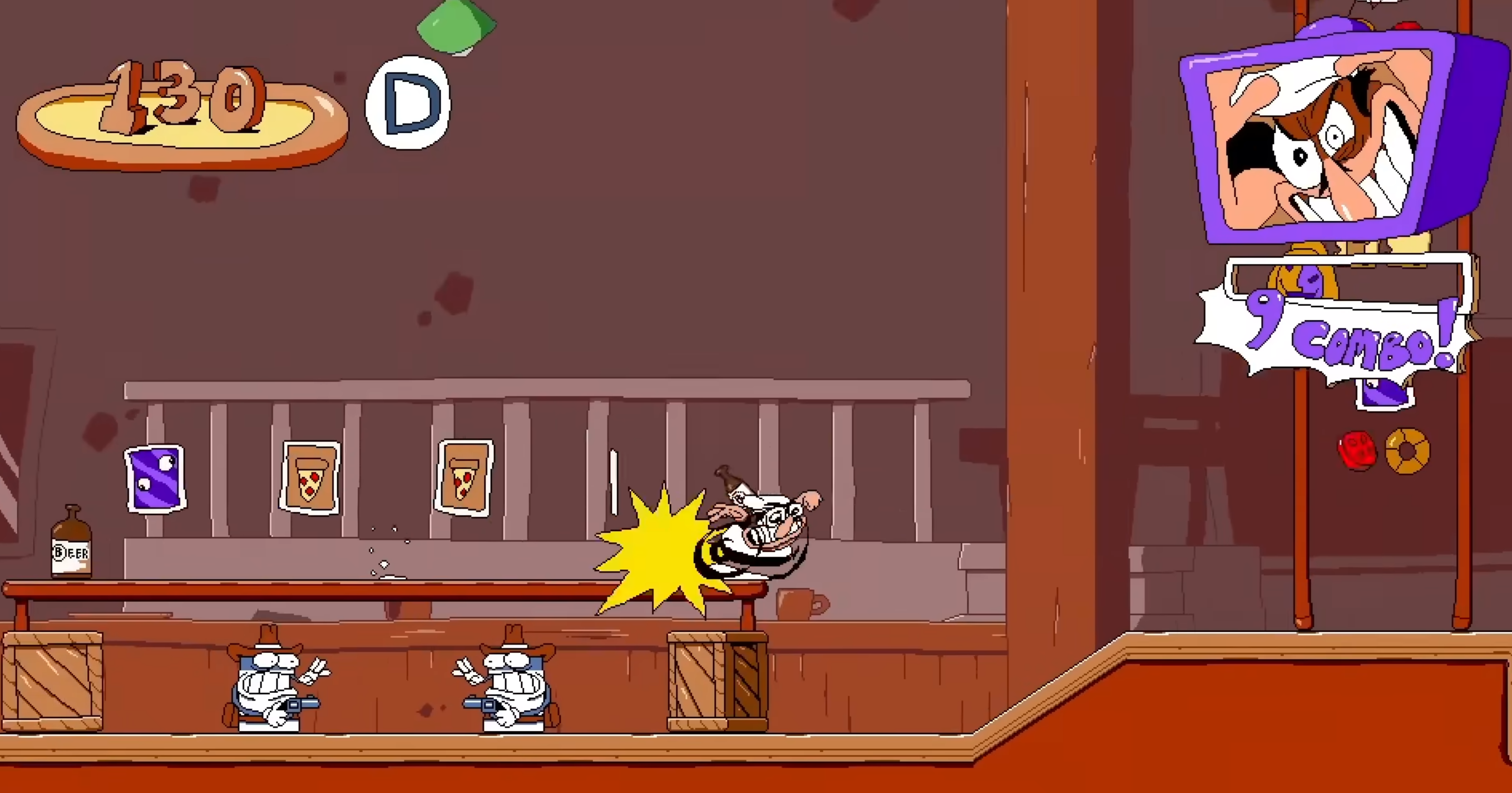
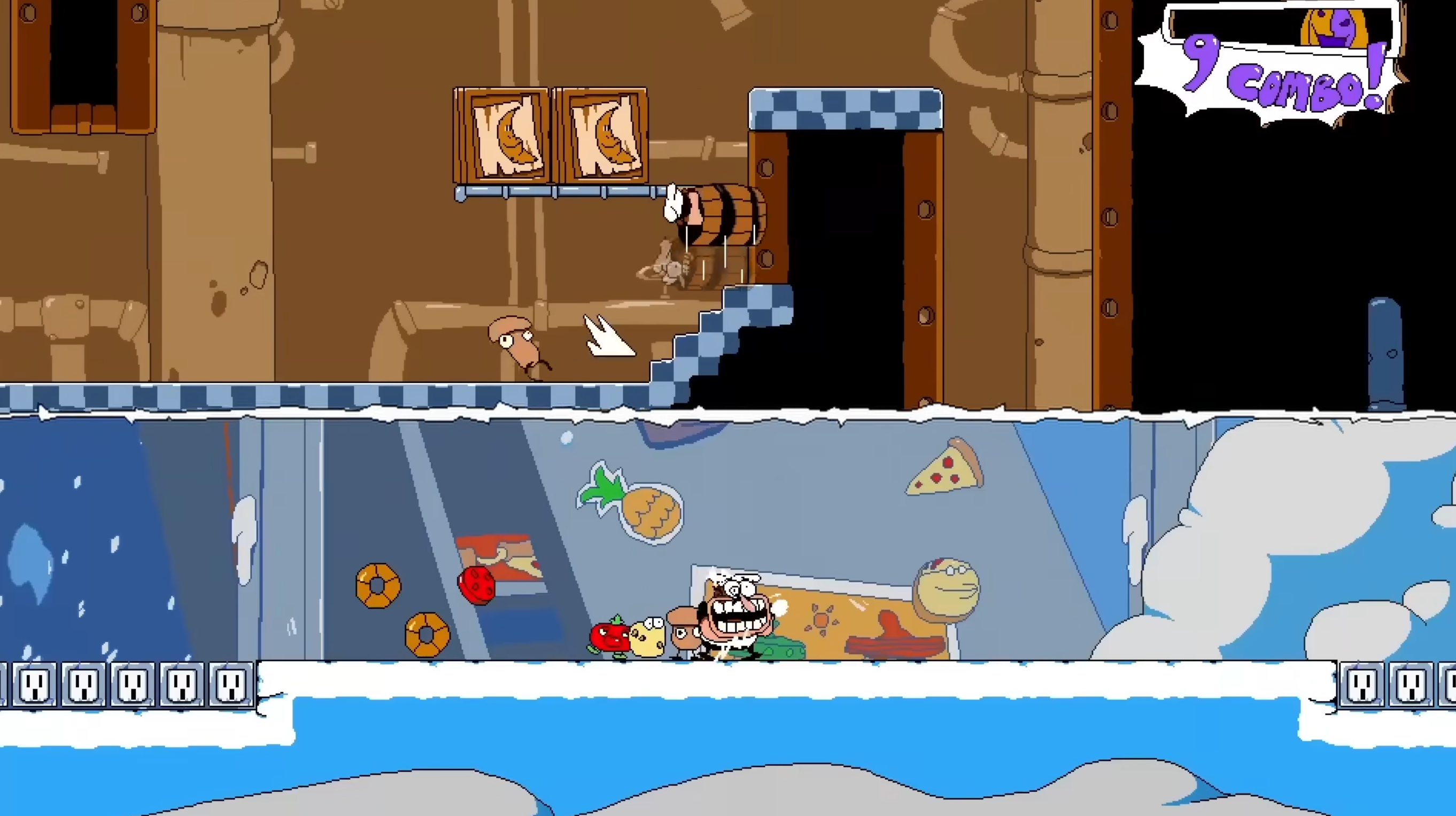
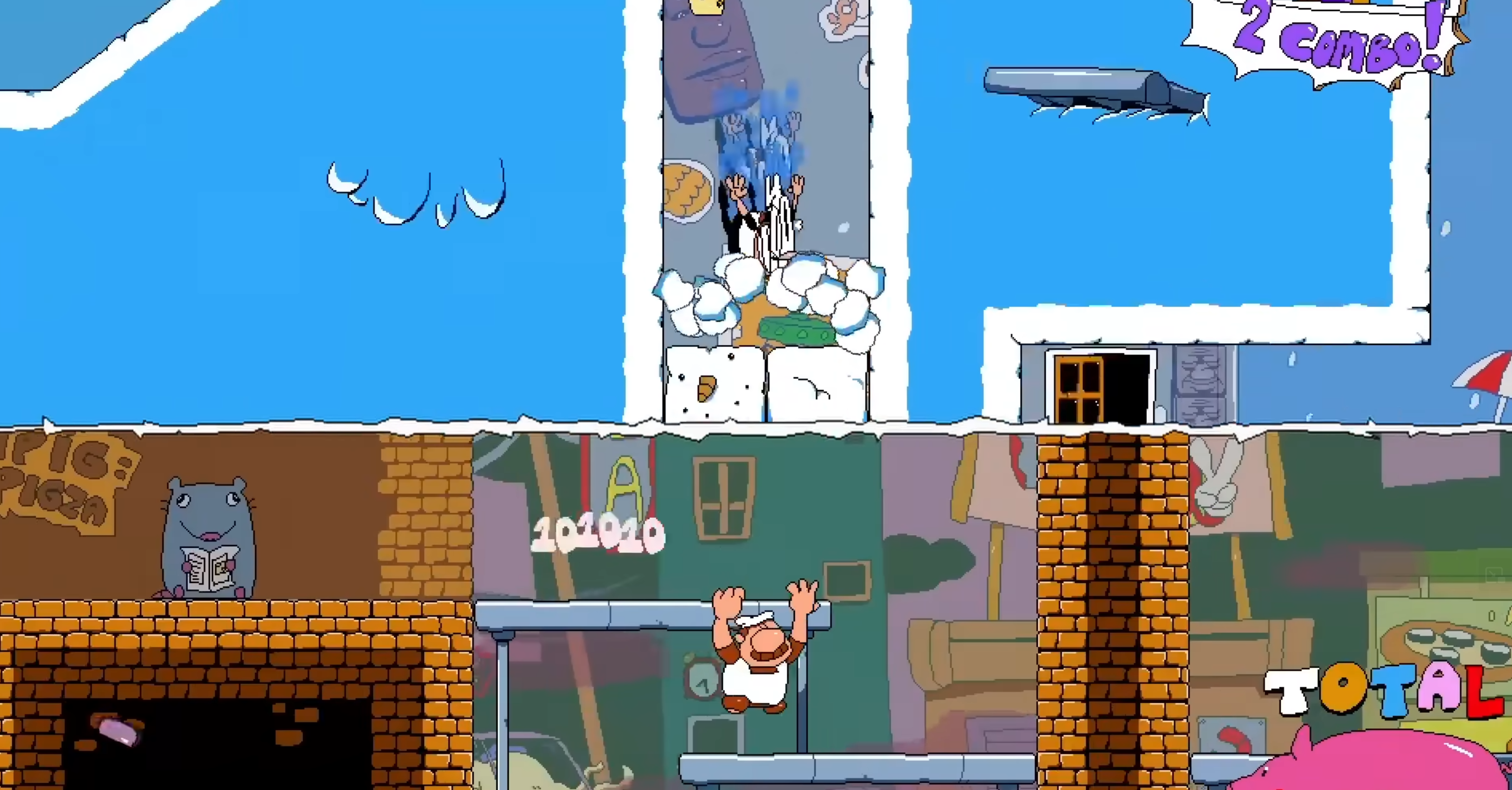
A collage of some more different shots that were included within the trailer that showed off the different locations, power-ups and level design that included needing the power-ups to get through different obstacles. These shots are very important in a trailer as they show just the raw gameplay footage that the player would get from playing the game. A very straight-forward and honest look into what the player is getting with what they would be buying.
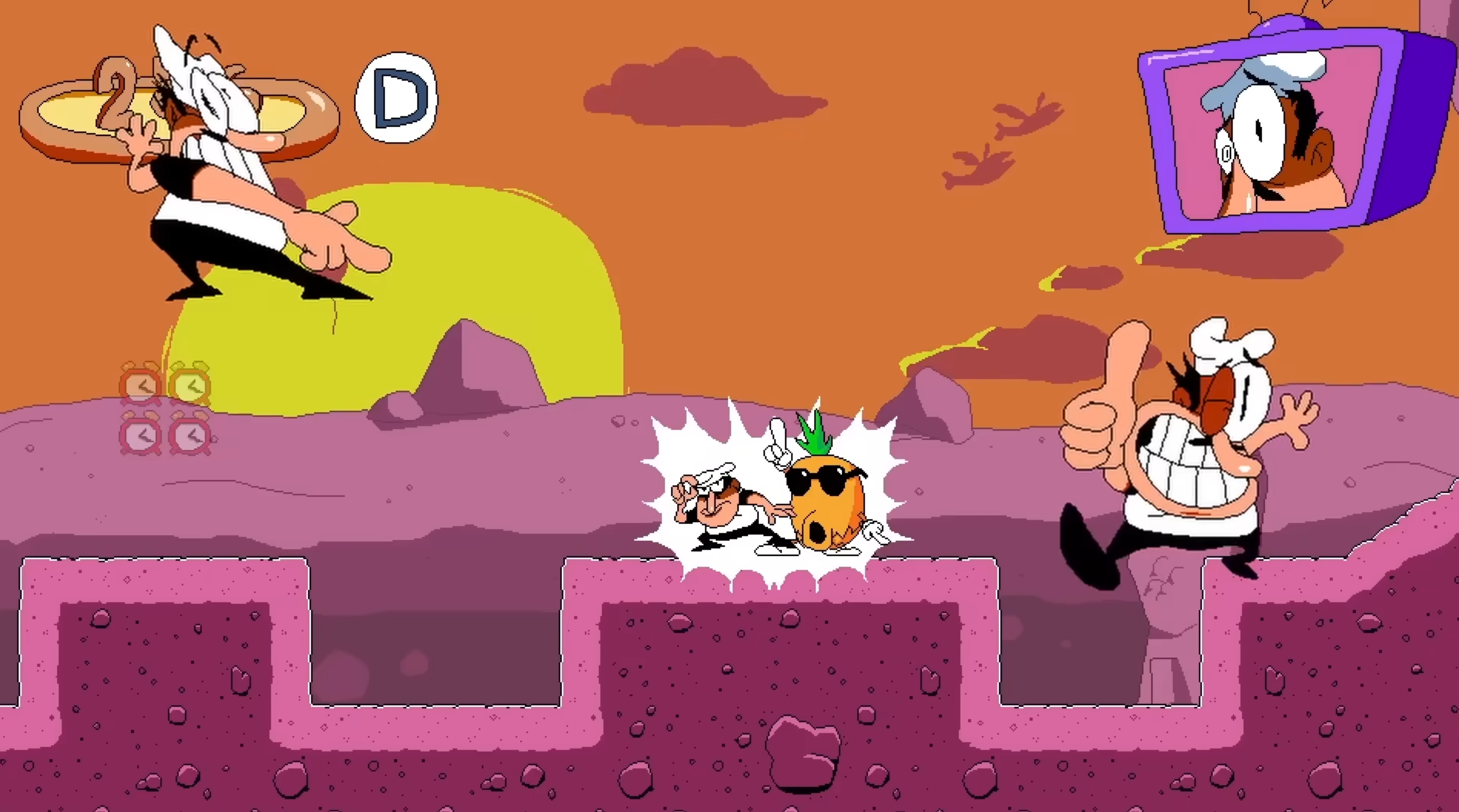
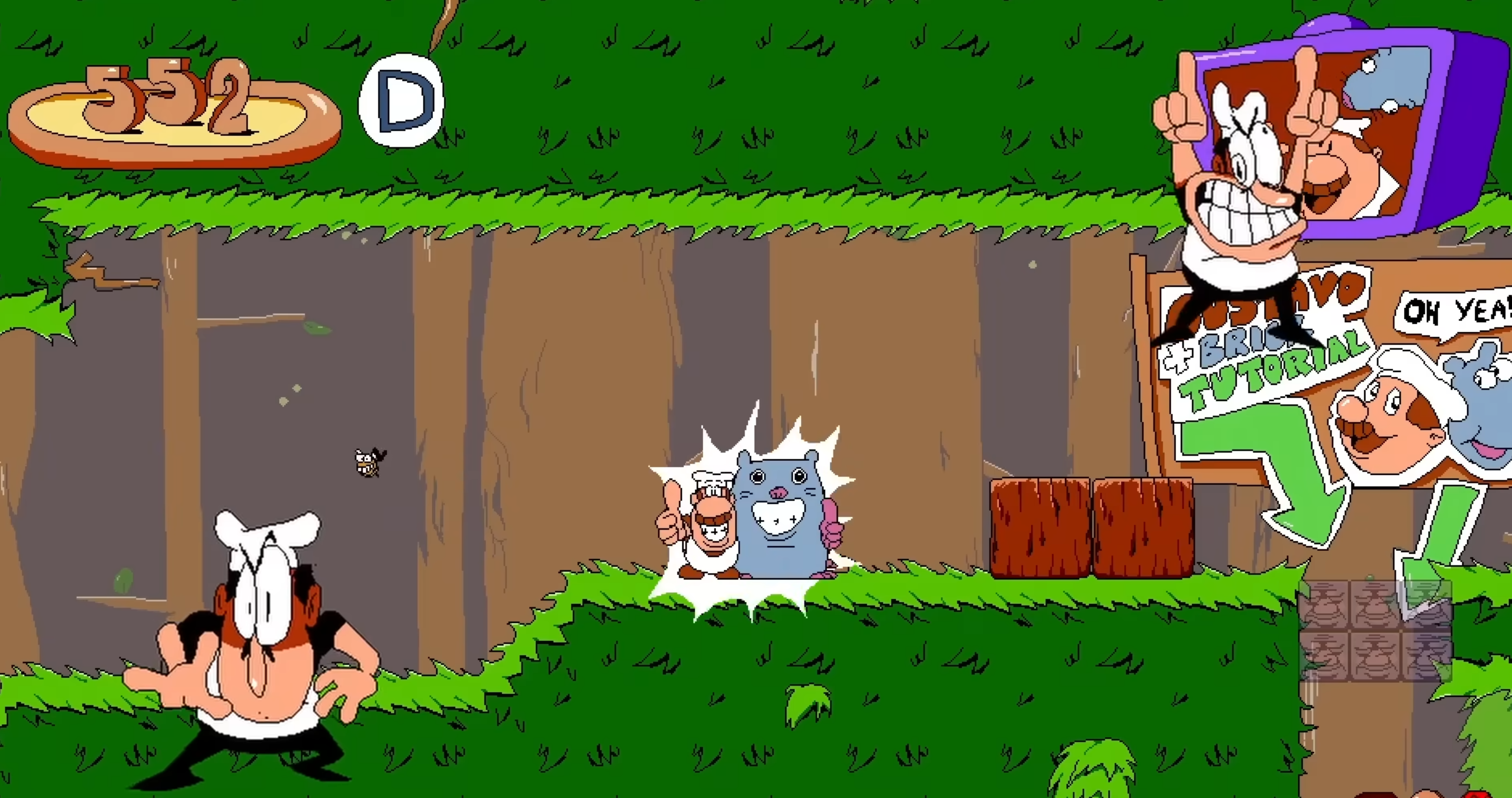
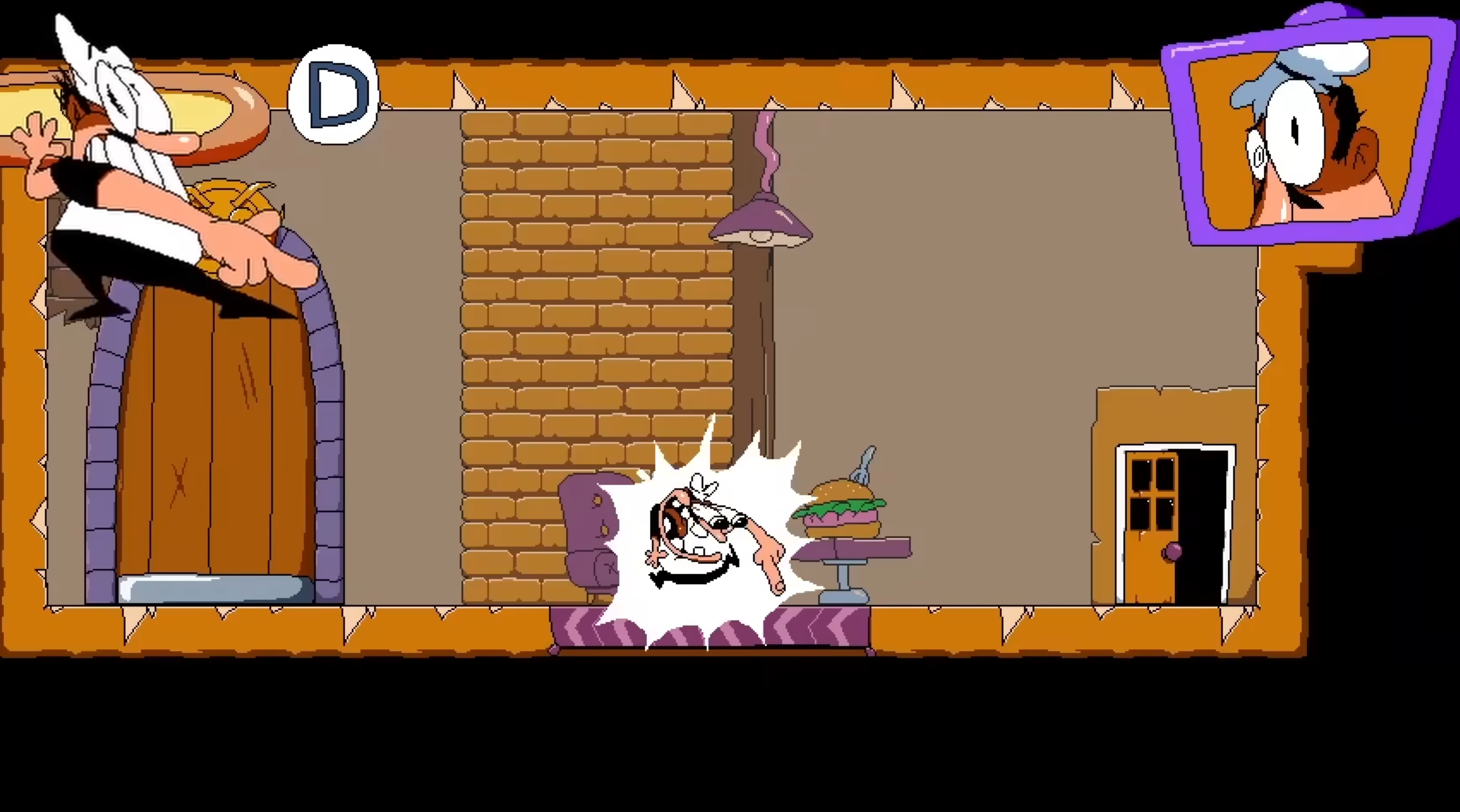
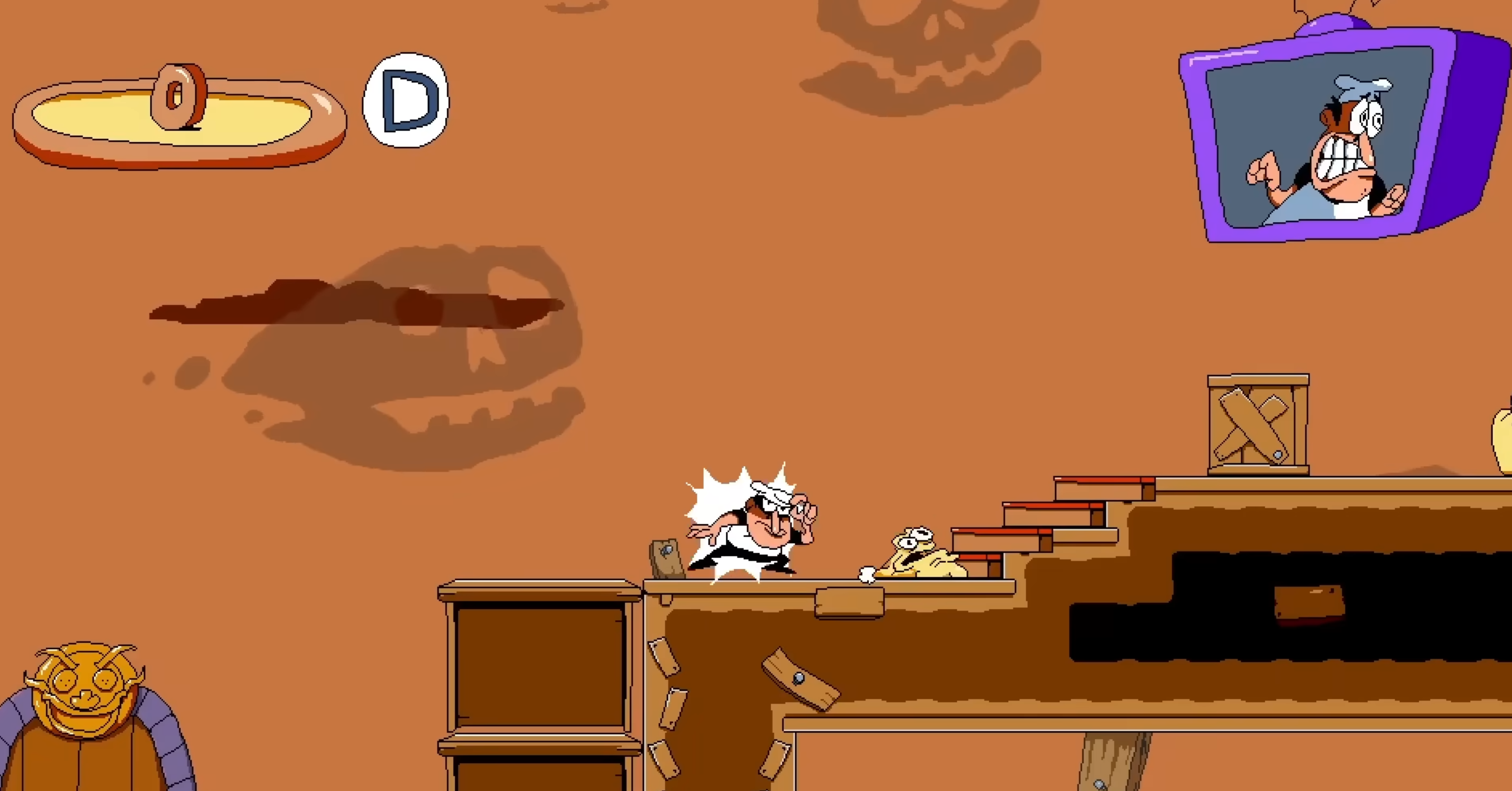
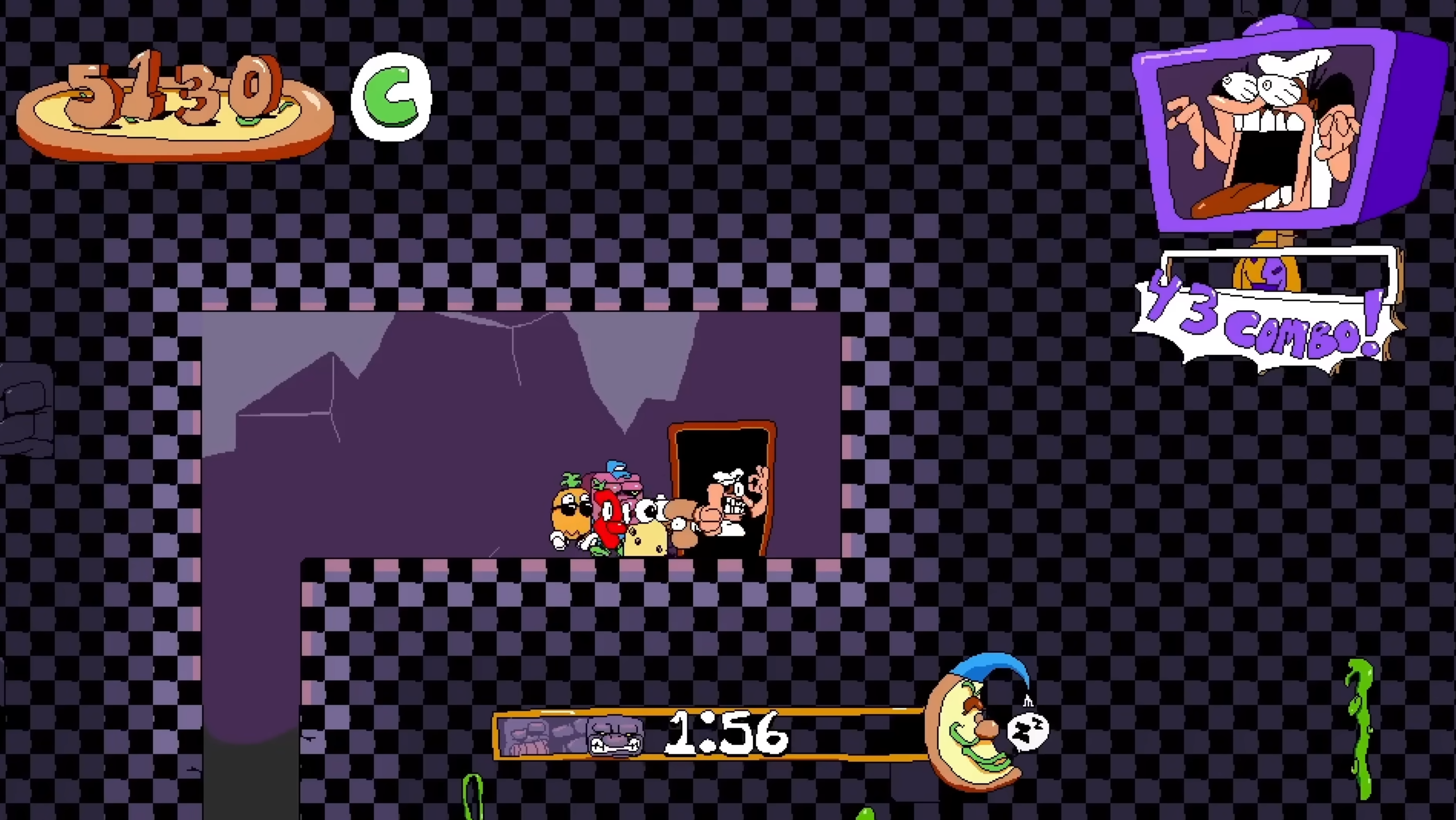
The Trailer begins ending with a small section which shows off the taunt system in the game, a cosmetic feature within the game that was made only for style points where a sound effect plays and the main character does different poses on a chance factor. This is done to show more of the comedic side of the game where the player could relax and enjoy the comedic factors rather than the fast-paced gameplay of it. A chance to slow down.
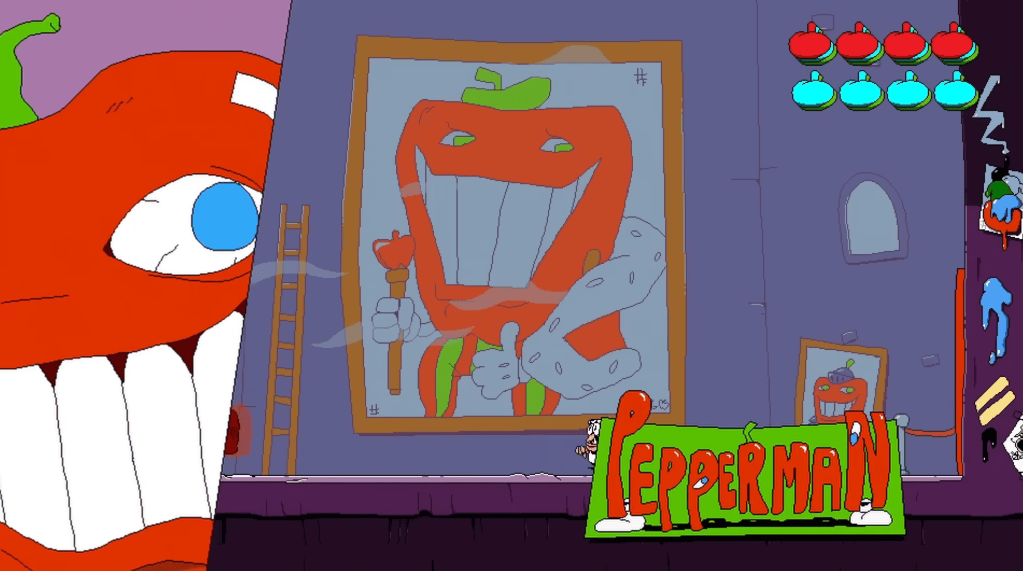
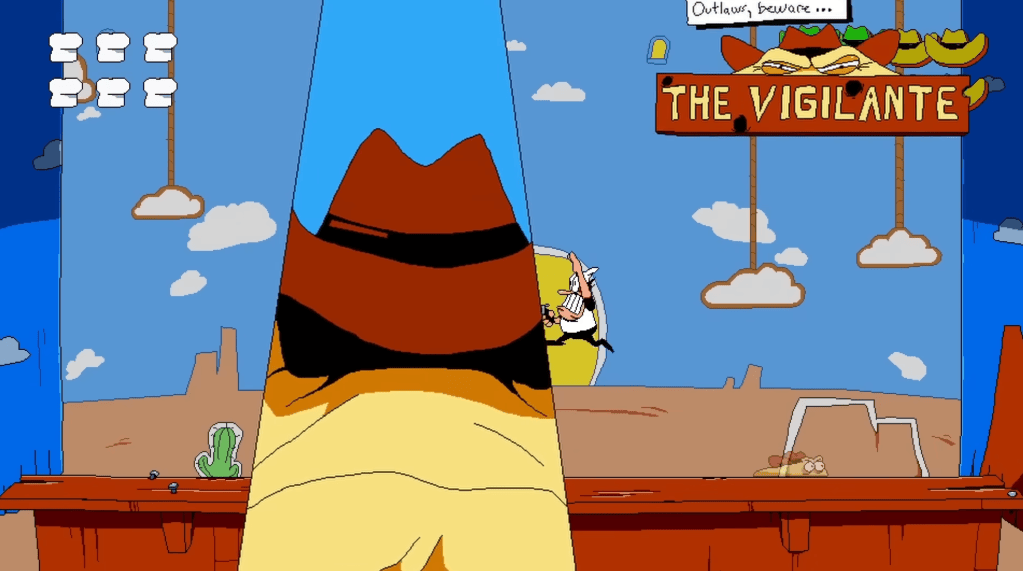
Here, the trailer shows off the different boss fights that are included in the game, boss fights which either let the player move onto further locations within the game’s setting or to unlock more cosmetic features for the future.
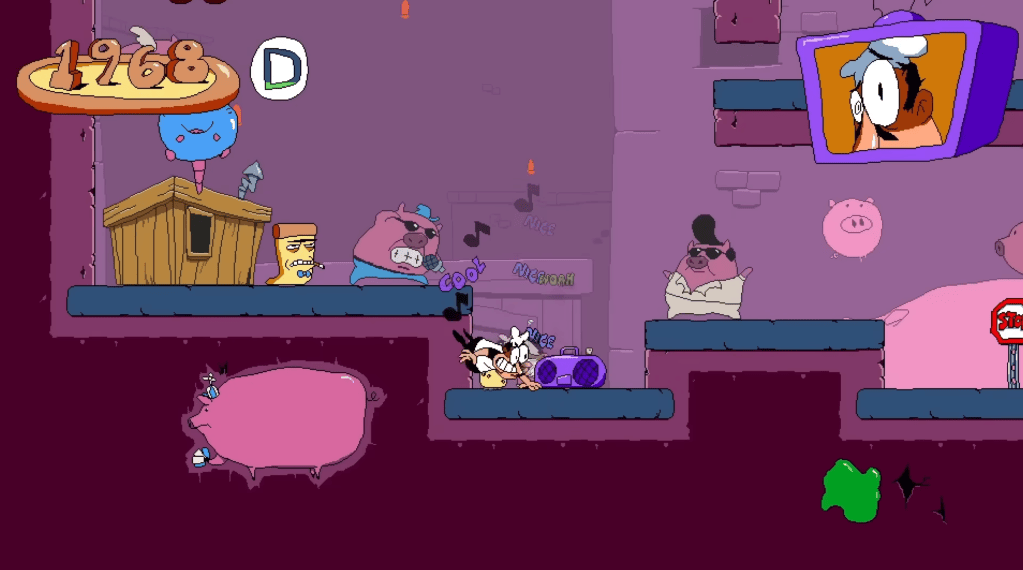
The trailer ends with the main character doing an animation of breakdancing next to a small music player, a way to show that there is more to the game than just running very fast and getting through all of the different levels and that the player has moments in the game where they themselves can relax and take a small breather.
The Nintendo Switch trailer for Pizza Tower was made roughly 2 years after the game first came out, this market a significant step for the game’s developers as it allowed a bigger market to be reached for the game. This trailer was done in a more professional manner where a lot more is shown with light cinematic animations and on screen text so that it looks more appealing to a wider audience that isn’t familiar with Indie games.
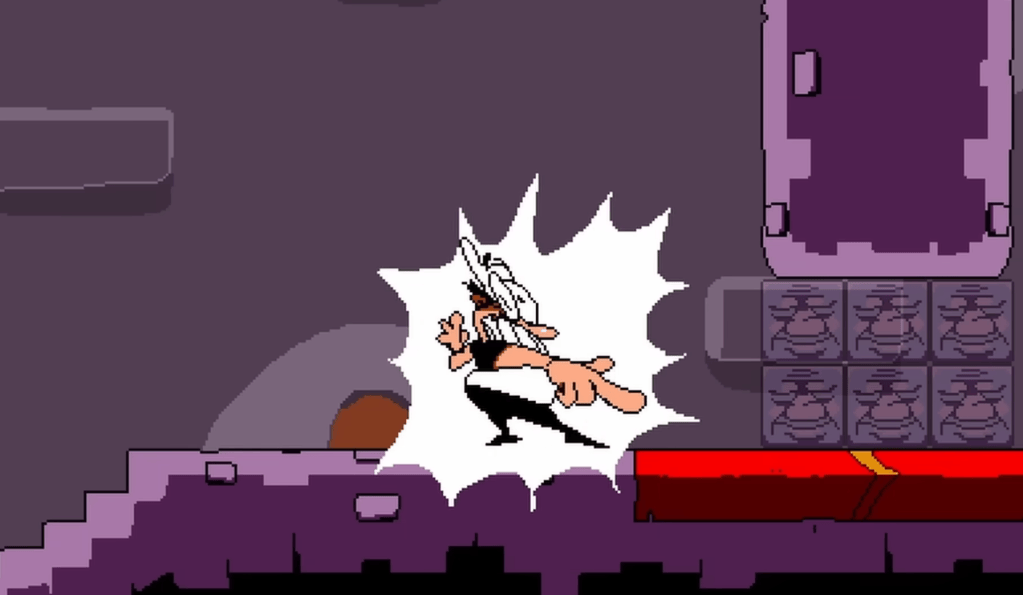
The trailer starts off with the main character doing a couple taunts, I believe that this was done for 2 different reasons. The first is for the audience who already know the game, very often when games or expansions get revealed, there is a lot of people who are streaming or recording themselves reacting to the different games that are being revealed, the main reason as to why the trailer starts off with no music and just the sound effects of the character taunting is for the audience who already know the game, have that initial shock reaction before the trailer actually starts.
The second reason for this is to create a slower start and to get the people who don’t know the game an immediate interest with poses, sound effects and visual effects with how the game itself looks.
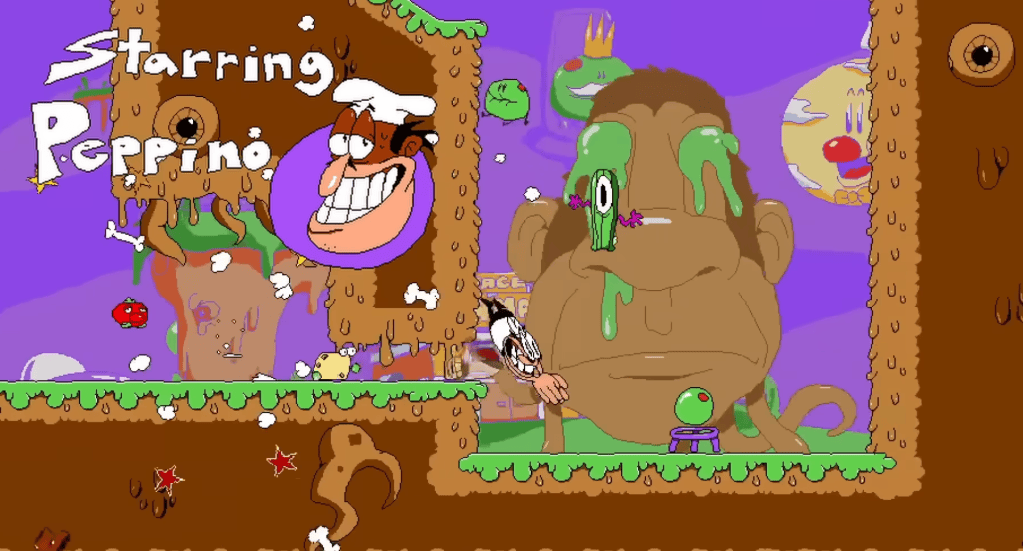
This trailer’s music is actually a lot slower than the one in the steam trailer, its more uniform and it fits very closely to Nintendo’s child-friendly like theme. The music being a lot slower contrasts the gameplay quite drastically as the gameplay still shows very much the fast-paced gameplay that the game is designed around.
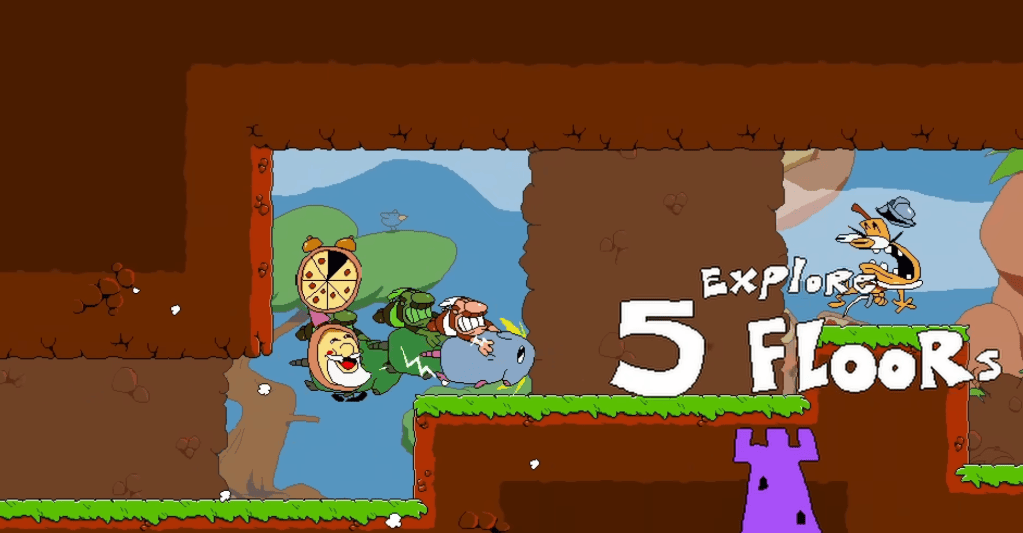
The music in the trailer hits to the beat of scene switches within the trailer, any time it would switch a perspective or different level with new text on the screen, a beat hits repetitively in the background.
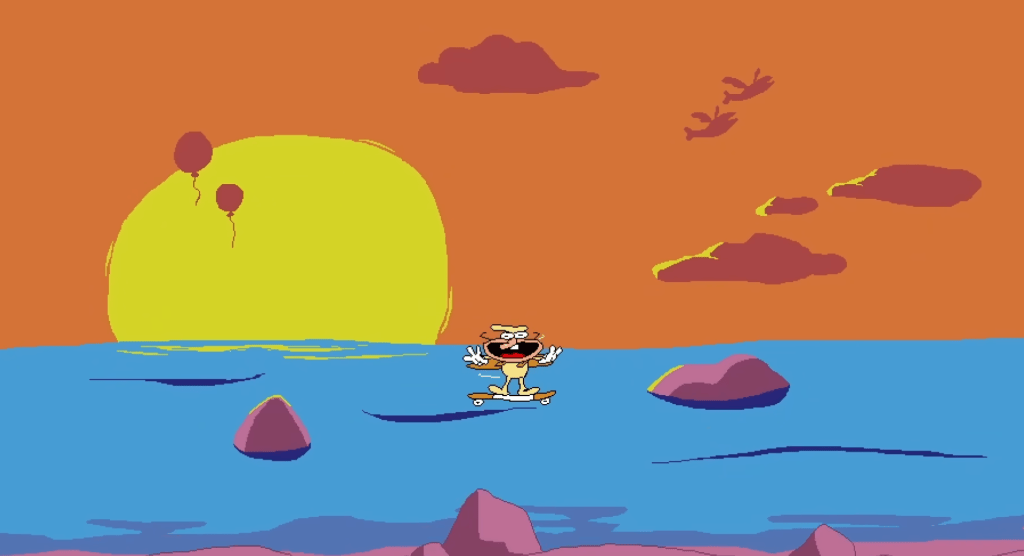
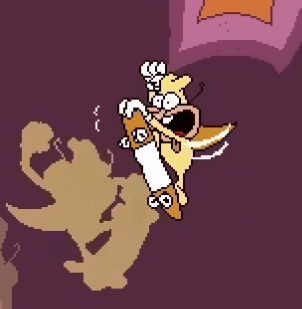
The trailer also shows off a couple of different possible skins that the player could choose to customise their character in the game as an added comedic effect that the game already carries to just make the game more fun.
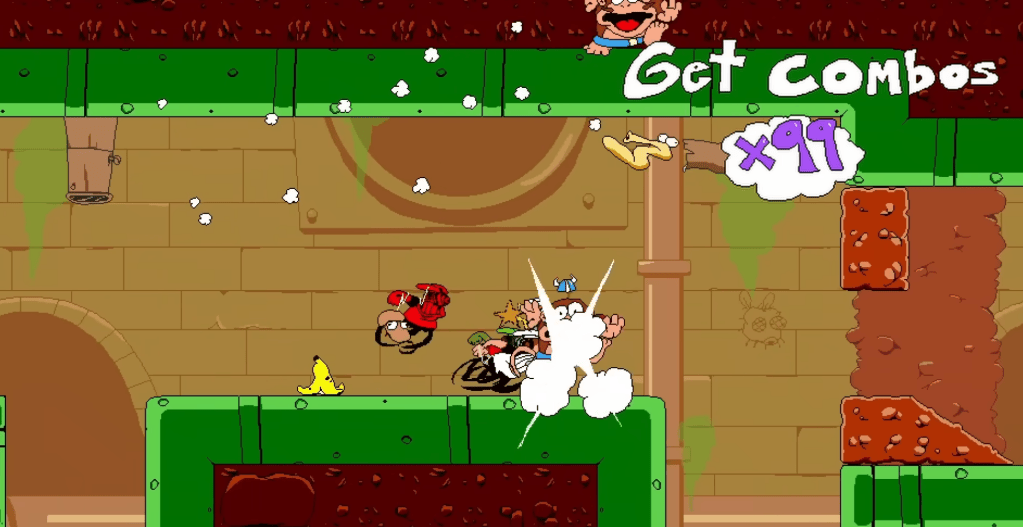
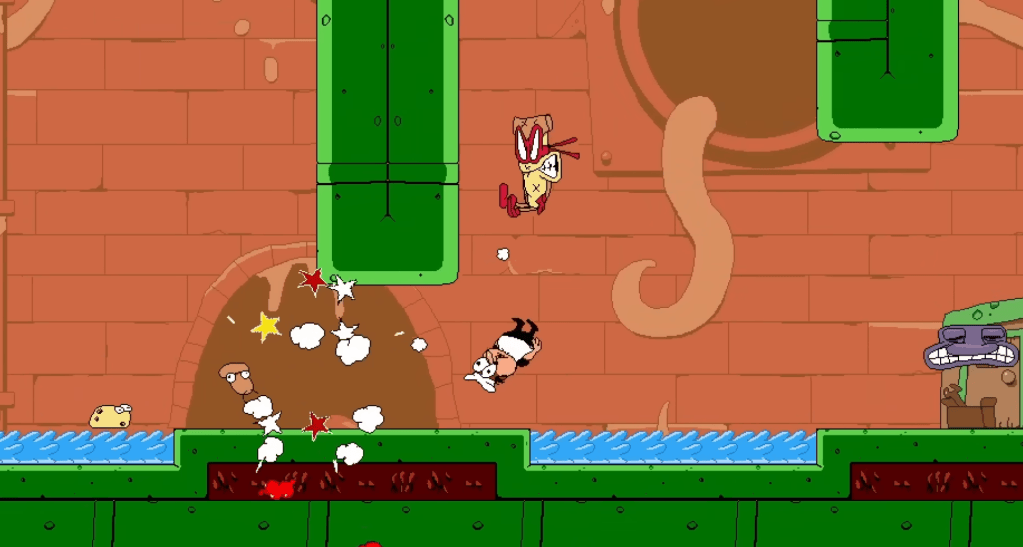
The trailer includes a lot more running sequences similarity in beat to the music in the background which stays very similar throughout this time. Until the music changes as these scenes end.
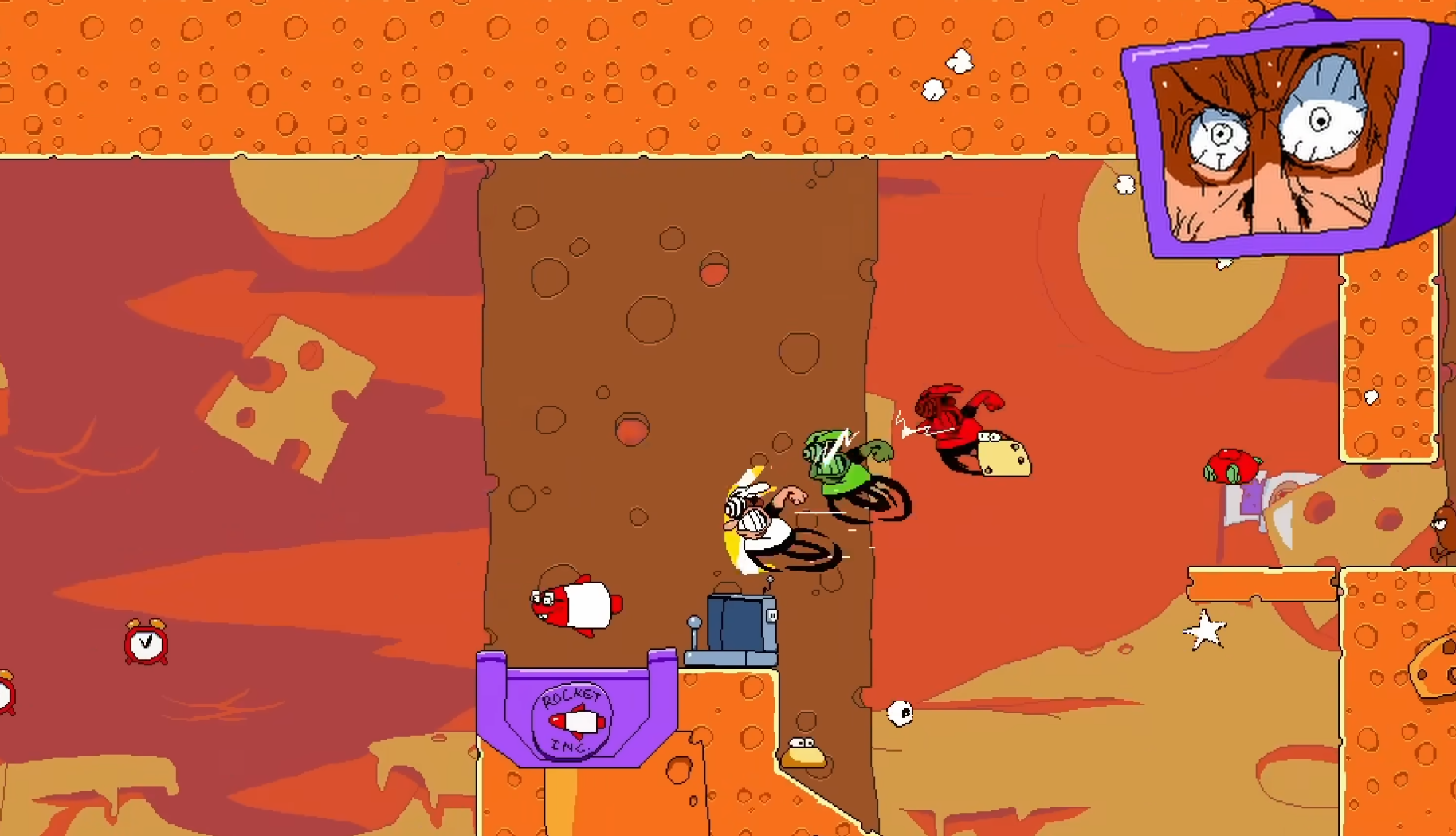
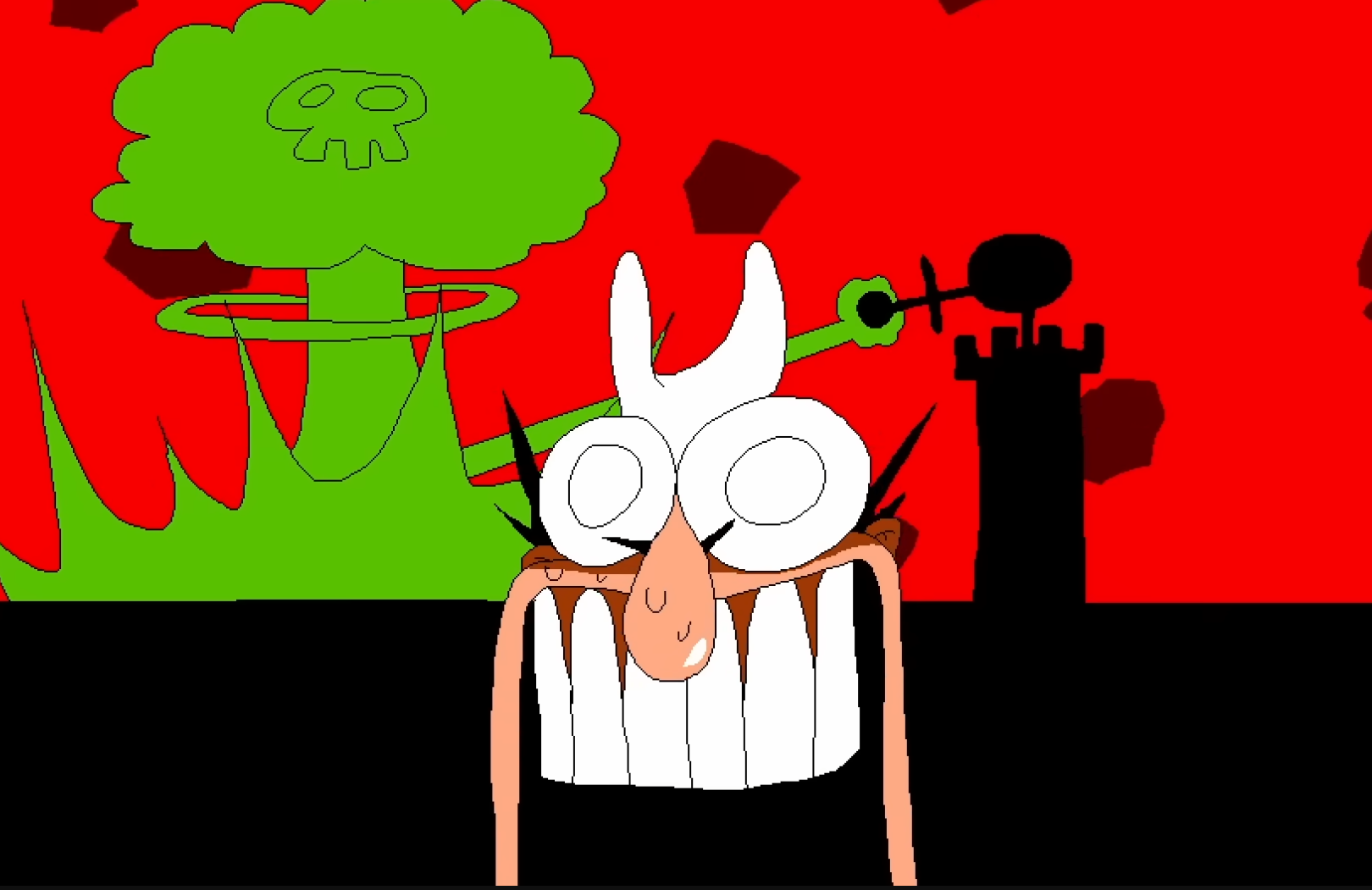
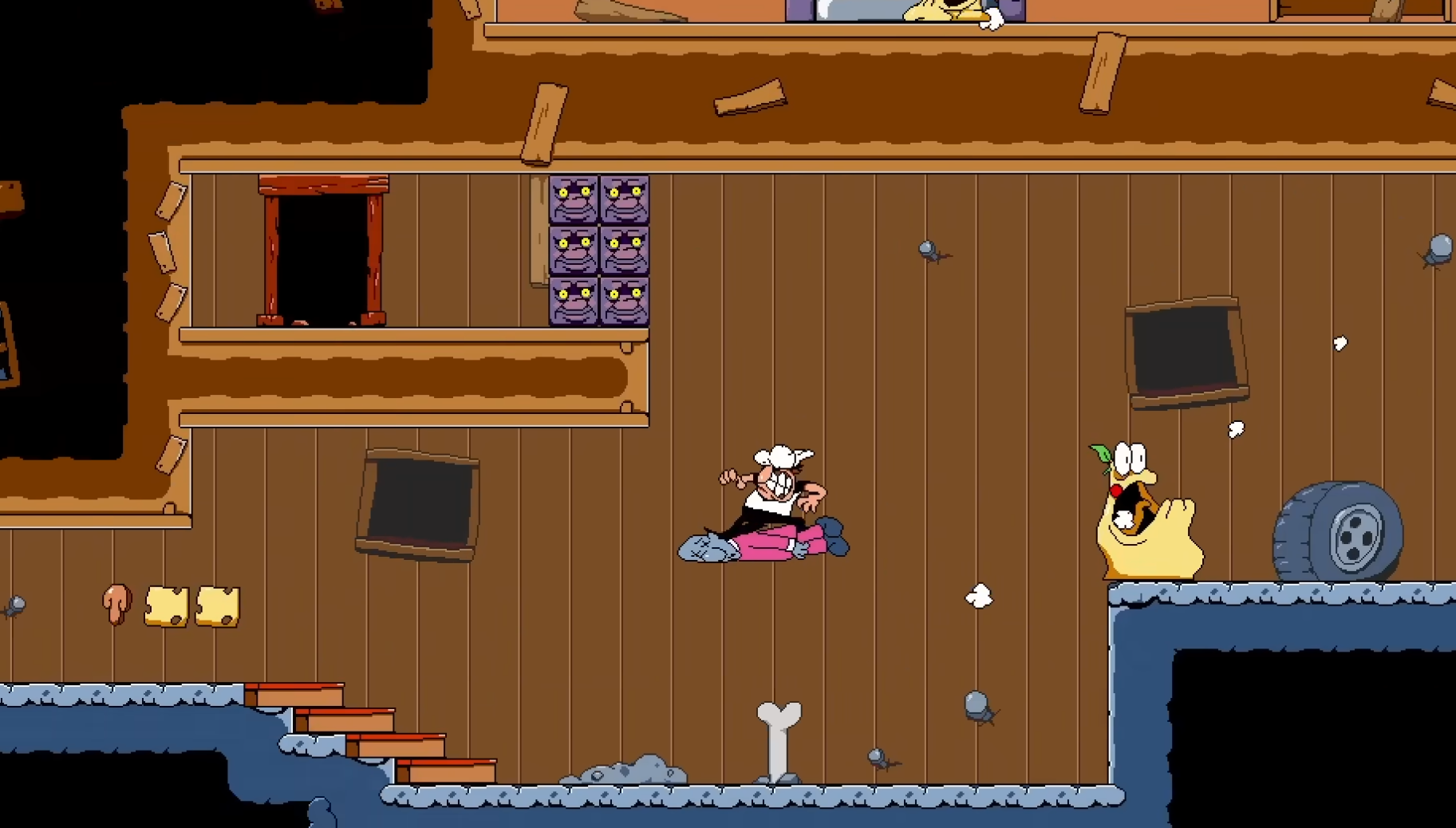
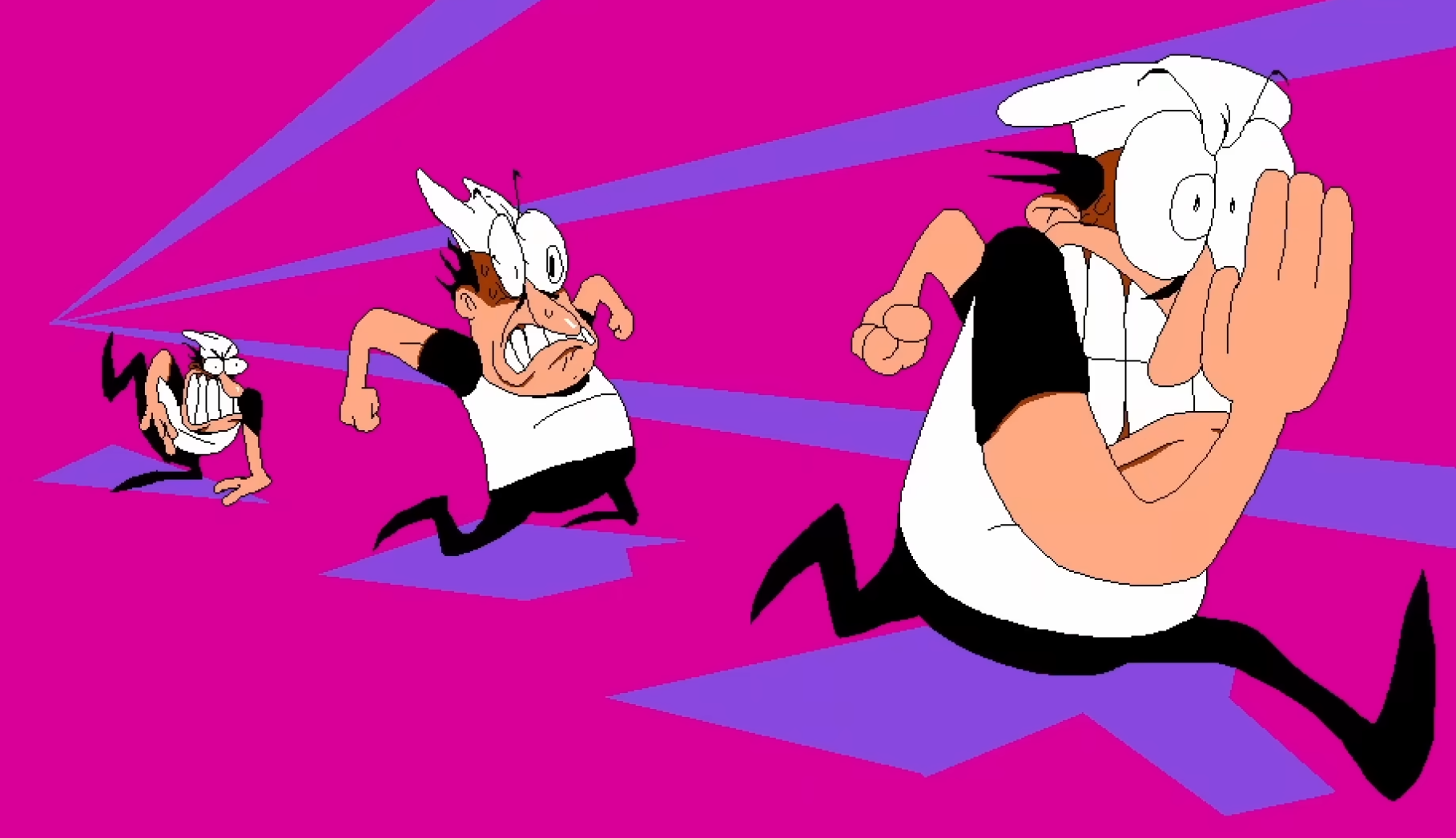
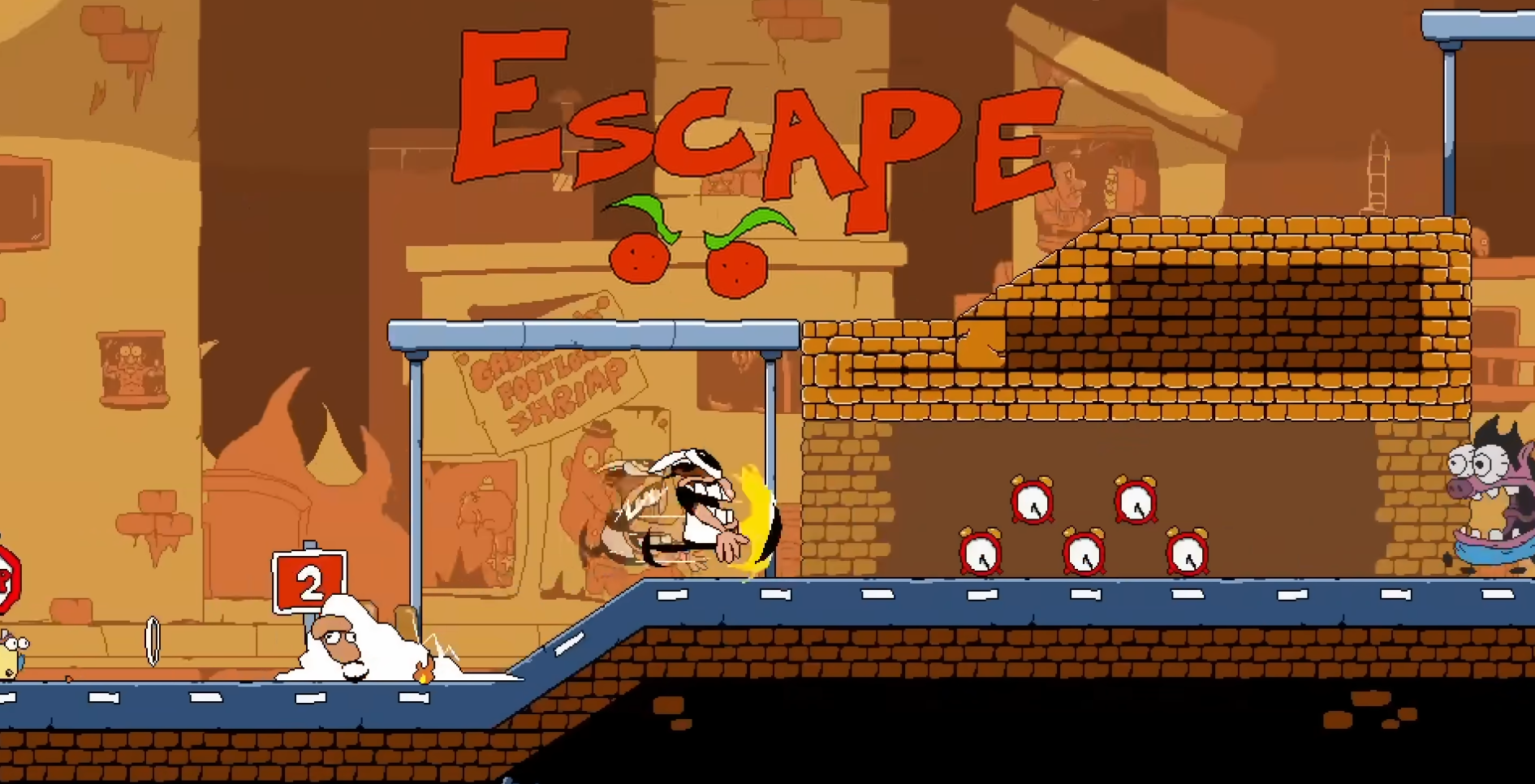
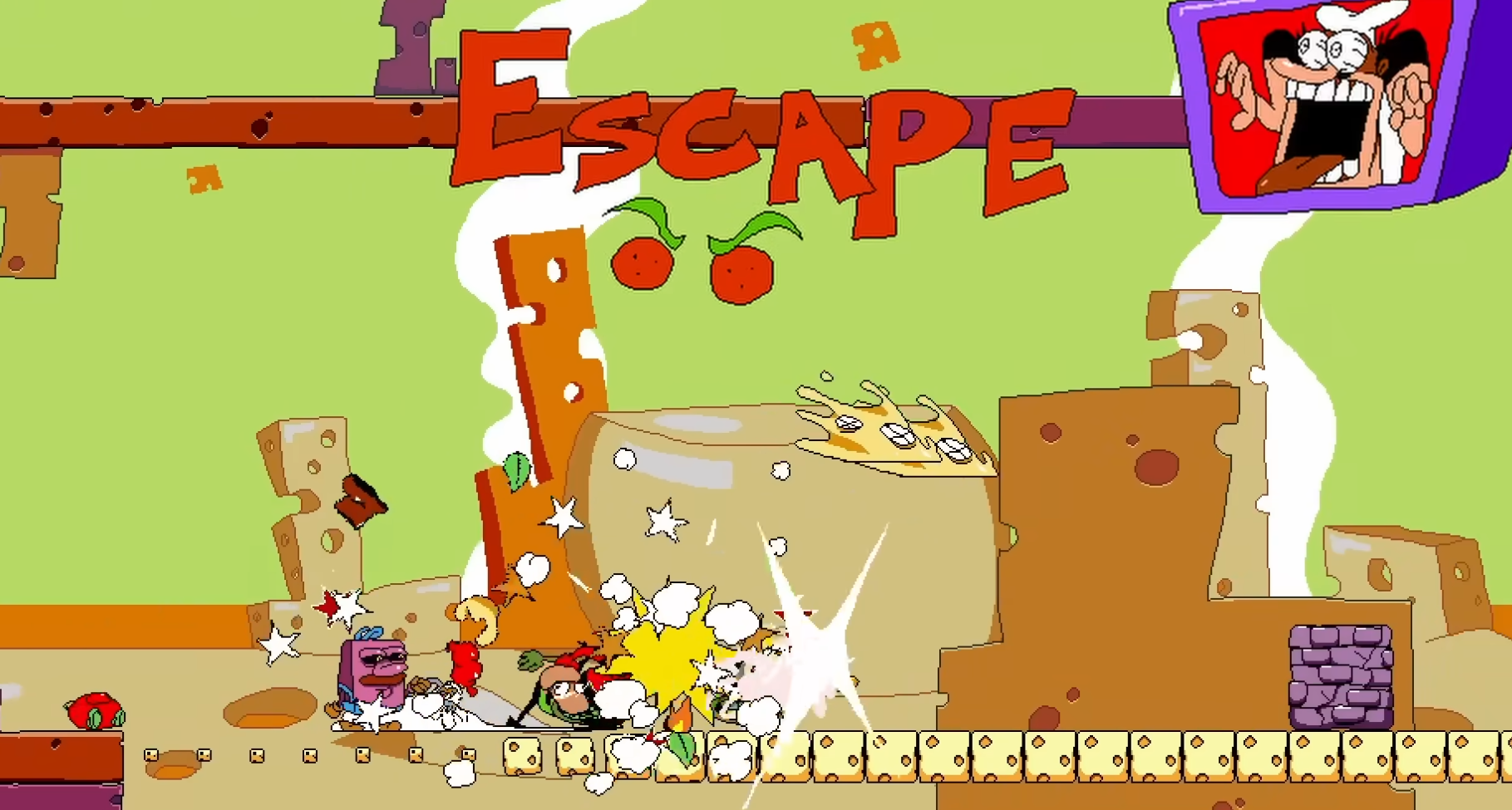
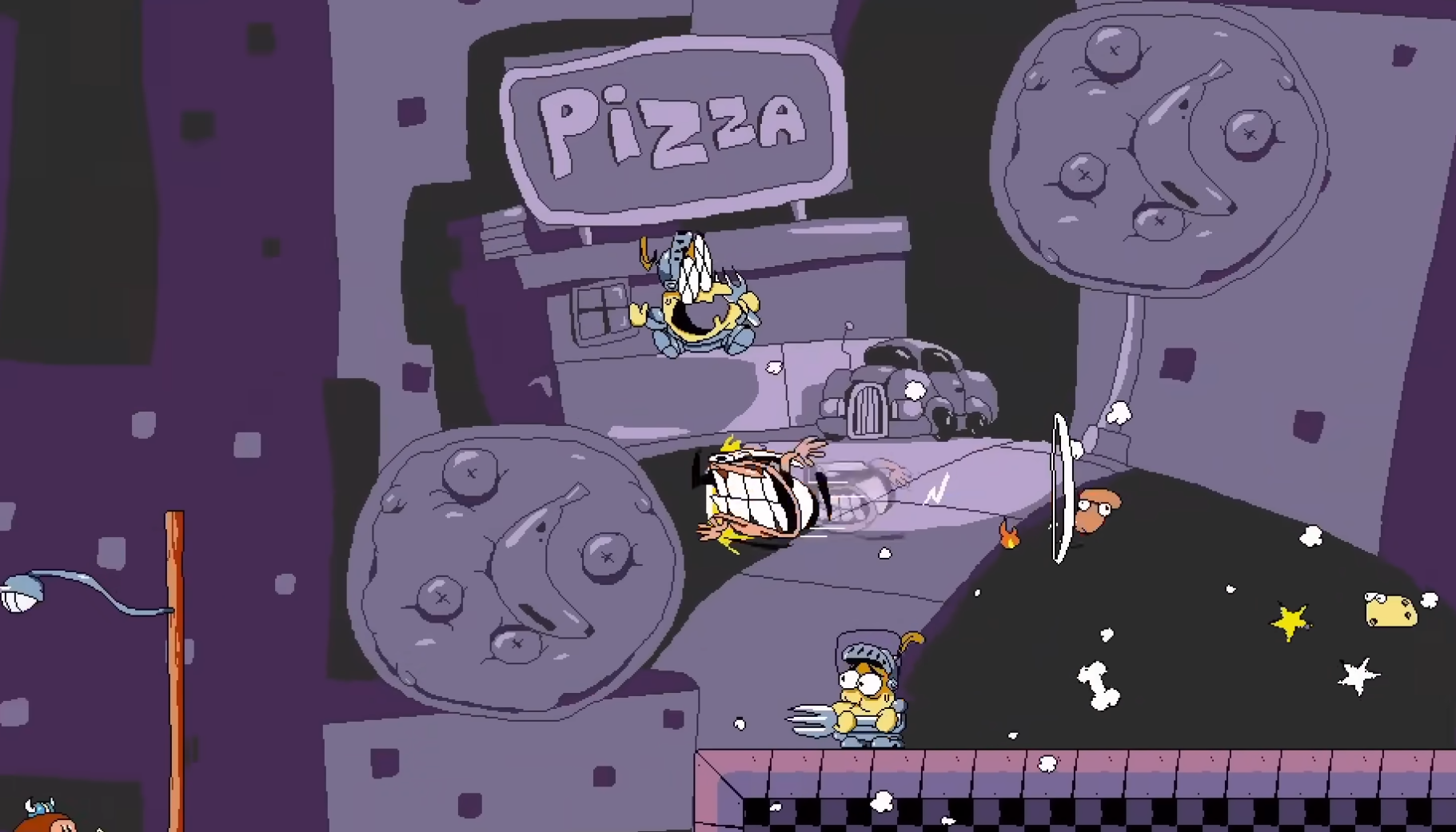
As the music changes, the trailer takes a turn, with the perspective changes being more erratic and changing more frequently as well as the gameplay in the trailer scenes changes to be even faster, even including some animatic shots as well as showing a couple really fast escape sequence perspectives. These shots are really good and show the true nature of the game, with the music change really representing how the player might be feeling in the situations that the game puts them in.
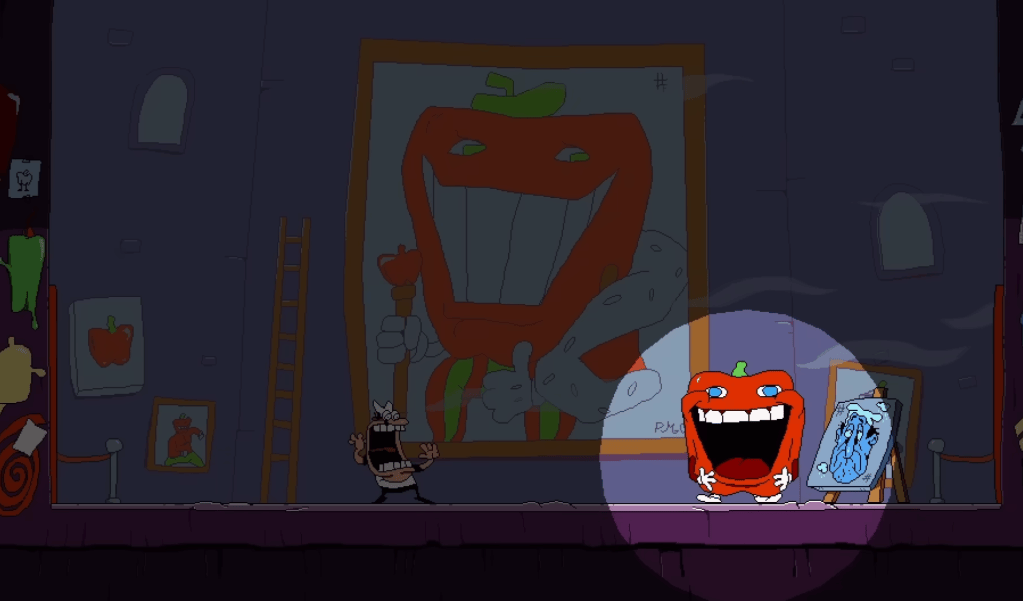
The trailer ends with Pepperman laughing as a running gag to put onto the end of the trailer to show off the humorous nature of the game.
I think that the steam trailer is definitely better than the Nintendo Switch trailer because its better at showing more raw footage as well as the trailer being more fast-paced which matches a lot more of the game’s core features. The trailer as a pitch for the game itself is done in a very good way I think as it shows all of the features of the game as well as showing off the main gameplay loop and what the game would be when the person bought it.
Pizza Tower – Steam Reviews
All of these features in the trailers are highlighted as the main key parts that are the most enjoyable to the playerbase. I looked at the Steam reviews for the game at https://store.steampowered.com/app/2231450/Pizza_Tower/#app_reviews_hash to actually look at what people are saying about the game, what they like and dont like.
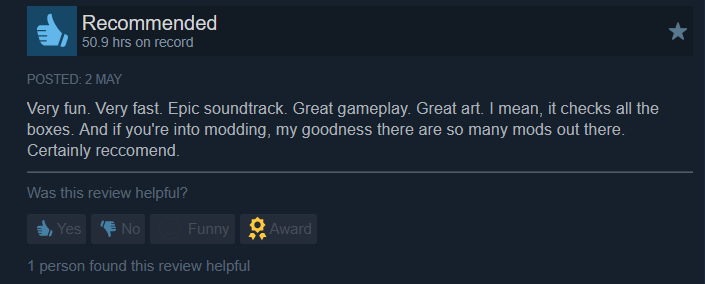
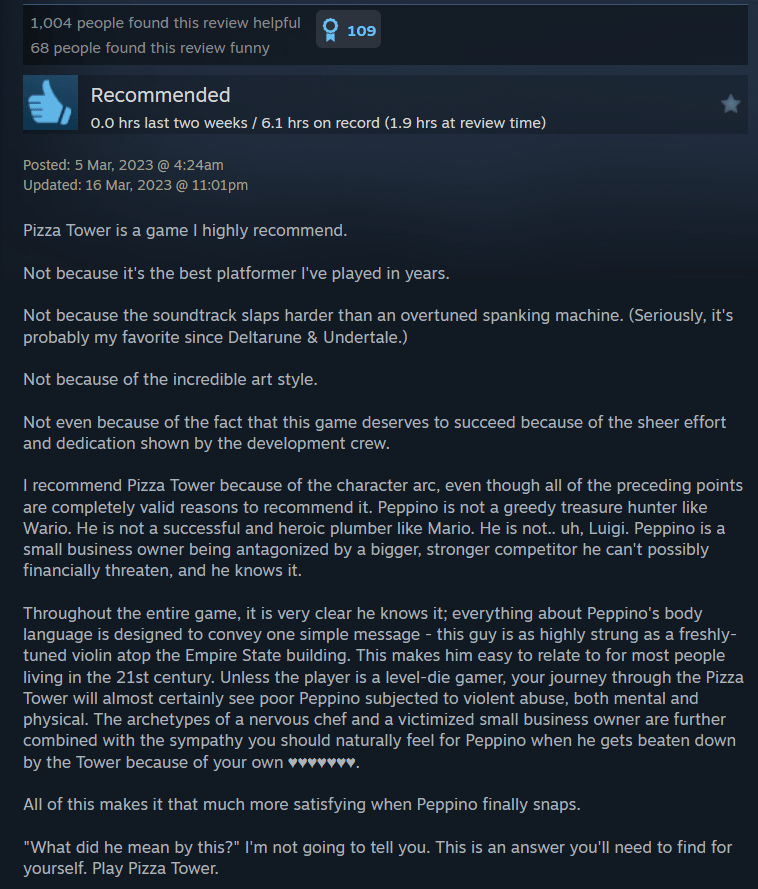
These 2 reviews were the ones that stuck out to me the most – They both talk about their experiences, one of them certainly is more impactful than the other but they both convey what they specifically liked about the game, and there are almost 70k reviews (with only 1189 total reviews being negative) that all basically say that they love the artstyle, OST and movement animation as well as the feel of the game.
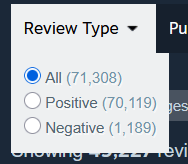
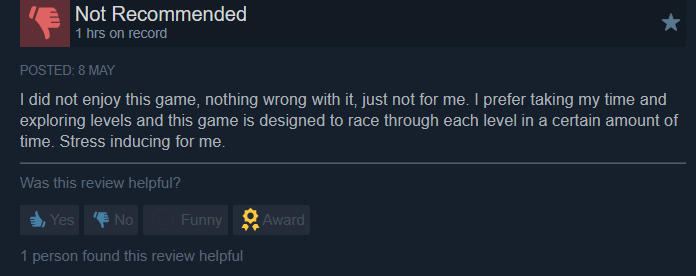
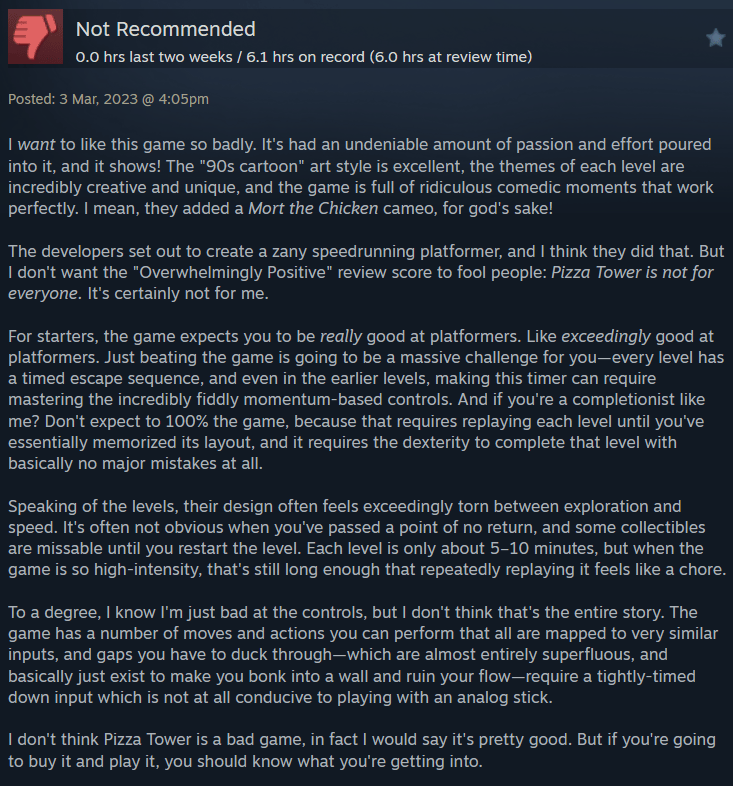
Looking at the negative reviews, there are reviews out there such as “This game sucks!” and just don’t go into it and reviews like that don’t bother anybody, people have their opinions, its the internet as well as the game having troll negative reviews where it is a person who has clearly played over 140+ hours of the game and will either write out a satire review saying it sucks contradicting the hours player OR will post a negative review talking highly about the game made specifically for the people who look at negative reviews for games.
But its reviews like these two that actually got my attention. The first one talks about the stress inducement and the way that the game tests you psychologically and they admit themselves that the game is just “Not for them” which is an incredibly valid statement in the fact that they clearly present the main issue with the reviews being the fact that a lot of the time it is the player’s fault in not liking the game, not the game itself. Sure, there are very clear exceptions to that rule, but a lot of the highly regarded games – there is either a skill issue on hand of the player or the game is just not made for the player that bought it – and its understandable.
The second review talks highly about the game, not calling it inherintly bad, but rather again, pointing out the very clear line between the player and a sheer skill issue, and the abi to enjoy the game, this leads into a kind of limbo where the players just need to simply get good, this may be easier on others and some are going to struggle but this game is made to be unforgiving for a reason, and some people realise that, while others don’t.
Celeste (2018)
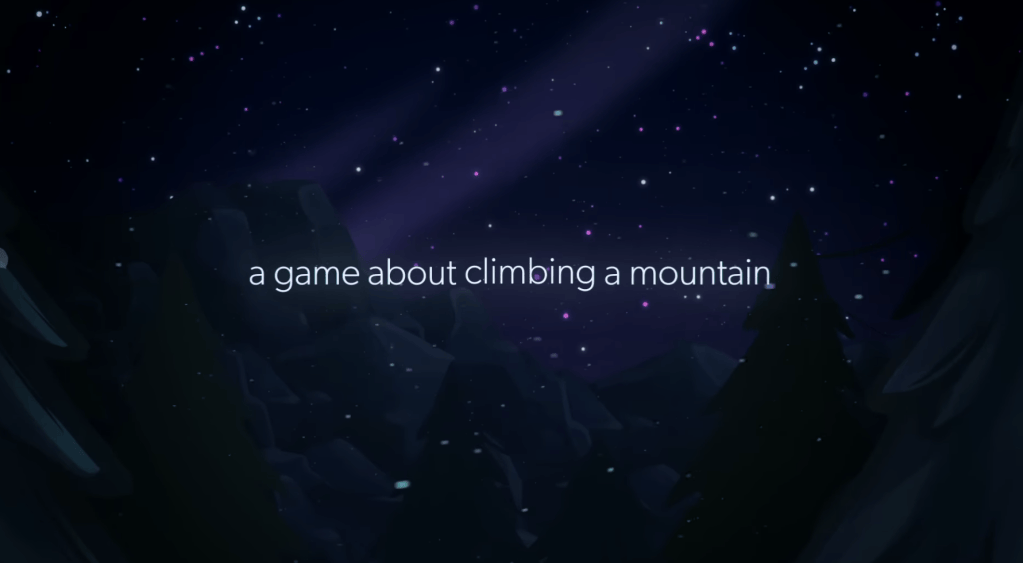
“A game about climbing a mountain” is the very starting of the trailer – it is a very basic synopsis of the game and purposefully plays down the actual events of the game as a deeper mention of what the game’s plot and story is actually about.
The trailer also begins off by playing the track “Starjump” from the Celeste OST.
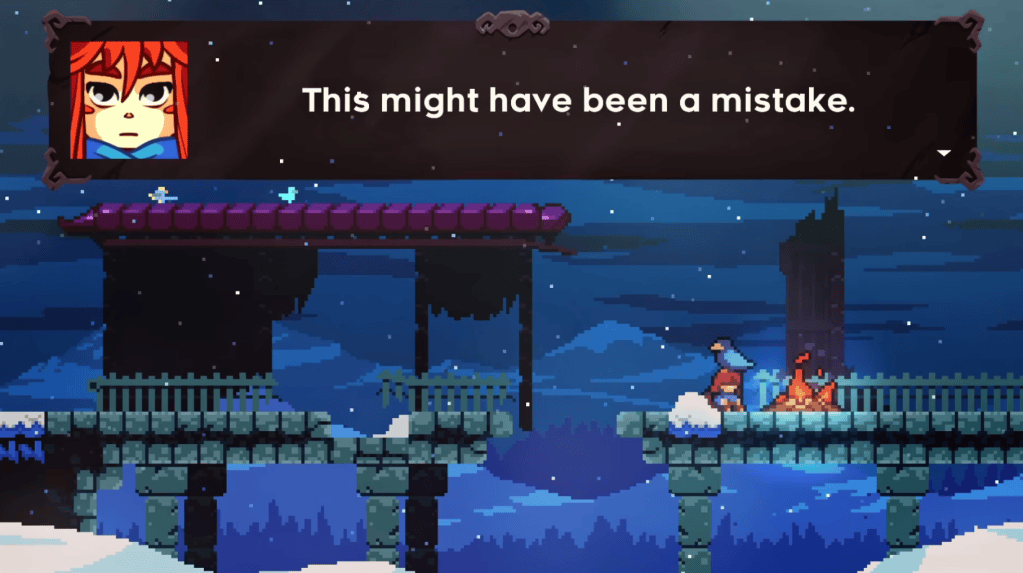
The first animation plays – the main character, Madelline is sat at a campfire that shes made as a bird sits on her head and comedically saying a line where she is doubting herself which is another point of the plot of the game where Madelline has to fight her own self doubt and how to get to the top of the mountain.
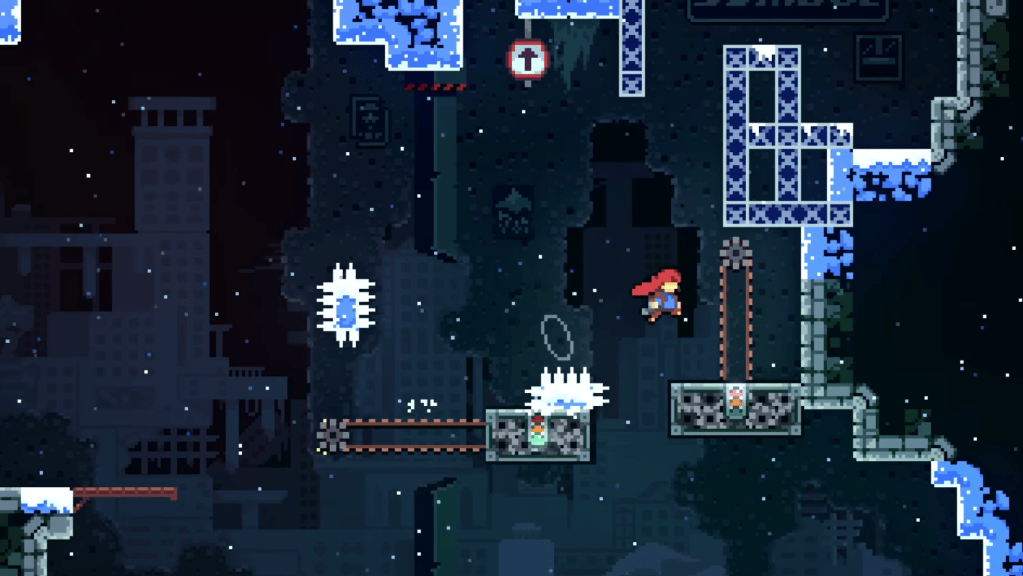
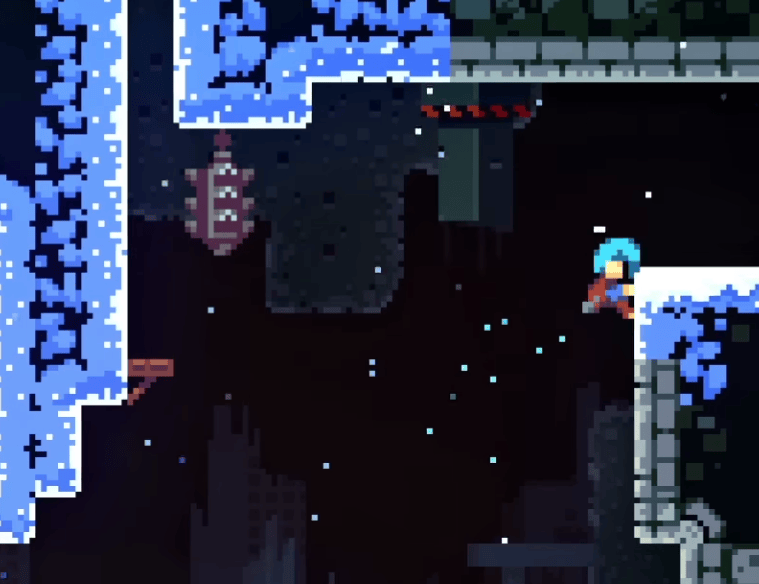
As “Scattered and Lost” (- Celeste OST) comes into focus from a music transition, parts of the early chapters of the game are shown as well as mechanics such as conservation of momentum from moving platforms, wall climbing and hanging as well as navigation around the ‘Dust Bunnies’ in the Hotel and the wind in chapter 4.
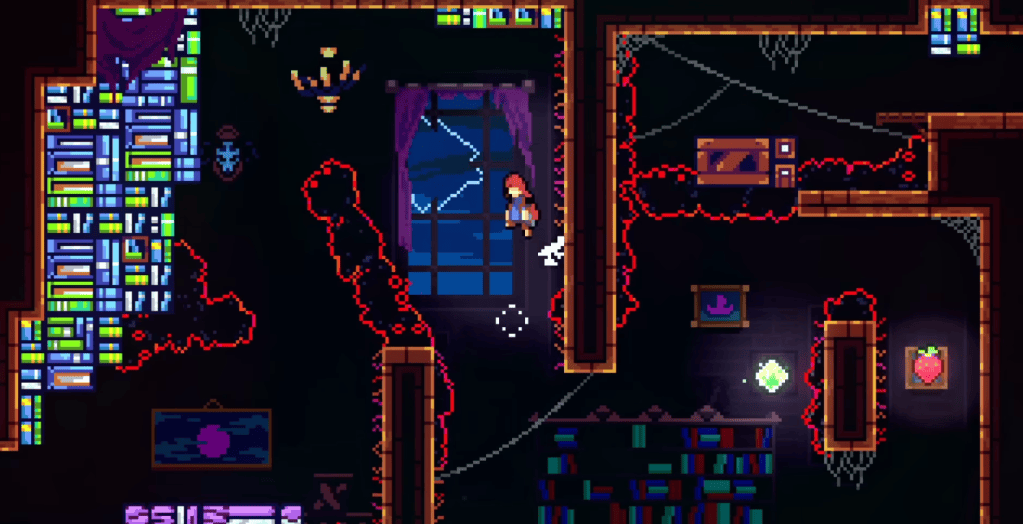
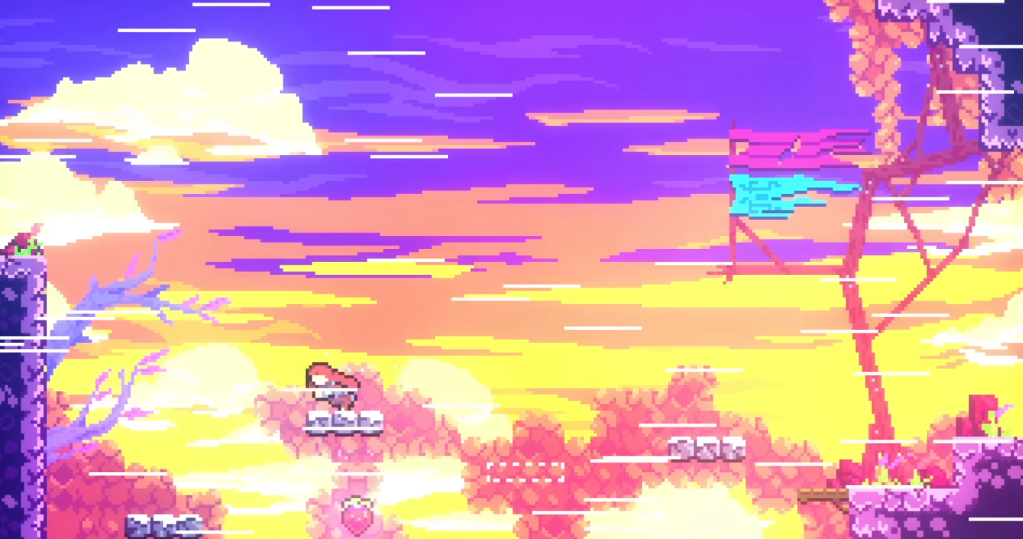
The game’s graphic and artistic design should very much be mentioned here as it is one of my personal absolute favourites, using 8×8 pixel tiles for all level objects, allowing for perfect tile snapping when it comes to the actual level design in game.
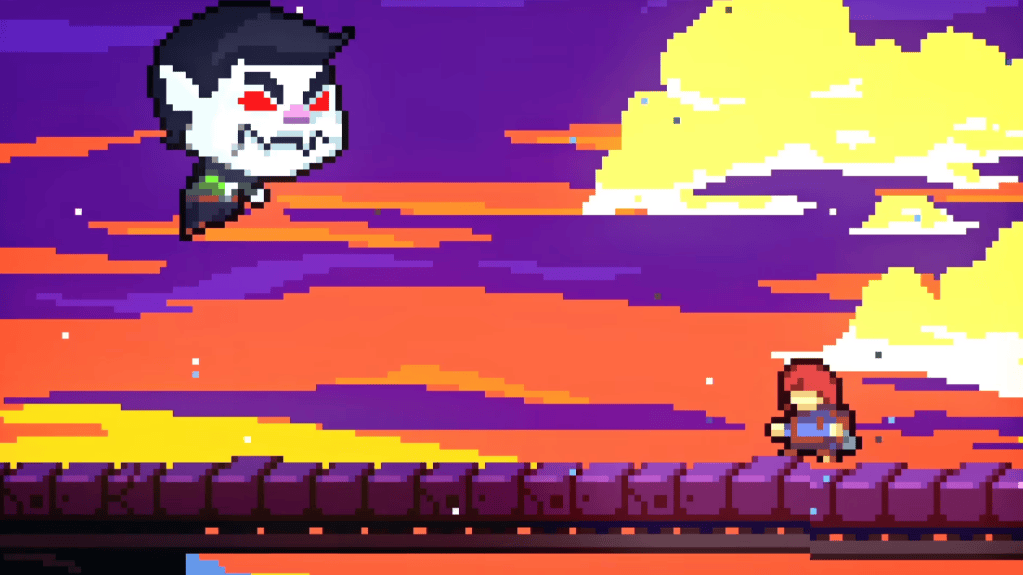
Animation between confrontation between Madelline and Mr.Shiro as a transition into the next segment and music change.
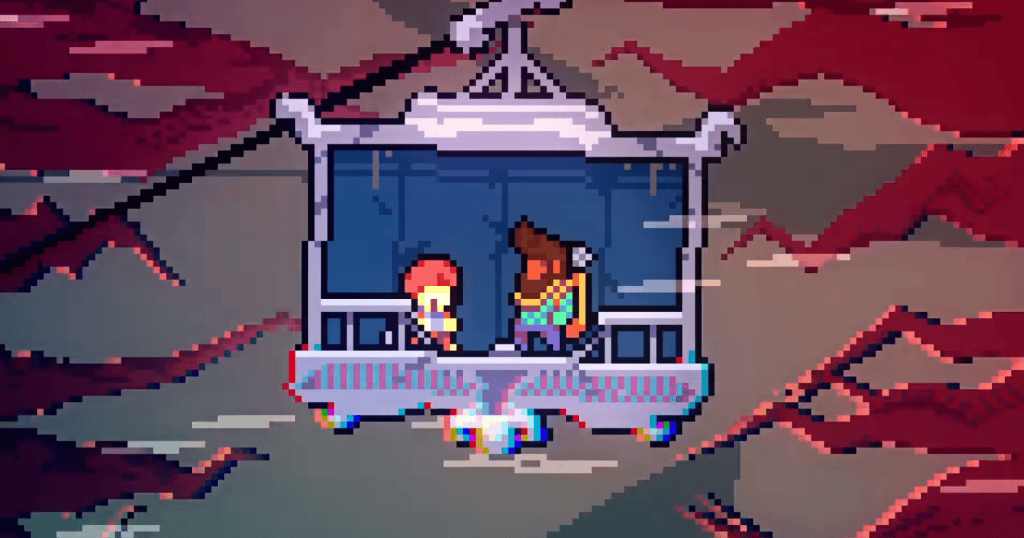
Confront Myself – Celeste OST plays, a very choir vocal heavy and generally very low and dramatic piece of music plays as there is a scene of vines encasing a cable car as Madelline appears to be having a panic attack. This dramatic music really hammers in the intense feeling of the game as well as even going for a shock effect for the player to make them realise that this situation shouldn’t be taken lightly. This game also can be very relatable to those who suffer from frequent (or even infreuqent) panic attacks where the game puts a special spotlight on it and it isn’t a situation that anyone who is in it should take it lightly and it is a very serious subject as the plot of the game conveys.
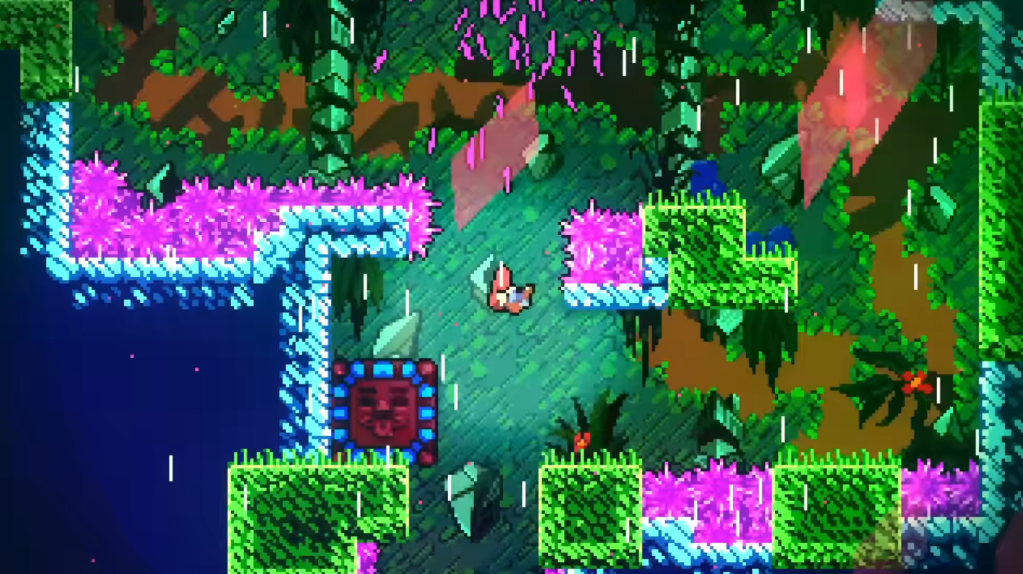
This scene shows the player falling, in a mix with the music that is playing in the background it can make the watcher feel as if they could be falling with Madelline as the music attempts to put negative and deeper emotions at the forefront to make the game even more relatable with an audience of people who struggle with mental health issues, this game talks about them in this way to tell the audience that they are not alone and that there will be people to help them.
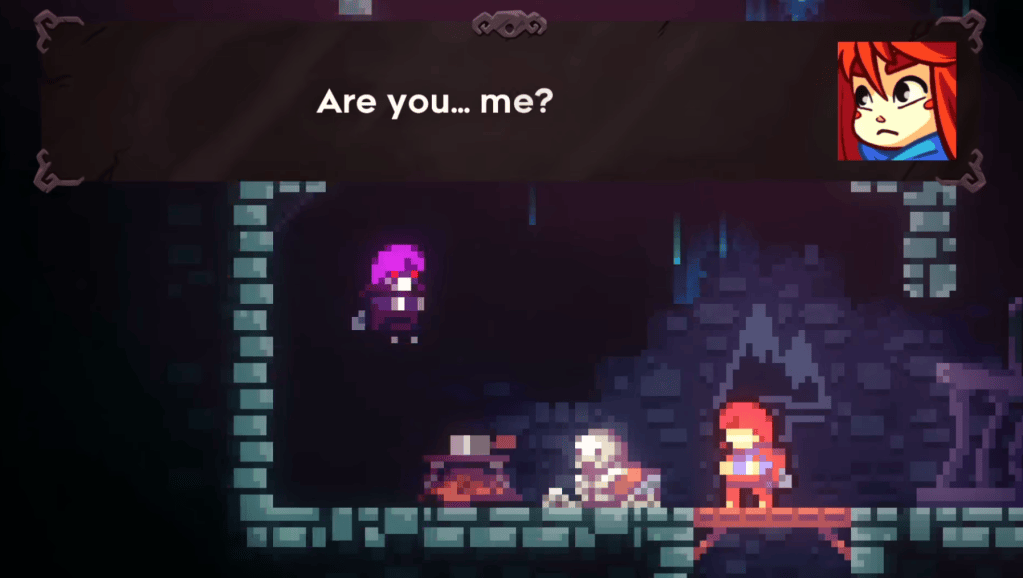
A dramatic scene is shown here from the main story plot of the game to showcase a very small segment to the watcher to get them interested in the game itself if the platforming didn’t interest them, then maybe the story could and it is shown off in this trailer by showing a reveal without the context, making the watcher yearn for the context which they could get by playing the game.
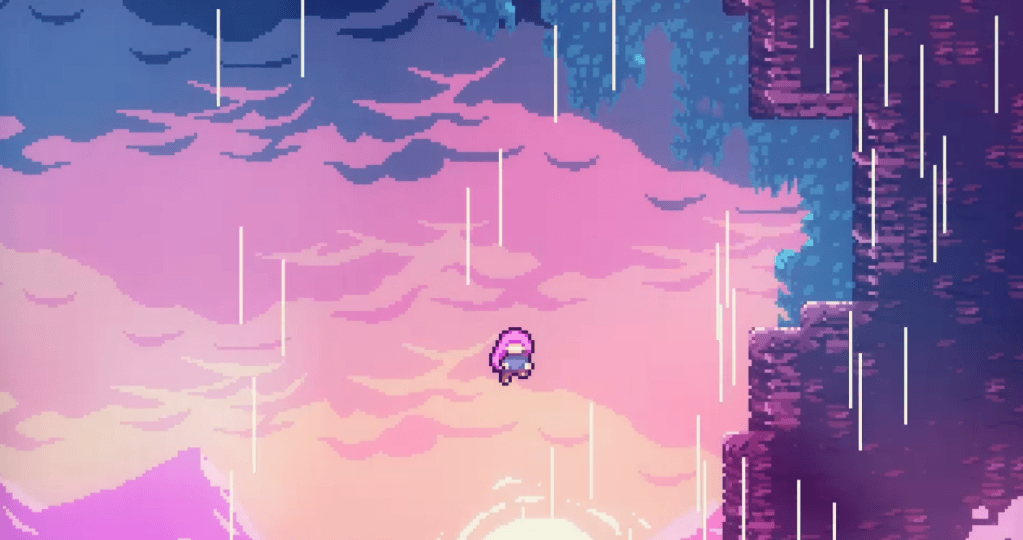
A clean transition to playing “Reach for the Summit” – Celeste OST which is one of the last songs from the game’s soundtrack (Excluding Farewell), there is some screens which really showcase the sheer difficulty that Celeste is very famous for because as much as the platforming is difficult and requires a lot of technical knowledge and skill, it is very fair to the player and very fair that with enough practice, anybody could do it. The trailer showcases a lot more rooms where the platforming takes place within the “Summit” Sequence of the game.
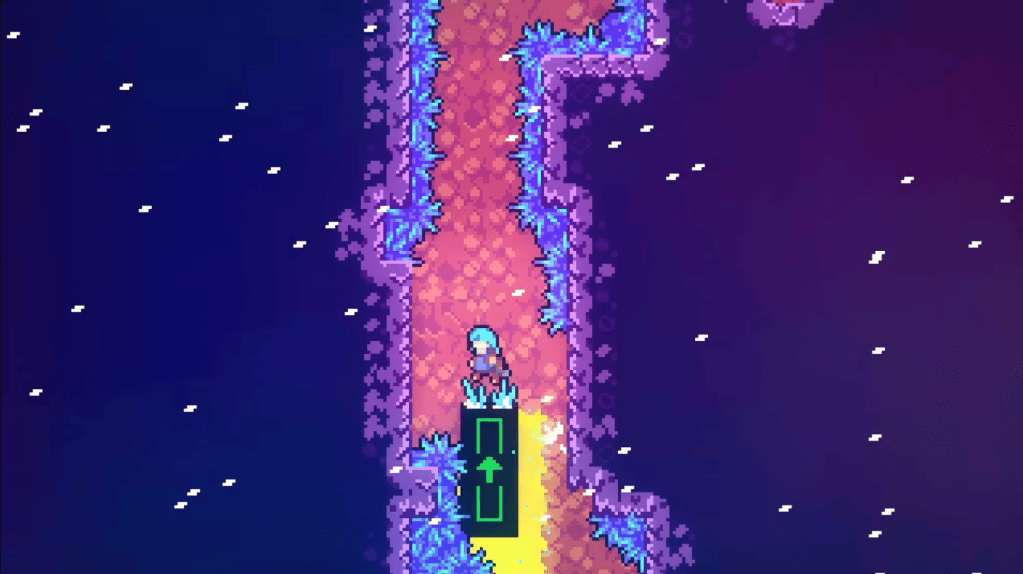
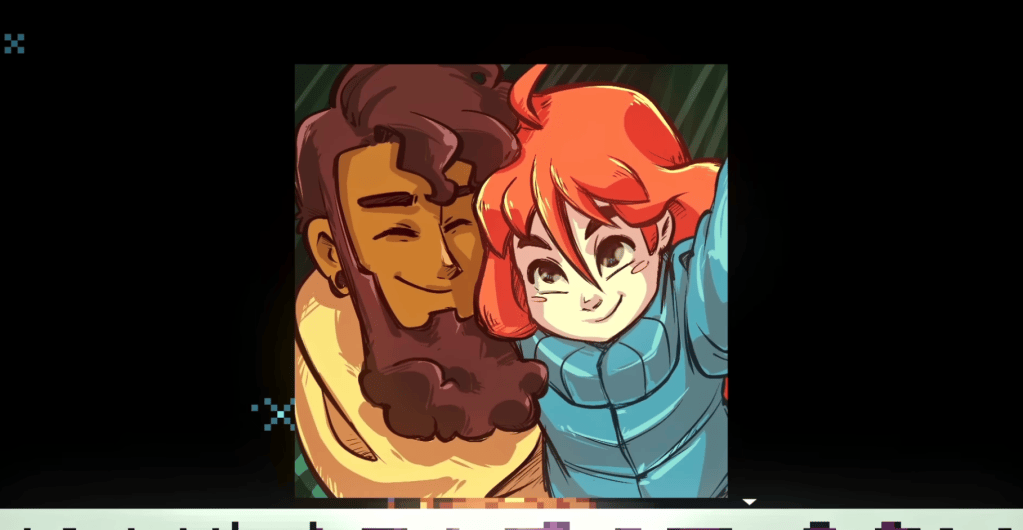
The trailer ends with a very cute interaction between Madelline and Theo where they take a picture together with Madelline saying she wants to “Remember this night” as she takes a picture with the two of them, showcasing the other artistic aspect of the game which is the out of game illustrations such as the chapter end screens, pictures and even character art for their text borders which are different to the consistent, low-texture pixel art that the gameplay is within.
I think that this trailer is actually really good for both inticing the player into wanting to play the game by actually being a very short trailer overall, only being 1 minute and 24 seconds total, without the starting sequence of just words and the ending main title screen as well as what platforms the game will be available on – the trailer is actually only 1 minute long. This entire game does so much with so little, whether it comes to the pixel art, keeping it very minimalistic and yet so pretty as well as the music direction, keeping it repetitive with very slight changes that actually benefit the style of the game by keeping it memorable and very simplistic and not complex. With the 1 minute trailer, this trailer shows off small aspects of the platforming, heartwarming interactions and the deep, emotional story that the game provides and because so much in so little drops and moments were dropped onto the player in so little time, it gave just about enough for the player to understand what the game is about, what it looks like and if they would be interested in playing it – without spoiling any of the story as well as any of the solutions to major platforming puzzles that the game offers. In my opinion, I think that MaddyMakesGames (the studio behind Celeste) did a very good job as an indie dev studio in the trailer pitch as it is very functional and proves itself to be a viable pitch for the public as the trailer works very well in enticing players into buying the game themselves.
Celeste – Steam Reviews
For a lot of these reviews, I will be taking and analysing some of the reviews here individually as I have found a lot of mature and intellectual reviews pertaining to this game – the sheer quality of them and the amount of maturity that the players have when it comes to this game, people look back on their journeys, people analyse not only the game but also themselves and how the grew up alongside the game. Celeste is an eye-opening masterpiece, especially with how it carries itself.
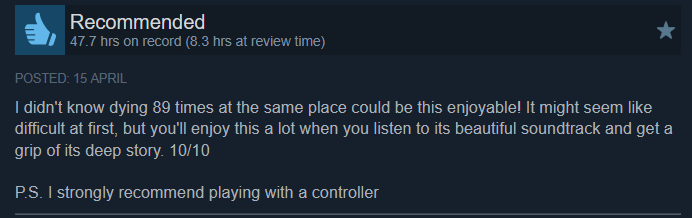
https://steamcommunity.com/id/plasmaborg/recommended/504230
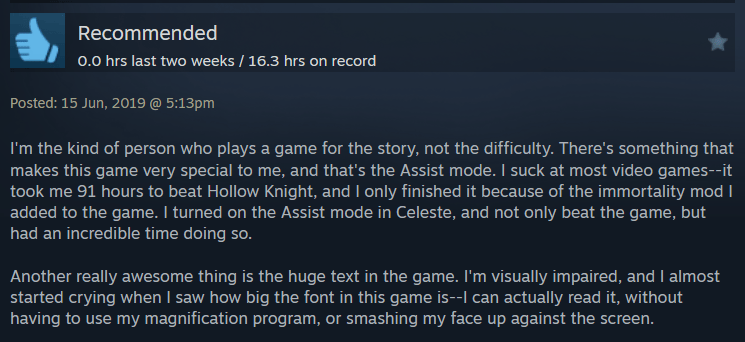
https://steamcommunity.com/id/singwhatyoucantsay/recommended/504230/
This review really stood out out to me, a person who admits and has the honor to put their hands up and say that they are just bad at games -they dont have anything negative to say about the fact that they used the assist mode in Celeste, it is there for a reason exactly for people like these – Celeste is one of the most unforgiving platformers even after it has been 8 years since the game’s release and it knows it but it also wants everybody to enjoy the atmosphere of the game and it wants everybody to play how they like it – a game is made for people to have fun, and if a person has fun by using the assist mode – so be it! They have the freedom for that. Also the part about them being visually impaired and the game’s big text accomodating for that fact warmed my heart because the dev team themselves had kept these people in mind and created the game so that is truly can be enjoyed by a large group of people.
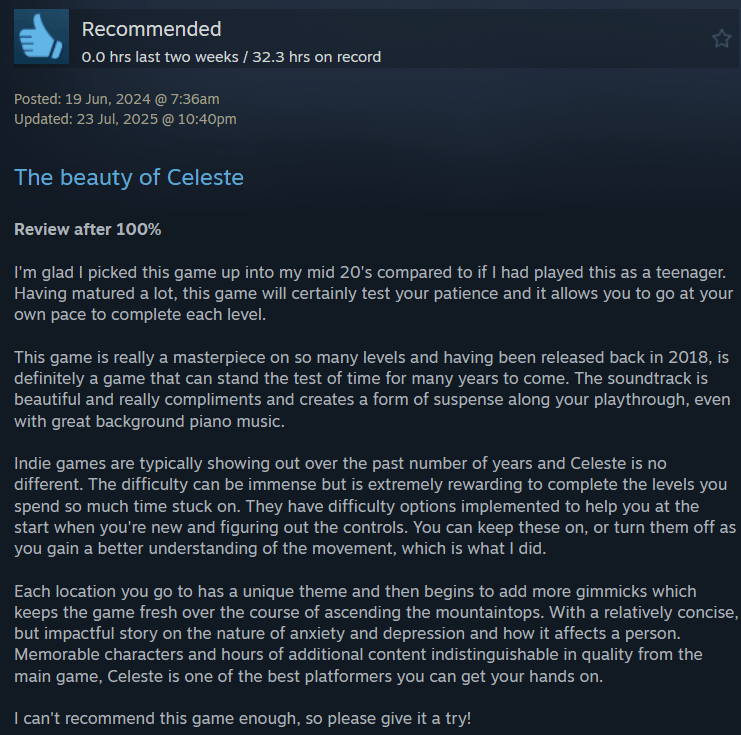
https://steamcommunity.com/profiles/76561198030393287/recommended/504230/
Another review that stuck out to me – this one highlights what I meant by “people analyse not only the game but also themselves and how the grew up alongside the game.” – This review reflects the fact that the experience of playing this game would have been vastly different between them as a teenager – when the game probably released in comparison to now (2 years ago) where the payer is now in their mid 20s (in 2024). The maturity that a person can go through when discussing topics such as how a person can deal with and handle depression and anxiety can be entirely different depending on the aging and maturity of the speaker.
Tthis review talks about the sheer beauty of Celeste, in its art, in the way that the game is geenrally made but also in the way that it is very difficult – but it feels extremely rewarding.
The positive reviews for the game are genuienly heartwarming and they share their experiences with similar themes that the game touches on and talk about their personal struggles and how hard they could relate to the protagonist of the game as well as the fact that they could experience this game at their own pace, nobody was rushing them and some players use Assist mode as it is literally there for them to use.
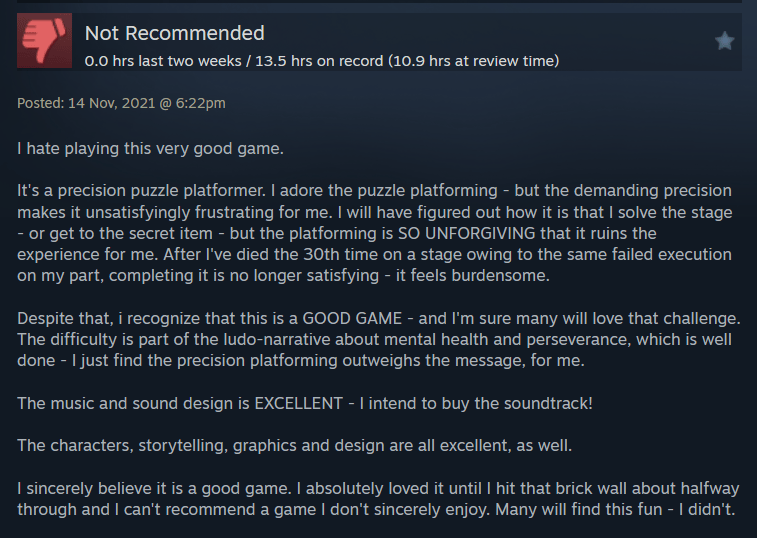
https://steamcommunity.com/profiles/76561198053584706/recommended/504230/
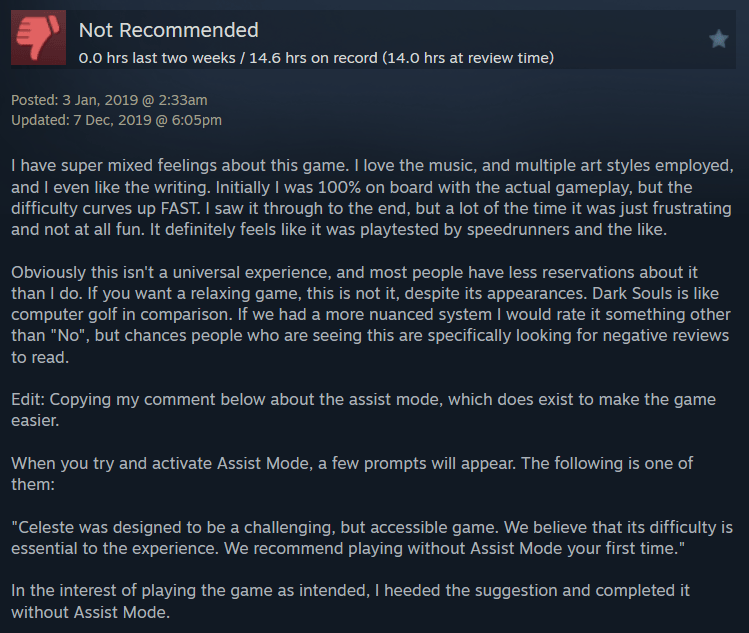
https://steamcommunity.com/id/twistedkestrel/recommended/504230/
The negative reviews for this game are understandable – the game is very difficult and people will complain, this game has purposeful difficult platforming and is intented for the kind of players that enjoy the reward from the difficulty and the best negative reviews are highly aware of that fact, while at worst the reviews will just call the game bad, say its too hard and just explain themselves. The first one talks about the player’s experience with the very extreme difficulty of the game (which is what almost 95% of the negative reviews talk about) but it actually stood out to me as it was one of the reviews that actually explained itself itself in a meaningful manner. It doesn’t actually blame the game itself but rather the player knows that the entire issue is a simple skill issue – and the way that they talk about it – it makes sense as to why they gave the game a negative review, they enjoy the atmosphere of the game but don’t dying over and over and over again. Which is very undertstandable from the player’s POV.
The second review is very similar to the first one, but the differece between the two is that this one stuck with the game to the end and just plainly didn’t enjoy the gameplay of it and how fast the game gets really difficult really quickly, which is simply a skill issue on their part. The comments of the review talked about the potential of using Assist Mode where the person who was giving the review talked about the fact that the warning about using Assist Mode turned them away from it and in the way that I see it, the assist mode is a massive help, but in the end it is up to you to choose to use it or not, if you want to play the game and not suffer and actually have fun – by all means, use it! Its what its there for. These negative reviews are very structually sound with how they actually talk about the game but the main complaint is that the game is too difficult and the player themselves can’t adapt.
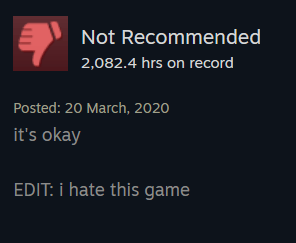
Including this one just to show an example of one of my previous points when talking about the Pizza Tower reviews – a negative review saying “its ok” and “I hate this game” when they have 2000 hours on it, its funny and meant to be satire as well as showing the people who are only looking into the negatives of a game that the game is actually really enjoyable behind everything.
Game Inspirations
Inspirations: Pizza Tower
Pizza Tower by Tour De Pizza is a fast-paced 2d platformer with a great soundtrack and a very stylised artistic direction, hand-drawn in Microsoft Paint in a very old pixel art way very inspired and similar to old 80s and 90s cartoons.
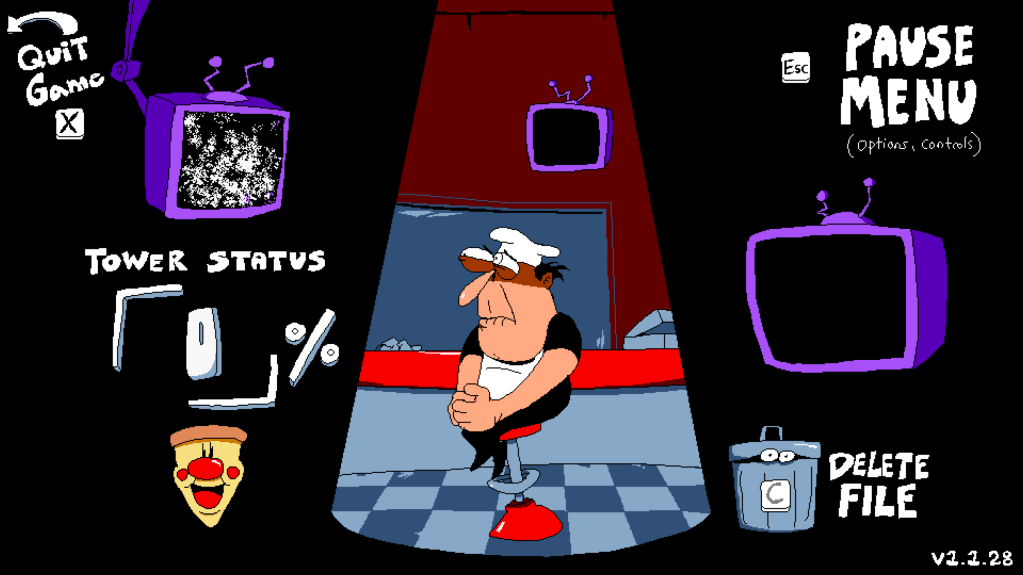
Pizza tower is a stylised platformer that takes inspiration from internet gags on Pizza and a very shallow, comedic look on Italian Pizza culture, mostly derived from american-italian new yorker style pizza internet jokes. The game is meant to be taken as a joke where nothing in this game is made to be serious which is the biggest selling point and point of interest for the game; the whole game was made and developed and sold as a whole comedic and fun joke on the foundations of it being a game. The game being a platformer is the most fitting genre that the can be made in as it allows for enemies and obstacles to be a part of the joke with being puns on pizza toppings and other pizza related items.
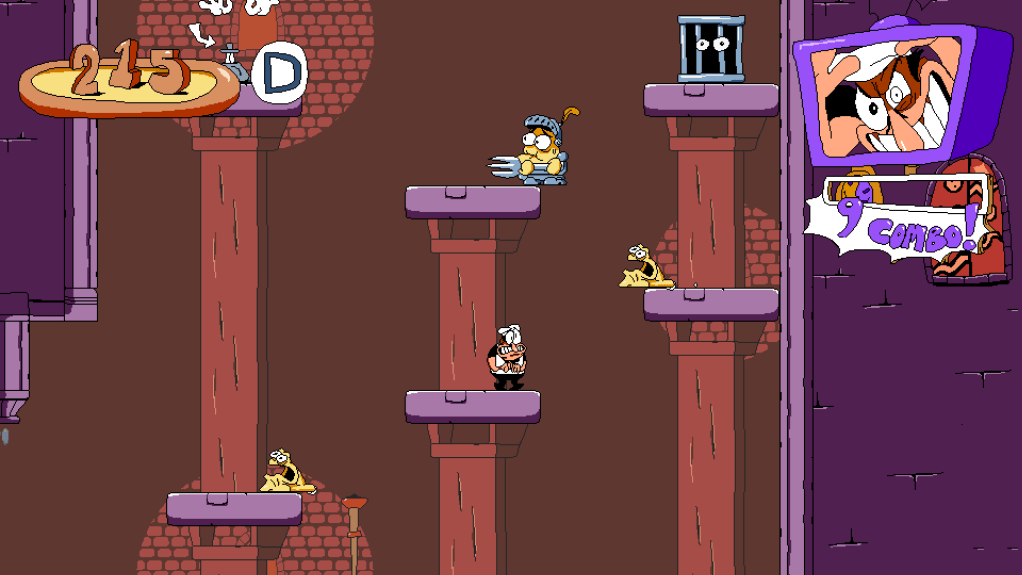
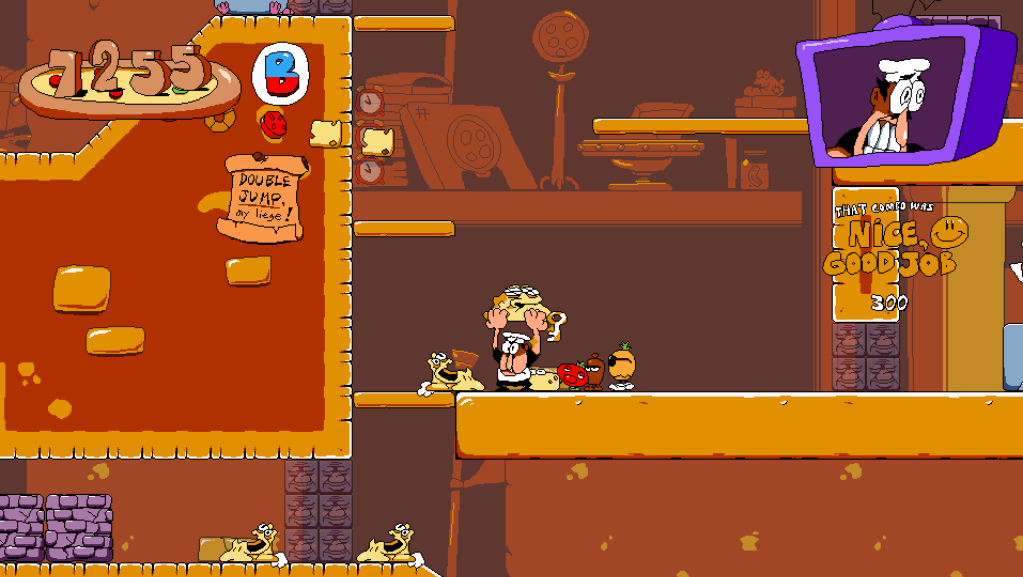
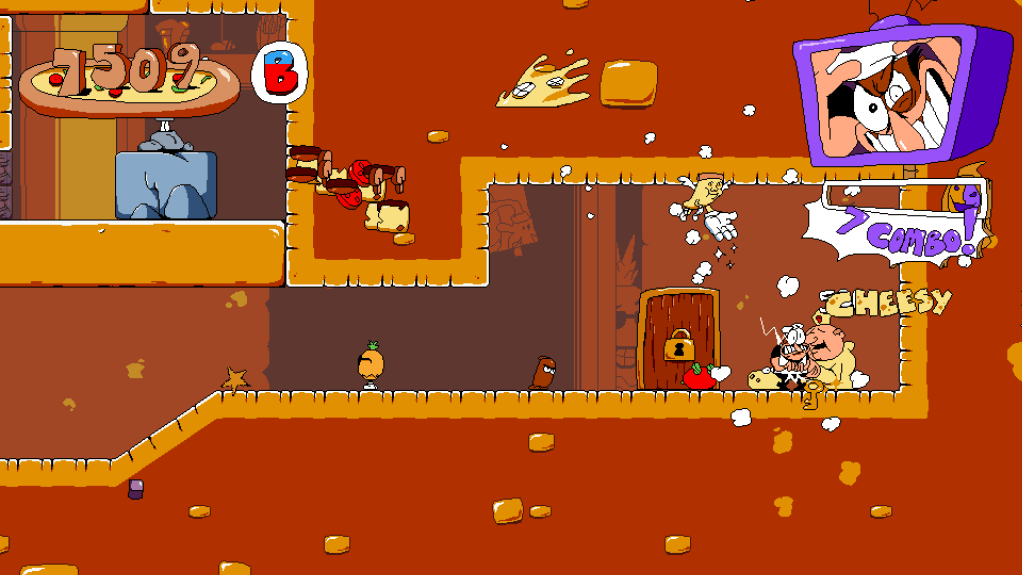
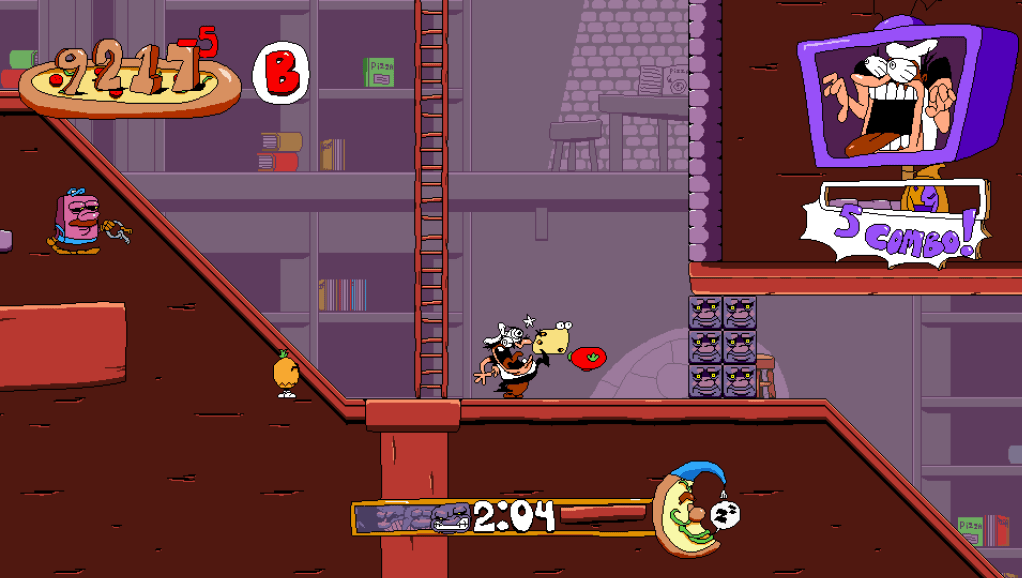
This game being a 2d platformer that specially emphasises speed both in the energy of the backing soundtrack as well as the gameplay pressuring the player to move quickly with timers. This game also has a deep movement mechanics system where the player can run at increasing speeds depending on how long they have been running without interruptions as well as different types of runs which also change depending on how long the player has been running.
The starting run is the initial animation + the first second of the player running, where the player only begins moving fast, the powered run where the character’s running animation changes to fit more cartoon-style with their legs moving in a circle, where the character can start running through metal boxes and defeat only some of the enemies by running into them, the final type of run is the Mega-Run which is when the player is going as fast as they can with the character eating everything in front of them that the player runs into. Along with the several different types of runs, the movement system allows for running up walls, wall-jumping and diving (both diagonally and vertically-down) into obstacles that would block the player’s path.
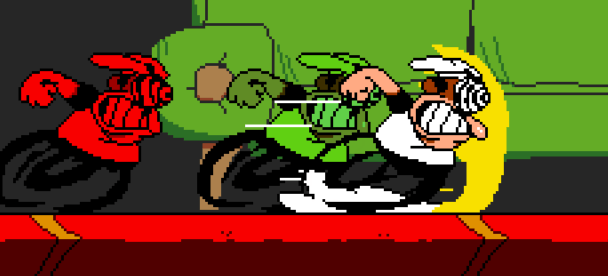
This game also features power-ups which all give different abilities that can allow to get through different obstacles as well as abilities such as being to double-jump.
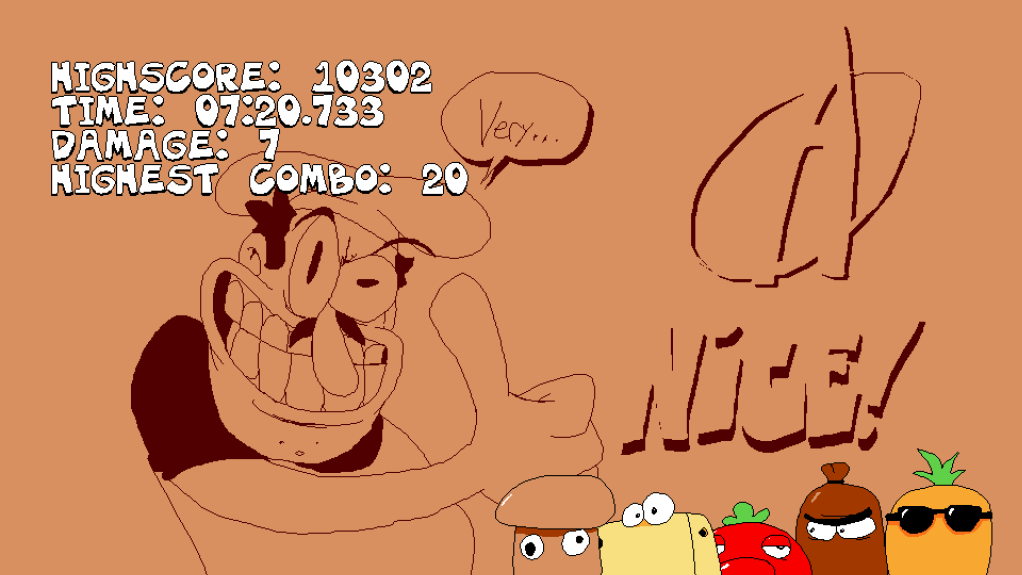
The game features a ‘Combo’ Counter and a points system named ‘Score Attack’ where the player gets a certain amount of score by doing things in a level, the higher the combo will equal to a higher score gained which is tallied at the end of the level and gives the player a certain ‘Grade’ on how they did on that level. The grades start at D and go all the way up to S, with the potential for a P rank which stands for ‘Perfect’ if the game decides that the player met all of the ‘Perfect’ criteria for that level.
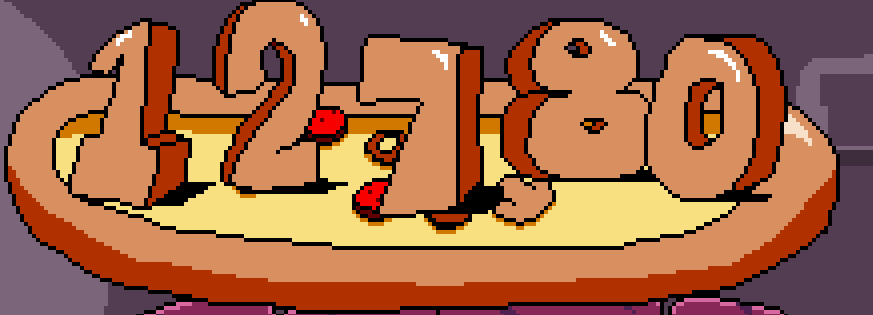
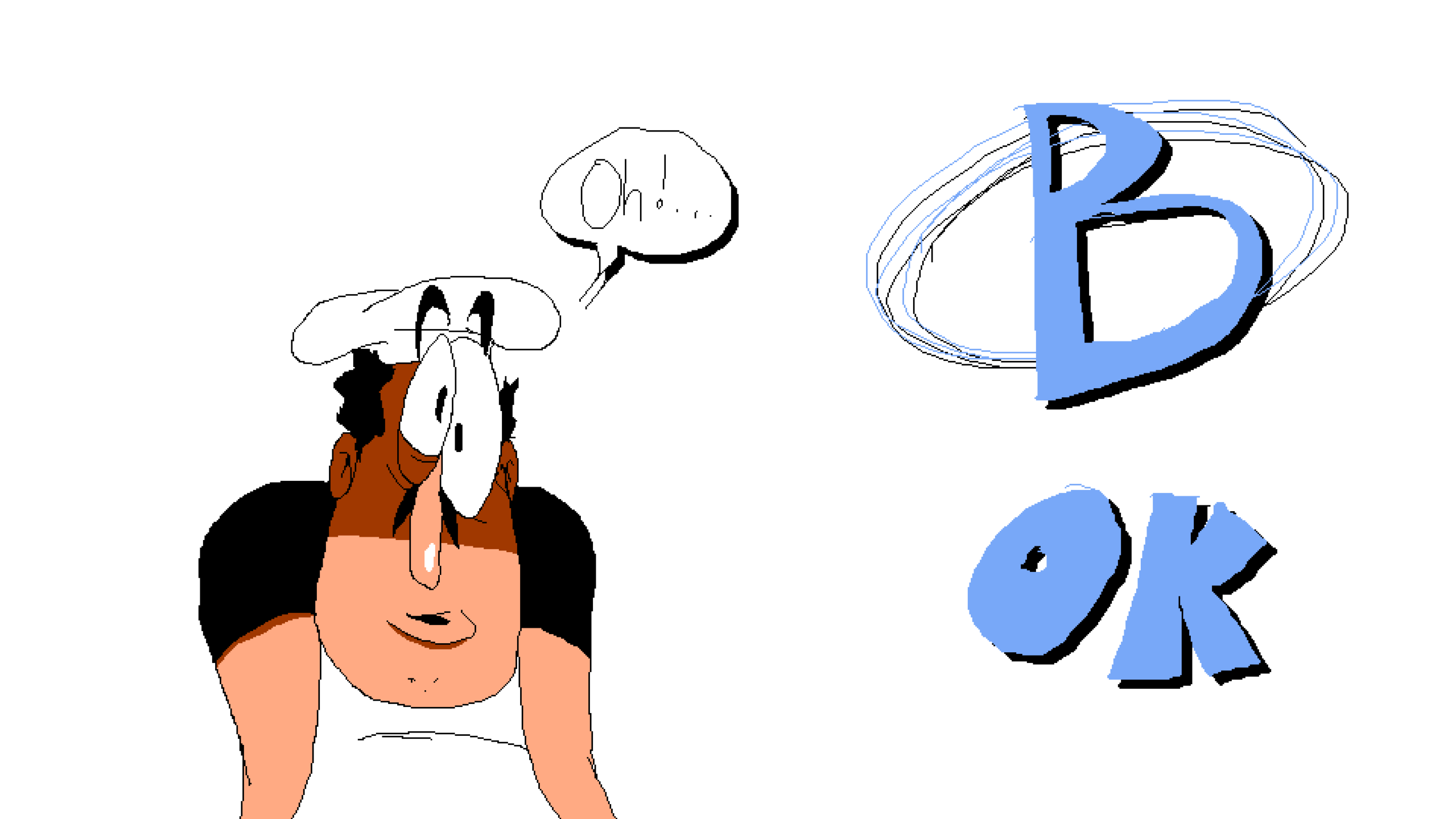
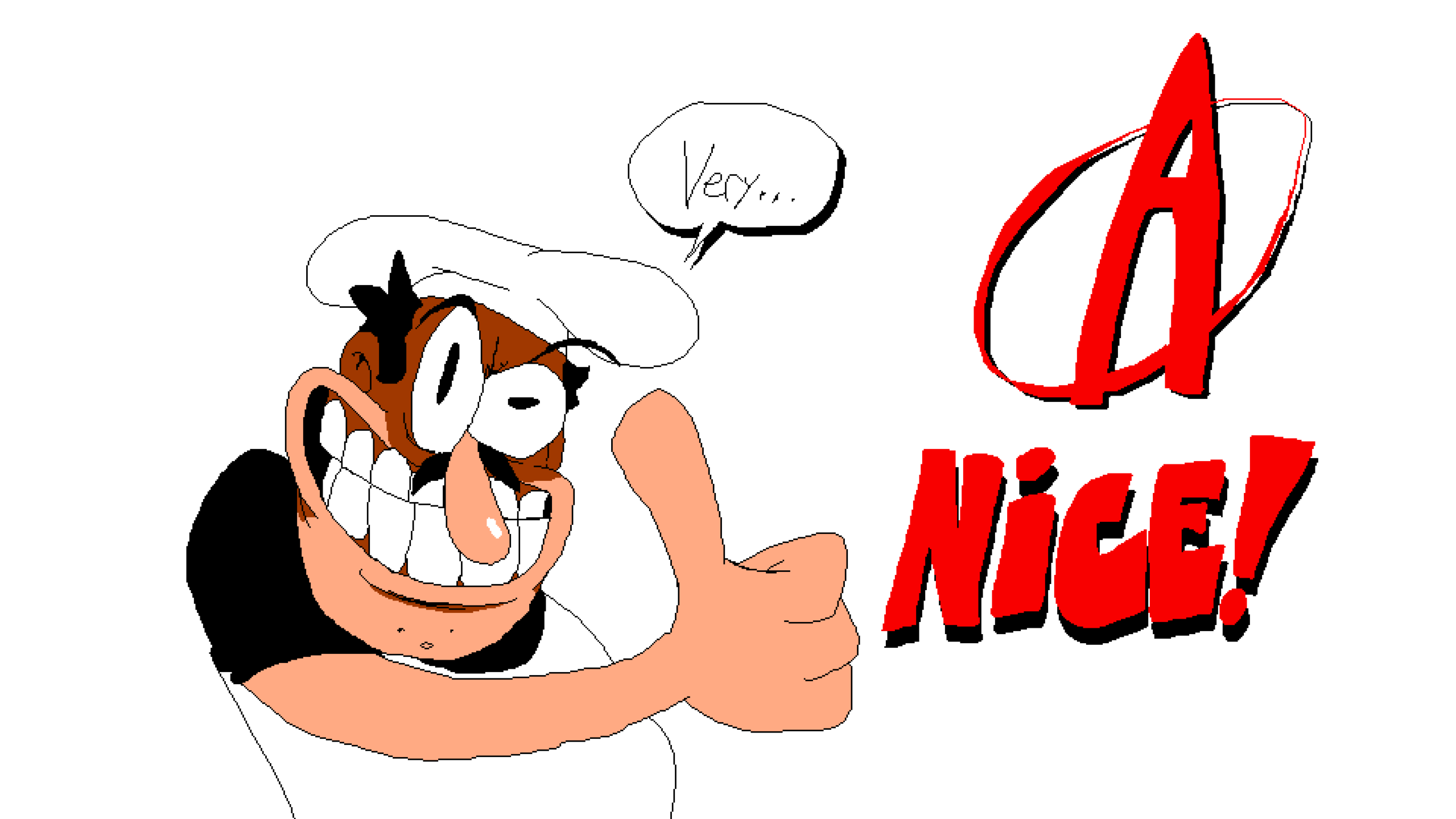
The main point that drew me to this game in particular is actually more-so the comedic value of the entire game, but also the fast-paced gameplay that goes along with. My music taste and game taste is very similar that I very often will enjoy games that have their own certain edge to them; whether it’ll be their aesthetic, their gameplay loops and mechanics, there are just very certain aspects which interest me about this game and got me very interested such as the animation and art direction which loops like it was made using the pencil tool in Microsoft Paint, a style that takes inspiration from 90s cartoons and pixel art but one that has its own magic to it where a lot can be done with it while keeping it looking very simplistic in its design. The adrenaline that I first felt during my first Pizza Time in the first level was on such a high point that I was hooked on the feeling in seconds, the intense music, the timer countdown and the real pressure on time is a really good feeling paired with the mach 1 speed that the player can get to when going intentionally as fast as they can.
Inspirations: Grace
Grace, made and developed by a group named ‘The Fartering Few’, is a popoular, fast-paced ‘Rooms’ game built and published on Roblox. Rooms is a popular genre within Roblox, having many other games such as ‘Pressure’ by Urbanshade and ‘Doors’ by LSPLASH being some of the most known titles within the genre. The genre follows the basis that you go in between doors to get through rooms in an almost infinite way. Most games choose to give the player a finite amount of rooms that they have to get through, usually giving the player 100 doors to get to their final destination so that they could finish a whole run.
The entire genre also makes a point of difficulty with their own distinct ‘Entities’ these entities have their own challenges and ways to make the gameplay more difficult for the player, whether its having the player hide away from a monster that will kill them or whether its making them stop and stand still when they are under the pressure of time.
Grace follows the same basis of the ‘Rooms’ genre, making the player go through doors and getting through rooms however the thing that makes Grace unique from all of the other games is it’s unique style which focuses on speed of the player and creating a huge pressure for the player to go as fast as they can while every other game attempts to make the player go slower, be more strategic about their moves, Grace has the player go at a very fast pace while only making the player interact with the entities more as if they were ‘obstacles’ rather than things that are actively trying to kill them. (The player will still die if they mess up with one of the entities though.)
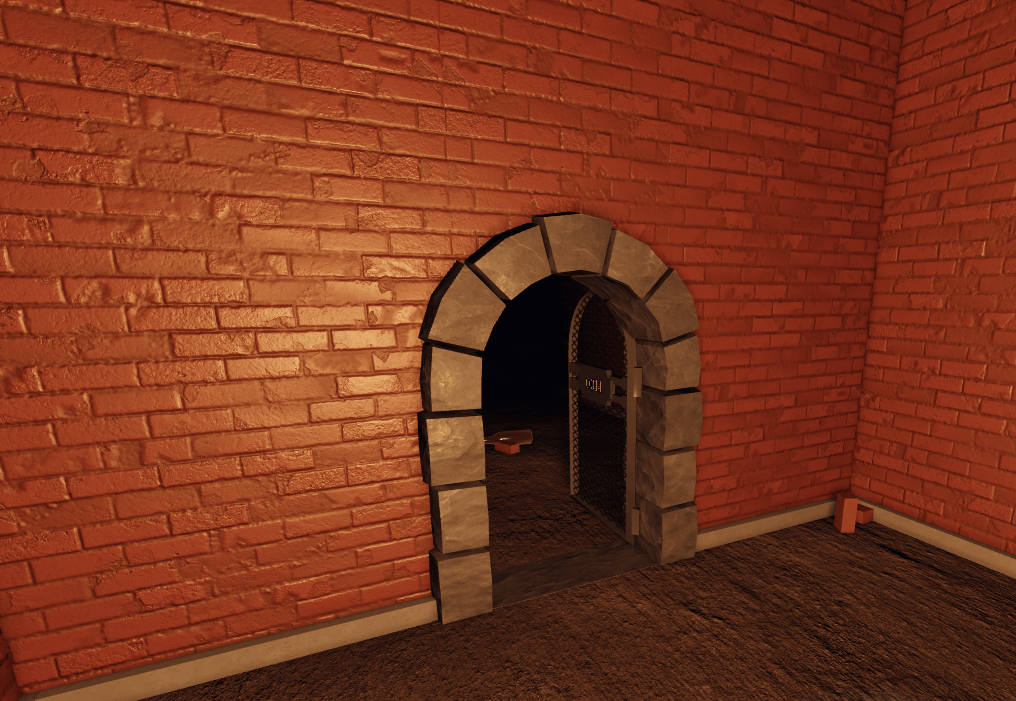
Every Grace ‘Floor’ has roughly 30-40 rooms as a base amount, where at the end of the entire floor the player comes across a hatch room which when opened takes the player into a small saferoom with frantic writings on the walls, presumably from some other characters in the story – these saferooms are very important as they allow the player to take a breath before continuing but also let the player choose modifiers which allows them to either make the game easier or harder for them selves in return for some extra XP gain throughout their run.
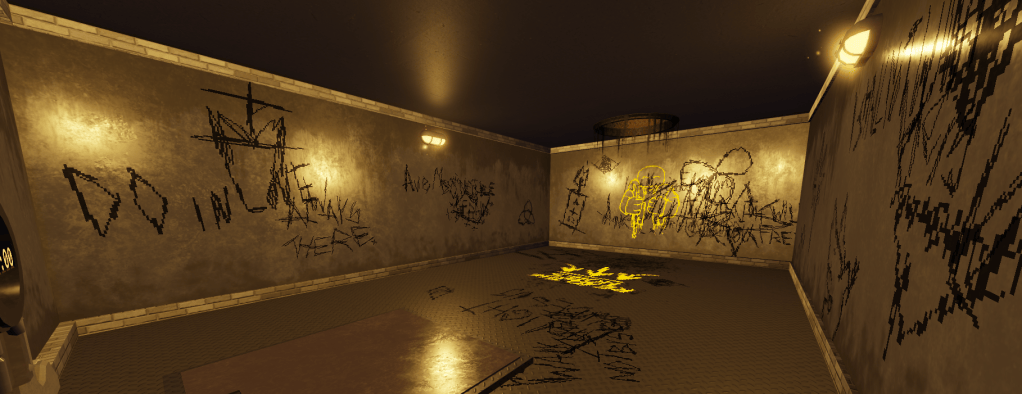
I think that generally, the design of these saferooms are very cool as there are actually several different writings that can appear in these saferooms depending on which saferoom a player has ran into, having different sets in the first 10 saferooms, after which any saferoom after the 10th the writings get randomised from all of the different tables of possible writings. These writings also fit into the general ‘MS Paint pixel art’ style that I would like to recreate the feeling of in Project;Horizons.
This game will make a person’s body start generating adrenaline, whether its the fast paced gameplay or the super erratic soundtrack, full of ‘Breakcore’ Drums and very energetic and electric sounds: Example Here (Ultrasonic Faith – Grace OST) this game was designed to make people feel overwhelmed and will attempt to always try and target the flight responce in a person when it comes to their natural fight or flight body response with adrenaline. Because of this; it is also very important as to not overdo the feelings that the game creates onto the player by giving the players a safe space where they can indefinitely take a break from their run if they need to as feeling too much of the same emotion for too long can cause negative response from the body which could turn into potential physical injury; this is also very important to keep in mind as the player may also get used to the feeling that the game tries to create which could cause the game to suddenly become boring for the person which is not the desired outcome as the game should be made to be repetitive for the players so that the game could keep player retention.
That is why the devs came up with the solution to all of those problems by creating these saferooms with 0 limit (in exception to Roblox’s 20 minute afk built-in feature which the dev doesn’t have any control over). The saferooms are that safe space that the player can access and sit in while the player themselves take a breaker after a peculiarly harder section that they just had to get through and almost didn’t make it so that they can calm down and prepare for the next section that is going to increase with difficulty.
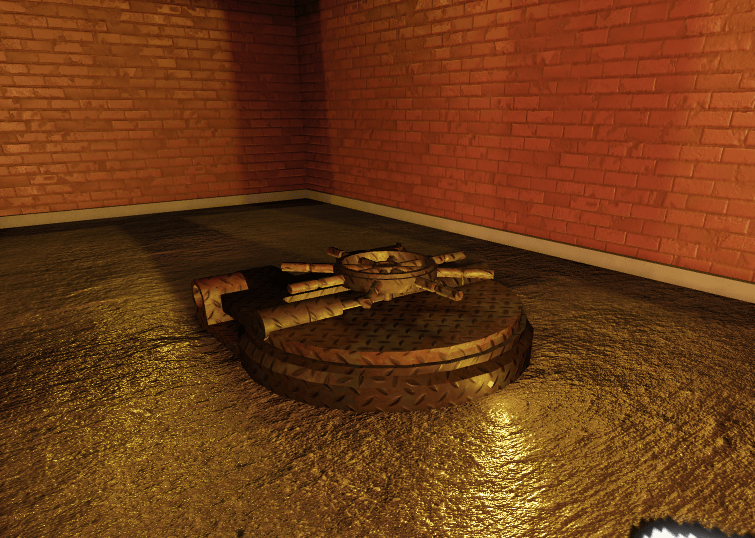
Some of the entities are really interesting to me, as they have a style which can impose a challenge and require the player to think about their positioning while also letting the player keep going on their run without posing the biggest challenge and that is why I will be showing off some of the entities in Grace as I am thinking of adding some similar entities (and some original ones that don’t take inspiration from the game) to my game.
It should also be noted that the art style of most of the entities is one of my main inspirations for the VFX and art style, will be mentioned later.
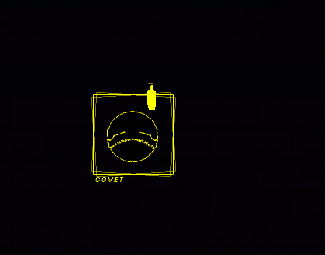
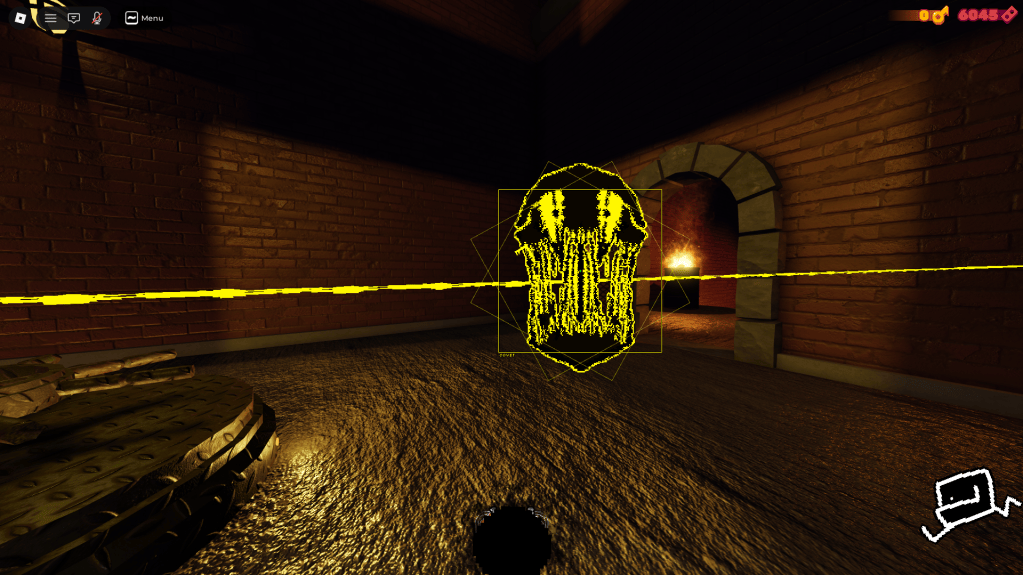
‘Covet’ is one of the aforementioned entities in Grace, it appears distant on the player’s screen but very quickly creates a straight line in the player’s view and charges in that line. If the entity touches the player, they will die and will have to restart. A very simple entity in design but when it synergises with another entity that would corner the player, this entity is a difficult challenge in the player’s movement. It is also one of my favourite entities in the whole game because of its style – both in art and in the gameplay that it creates for the player.
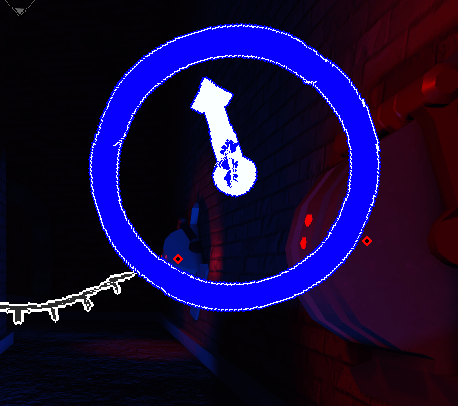
‘KooKoo’ is an entity which was also one of the main inspirations in terms of graphic style – both as ‘Pixel art’ and as ‘MS Paint Style’. The same goes for the entity ‘Dozer’ (seen below).
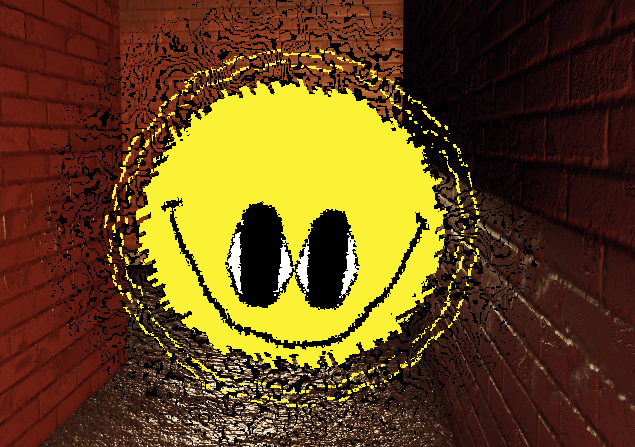
As much as I am not a huge fan of Roblox games, this really is a special case and is one of the only few games on Roblox which I actually do enjoy, but the feeling that I felt was very similar to what I had felt in Pizza Tower, the original soundtrack really enhanced the feeling of pressure on time for the player and it really did give me that big adrenaline kick that perfectly combined with the first person perspective that just made every feel a lot closer together and made it feel like everything was a lot tighter in terms of corridors and passages which just amplified the feeling of urgency that the player just needs to run as fast as they can between the multiple saferooms. The visuals of all of the entities and how the player has to interact with all of them and how the player has to adapt their own gameplay to the different entities is really interesting to me and the whole adrenaline based gameplay loop where the player has to run and get through different obstacles as fast as they can is really engaging for me and as much as the game often has me feeling overwhelmed, its not a pure overload where my brain feels the urgency of the gameplay and the situation that the character is in while at not such a high level where there is an overload of information.
Inspirations: Celeste
Celeste is a 2018 precision platformer with a special emphasis on a very certain level of difficulty. The player plays a woman named Madeline and follow her journey up the mountain Celeste. At the very base, she meets an old woman and a crow which teaches her how to ‘Dash’. The dashing tech is the main fundamental of the entire game as the player proceeds to go through the entire game, getting over obstacles and having to do very precise timing and positioning on jumps to get through the entire game.
The game starts off in an area named ‘Forsaken City’ which is known as more of the tutorial stage, its a short area which teaches the player the basics of the game as well as the controls for it, the rooms have a lot of room for the player to move and dash around where mistakes have a lot of forgiveness.
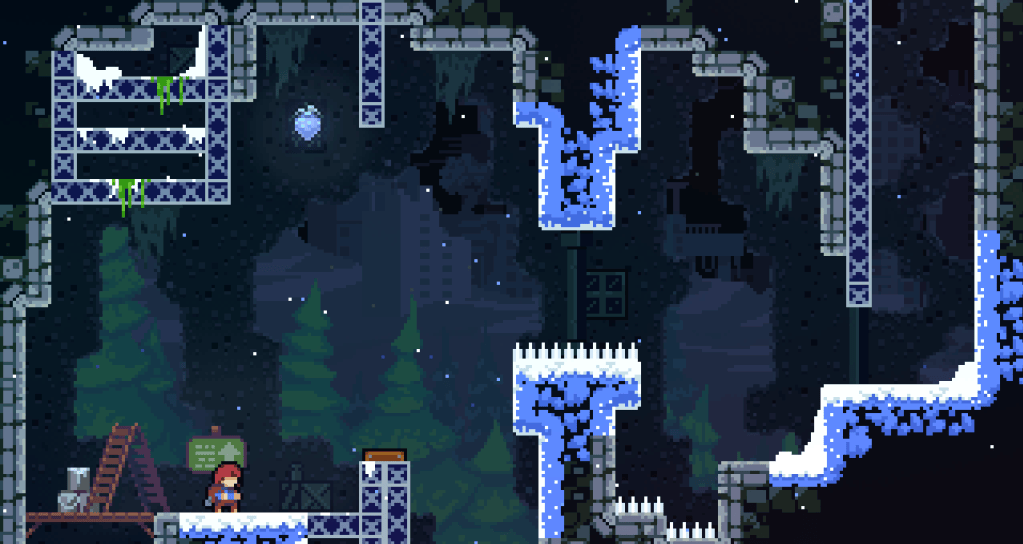
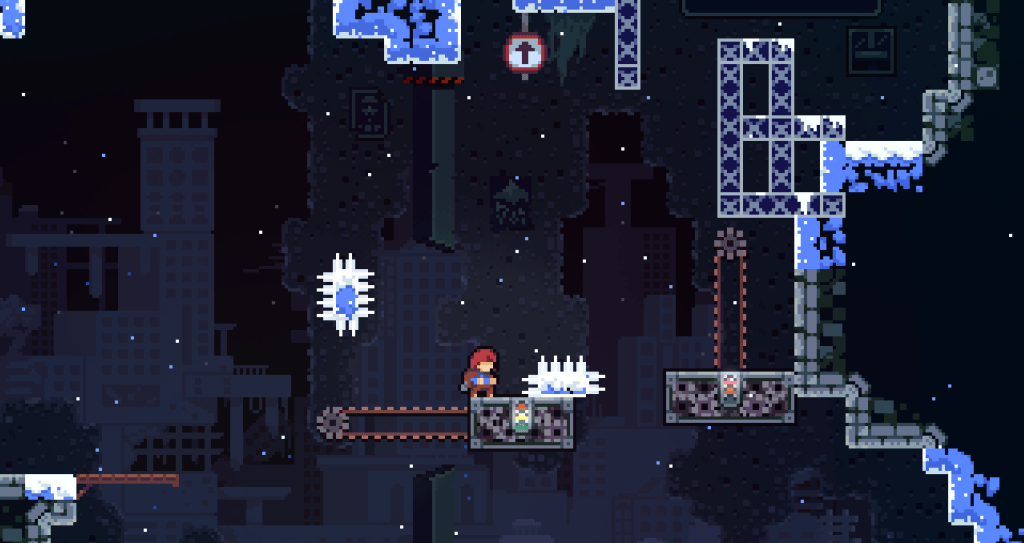
It introduces momentum dashing, where a player will receive a boost from a moving object that can be transferred into a dash, this introduction bases future levels and their obstacles in different but similar fashions, the game does this very often where it will make a very basic introduction into a mechanic and then will introduce objects that work off of that introduced mechanic but in various different ways.
This game features also very heavy difficulty and skill walls between all of the levels, the first biggest level-wide obstacle would be Chapter 3: Celestial Resort (also known as the Hotel). Chapter 1 and 2 have a lot of forgiveness in their jumps and their obstacles meanwhile Chapter 3 spontaneously scales its difficulty highly and has the player jumping through very tight timings and very tight corridors with a lot more hazards that the player has to navigate through.
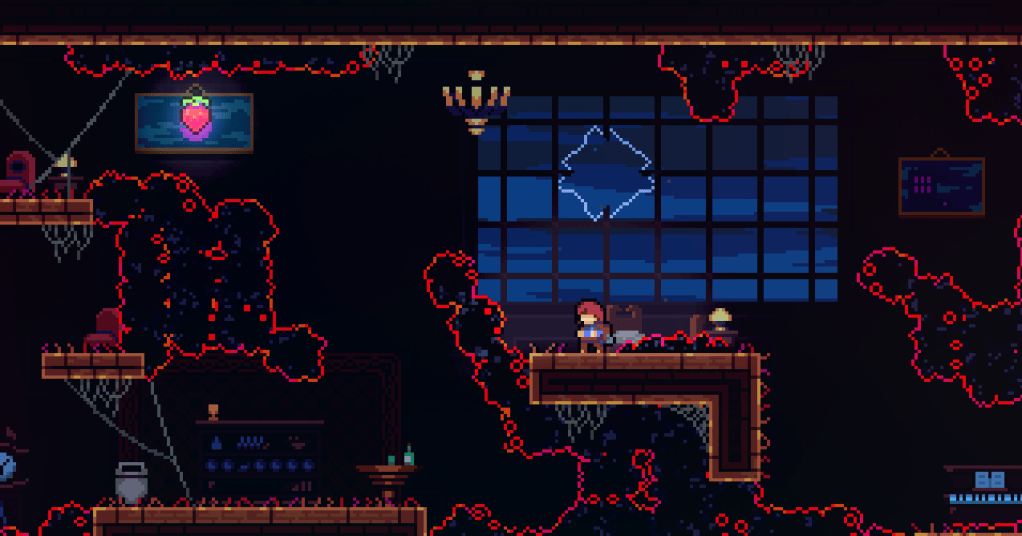
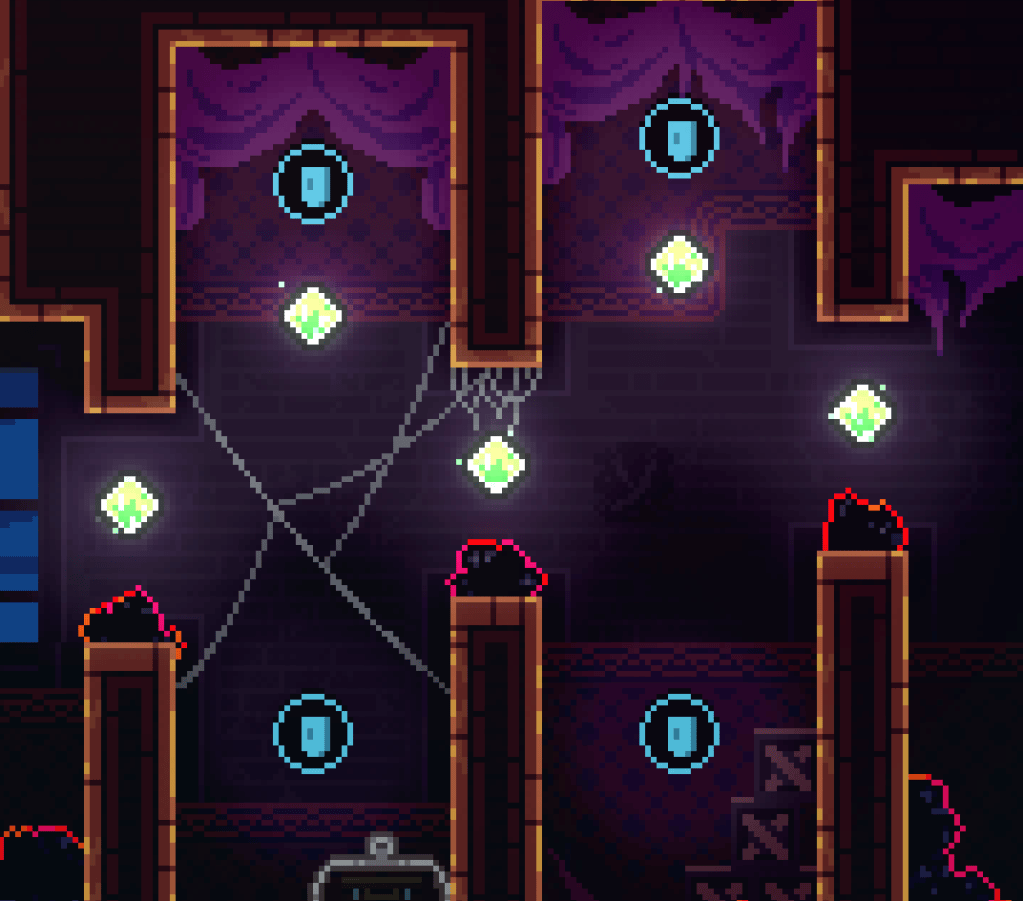
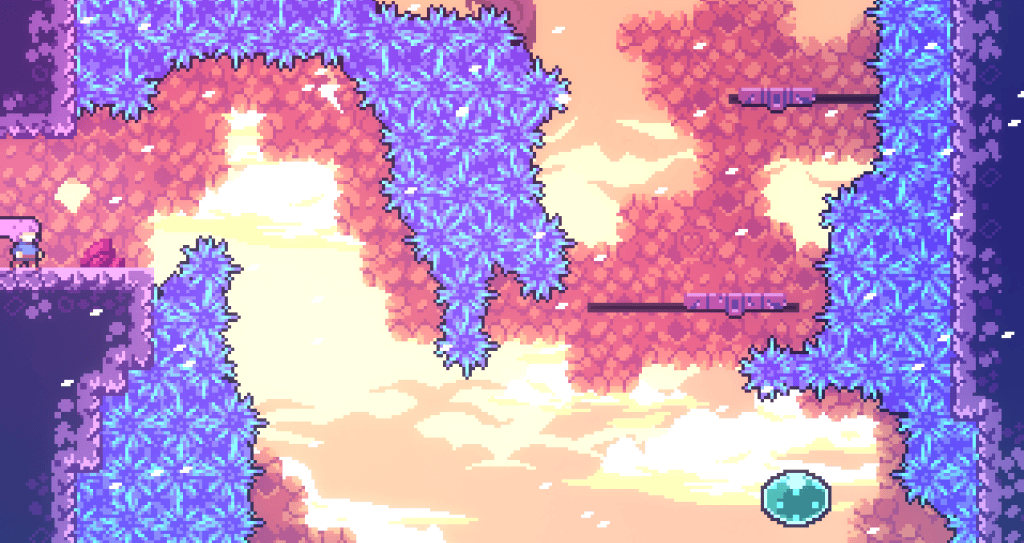
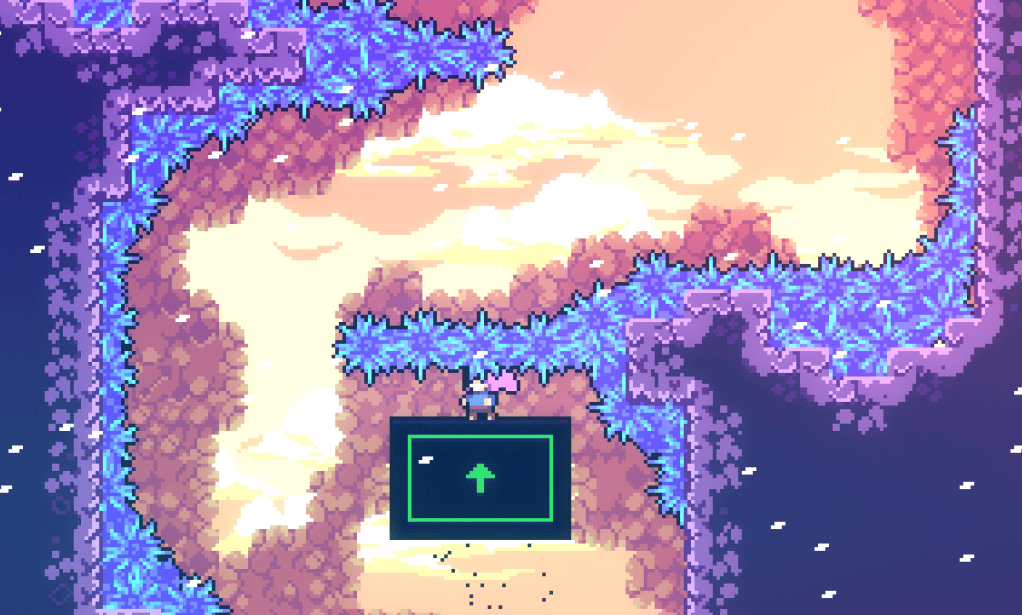
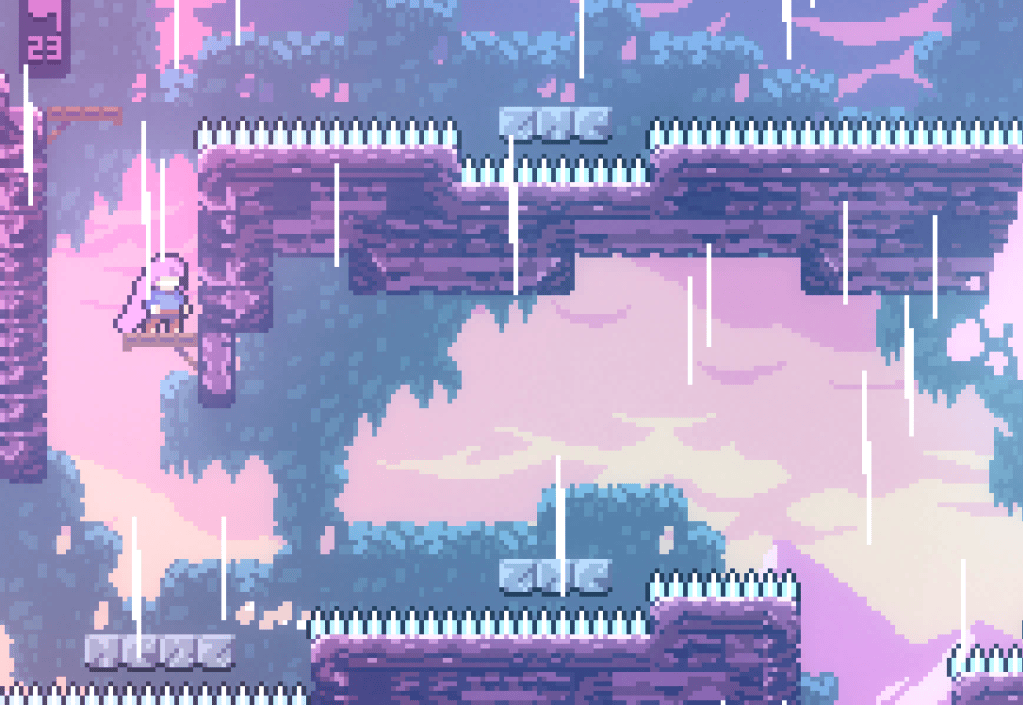
One of the main reasons as to why I am looking into this game in the first place is because of its a 2D platformer, similar to the idea that I will be going with, where I might take inspiration in some rooms with a dashing mechanic because it has such a huge movement potential for a movement based game. Another one of the main reasons is that I personally really enjoy the visual feeling of the game, the Pixel Art in this game is beautiful and is yet so simple and is one of my main inspiration behind the Art direction and VFX (along with Pizza Tower). The Level design is very difficult as well and I am thinking of adding hazards to the room generation in the game to further increase the difficulty because of Celeste.
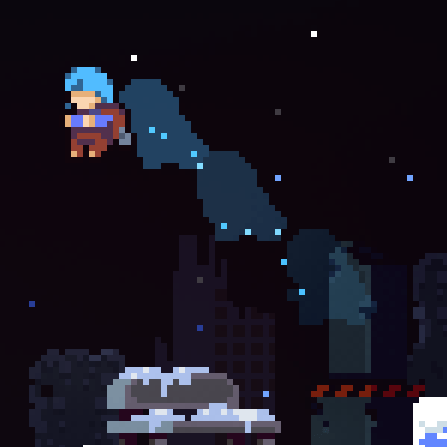
This is the dashing movement in Celeste. The player is allowed to dash in the 8 directions and while very simple, the player is seen gaining speed with the dash in the very first level with the moving platforms. There is a lot of different hidden techniques that don’t get taught properly to the player after the player has completed the base game, such as the Wavedash and Hyperdash which are different types of dash that allow the player to cross really long distance at the cost of the player’s height gain.
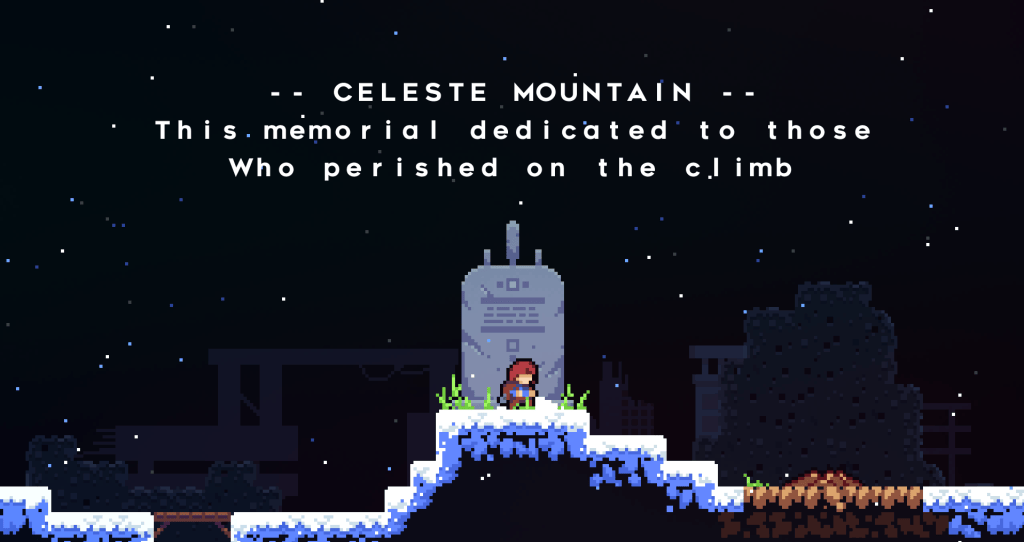
Just one of my favourite shots in the game’s pixel art direction. It should also be mentioned that the game does to hand-drawn scenes and text-bubbles for the characters as well as art for the end of every chapter, but here I am solely focusing on the pixel art that makes the game.
The point that this game really drew me in with are the visuals of the game and partially even the difficulty of the game itself; as much as I caught myself getting mad at it because of really hard sections that I couldn’t crack, the beautiful visuals and my sheer stubbornness kept me going and I really am glad that I did, the very small story behind the entire game is a really beautiful one which touches on themes such as escapism as well as characters suffering from bad anxiety and depression as well as having regular panic attacks and as much as the game touches on those subjects, it also provides ways that people who can relate to having very similar issues in their own personal lives can cope with their problems, such as picturing a golden feather and keeping it afloat as a way to regulate their breathing during a particularly panic attack and the entire driving story between Madeline and Badeline and their interactions in the different Chapters until Chapter 6: Reflections is beautiful where Madeline eventually learns to control and overcome her own personal fears and anxieties about the stress of life and learns that there will always be that Part of Her, but also how she can come to accept that that part of her which symbolises the depression and anxiety she suffers with will exist and she can learn to live with it in a more manageable way and that resources are always available which is a particularly important lesson for people like that as very frequently they may not feel like they have those resources and often struggle alone, which they shouldn’t.
Inspirations: Super Meat Boy
Super Meat Boy (SMB) is the last 2D platformer that I will be looking at. The entire game is designed over being fast and a very aggressive game overall, the themes of the game, the music behind the game and the graphics all cause a certain aggression within the player that makes them want to take the challenges that the game presents them really fast and aggressively, the timer at the top-left also adding a certain pressure for time that allows players to compete between eachother.
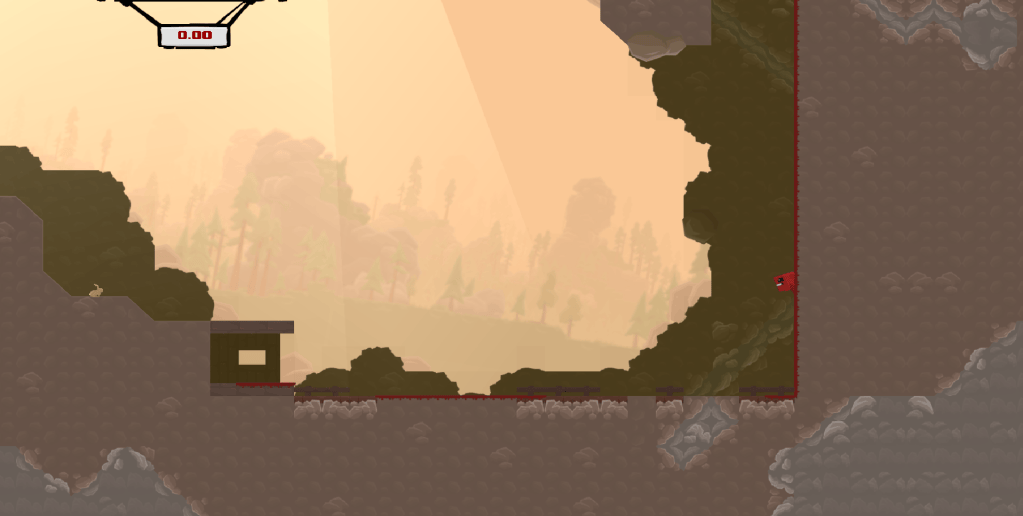
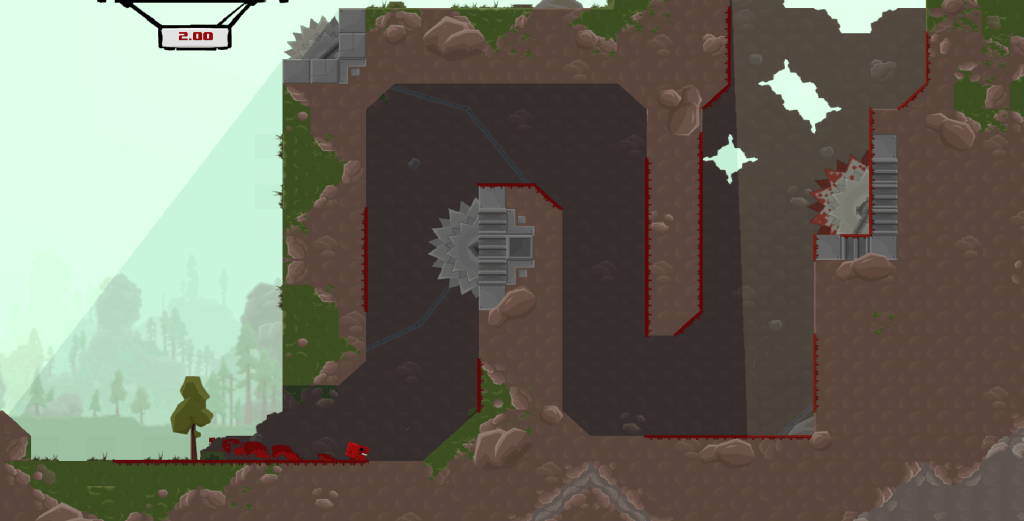
One of the main reasons as to why I am researching this game in the first place is actually some of the main features such as the blood friction, where the character slides on walls more while they are covered in blood as well as the characters running as fast as the playable characters in SMB. Partially I am also taking some inspiration behind the playable character design as the character is generally very small and nimble, which would actually make sense as to why they would be so fast as there wouldn’t be a lot that would actually weigh them down and slow them because of them being very short and skinny, meaning they would be nimble and agile.
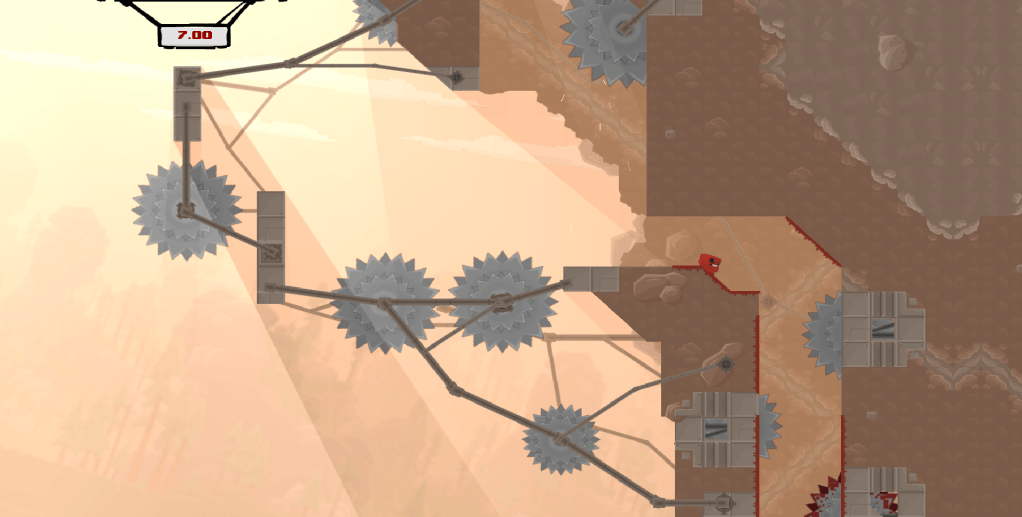
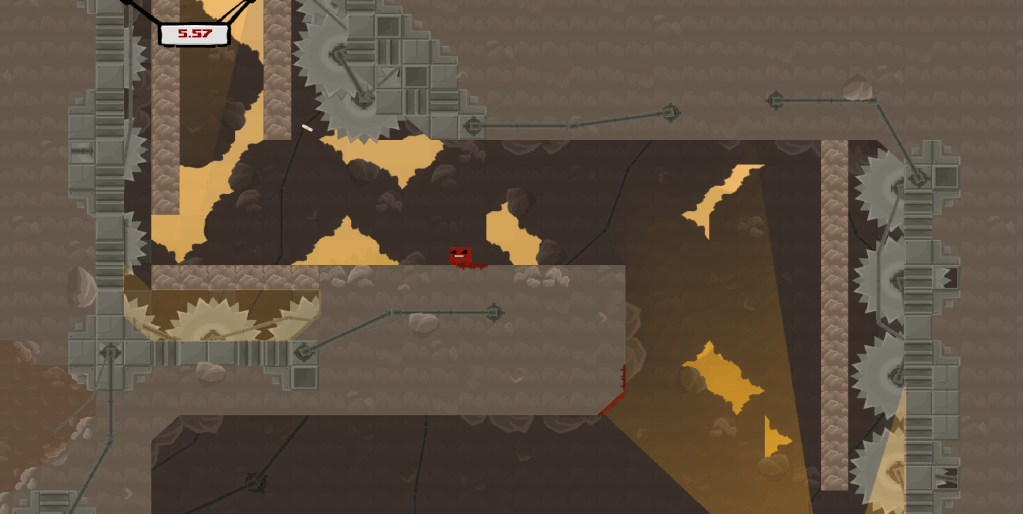
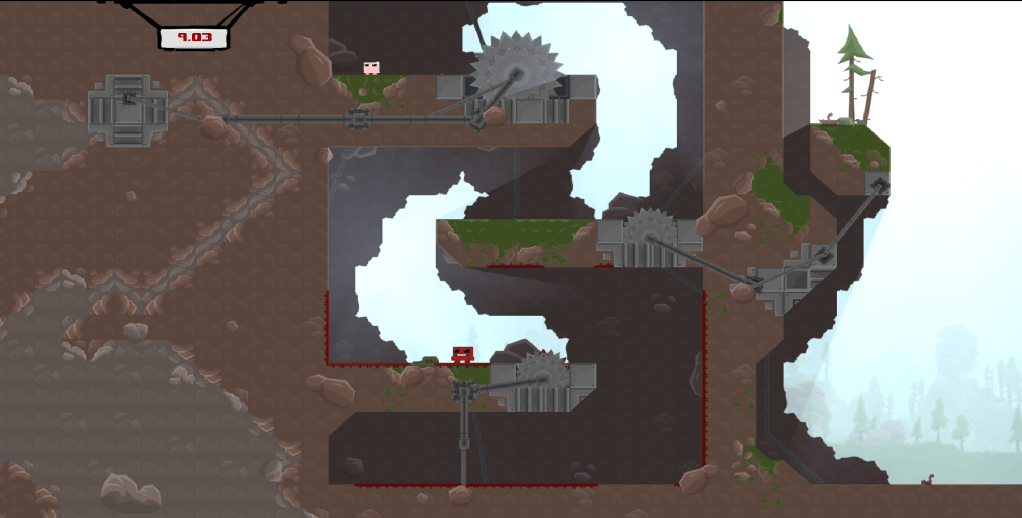
SMB is a generally very old game, but it solidifies itself as one of the most recognisable platformers out there with a ridiculously large speedrunning community, A game built on speed and beating times that the level takes a person to complete. One of the reasons as to why I personally enjoy the game is the aesthetics of it; the more gorier sections and the darker undertones of the game set the foundations only reinforced by the metal soundtrack and the fast-paced gameplay among some of the core features of platformers such a jumping and wall-jumping, this game does a lot with its limited movement capabilities such as the ability to slide and have more friction on walls that the player character has already touched previously, which could either make some sections easier or harder to perform, which encourages the player to think as strategically as possible about their movement and character placement instead of the player just blindly going in without thinking and dying over and over and over again.
Target Audience
As stated in my project proposal, I carried out a target audience survey to help me gather feedback on my game as well as find my target demographic and psychographic through a series of questions. I asked closed questions such as gender, age, but I also gave some very broad open questions such as if they would enjoy my game and what platforms they play on and what makes them continue a game. By asking a mix of these open and closed questions I can get feedback on what people typically enjoy when playing a game and try and listen and implement some of the feedback from the survey into the game itself.
Link to a spreadsheet with all of the answers to the survey here:
https://docs.google.com/spreadsheets/d/1_PlkEV2erPrpRUFmyNFQjPLotTuLgZN0HOqGP6ZuIsI/edit?resourcekey=&gid=819739727#gid=819739727
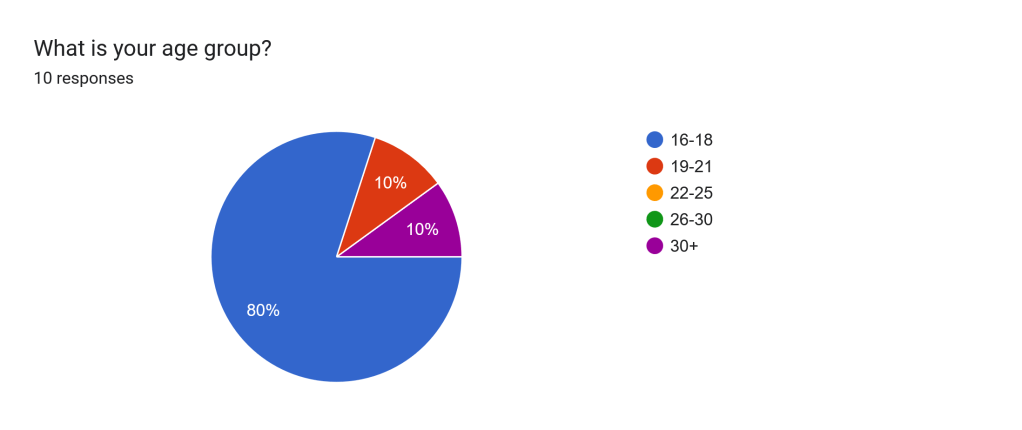
From my survey, so far I was only able to gather 10 responses for the survey, All of the responses except for 1 were in the initial age group from my proposal, however all of the other groups are within the target age group for the game.
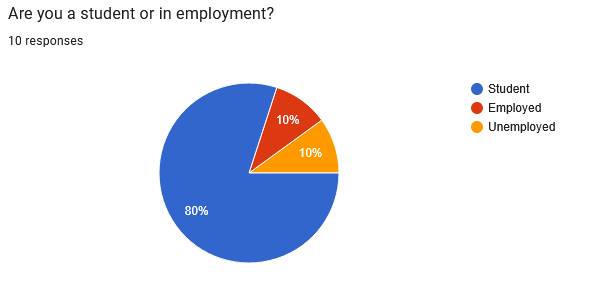
This question is very similar and tied to the previous age question, it’s more-so a question to know about the person that could play a game like this.
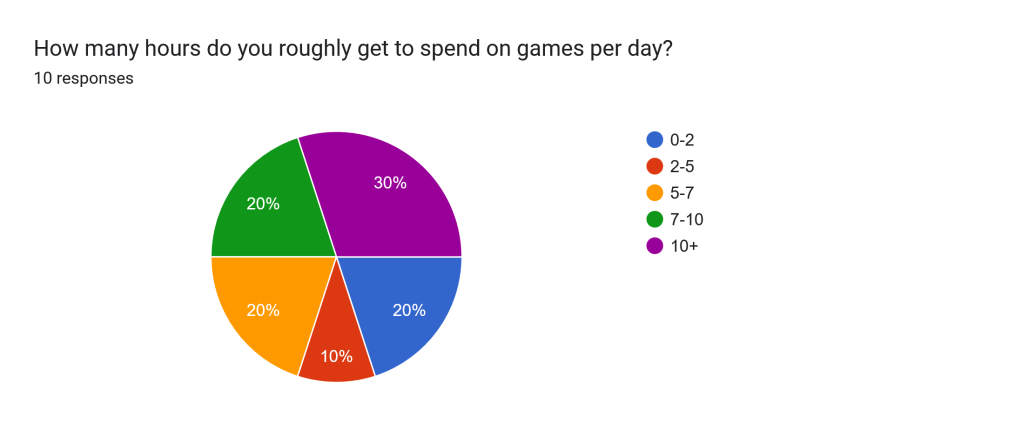
I added this question mostly to get a very rough idea in how big and/or lengthy my game should be as I know people that have been turned away from longer games because they don’t have enough time in their day to feel like they would get much progress done and I wouldn’t want my players to feel like that.
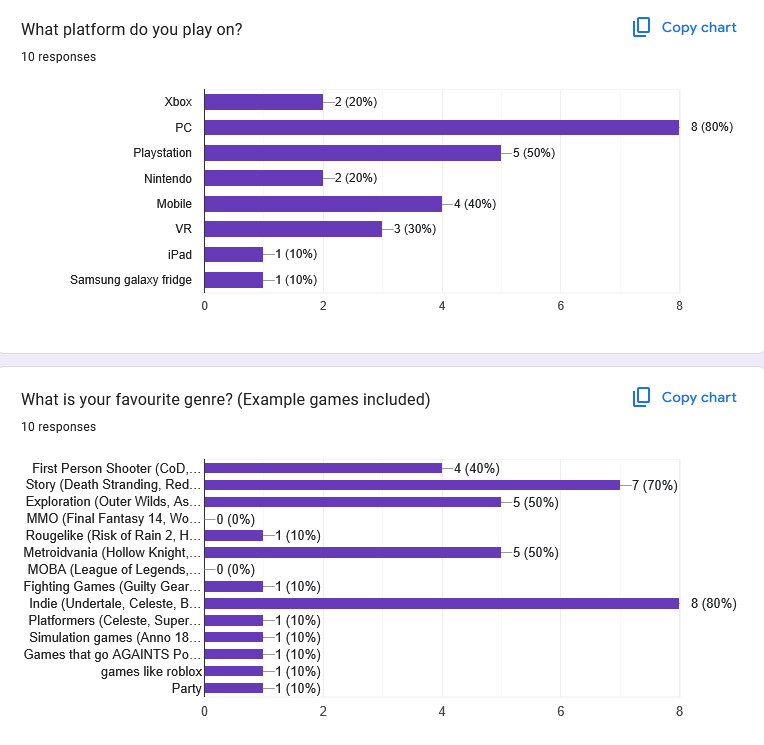
Probably two of the most important questions that ask about the player as they can be identified by which player picked what genre of game and what device they play on which can tie into their own opinions and thoughts about the platformer genre which is what my game is
I asked this question to gain an idea of what features of the game I could probably focus on to make the game suitable for as many people as possible and to get an idea of what the public wants nowadays.
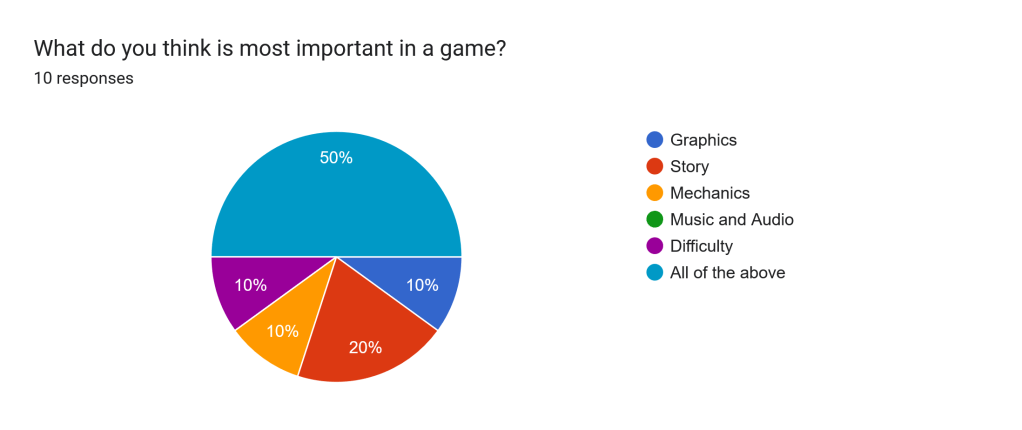
Honestly the answers for this question surprised me the most as I was expecting everyone to choose the All of the above option, but some people enjoy story and mechanics than other aspects of games which is respectable.
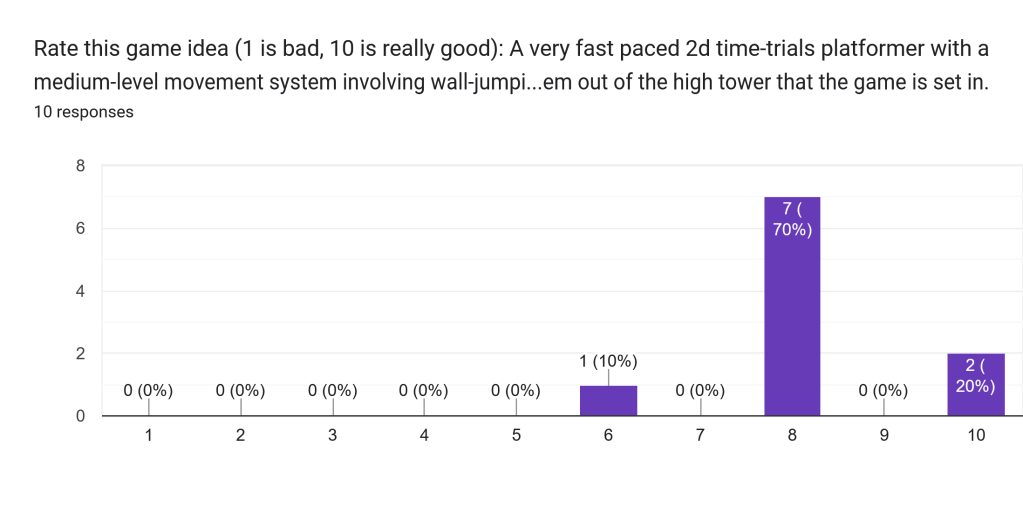
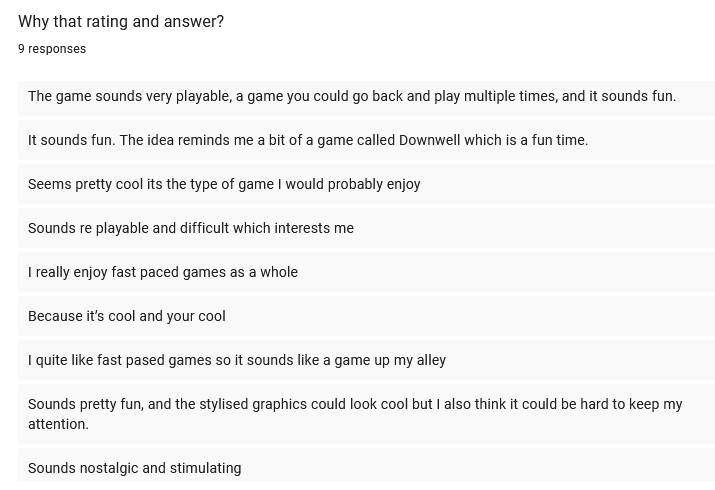
Most of these responses are very helpful and allow the dev to be able to actually gauge the general mindset within the respondents to be able to properly respond and even take in feedback and possibly add it into the game.
The 2 most important questions in the survey, the first one being a open question that is purely up to the reader’s interpretation but it looks like from the responses that the idea is doing well with the people and the second question is giving feedback towards the developer and giving me more ideas on what I could add and people’s concerns with the game and its production and the way that it is going to turn out.
Because of this survey, I am probably going to add more lore to the tower itself as well as one of the respondents mentioned another game named “Downwell” which interested me, I watched a video about the game and it gave me even more inspiration for my own game! (https://www.youtube.com/watch?v=i5C1Uj7jJCg)
PEGI Ratings
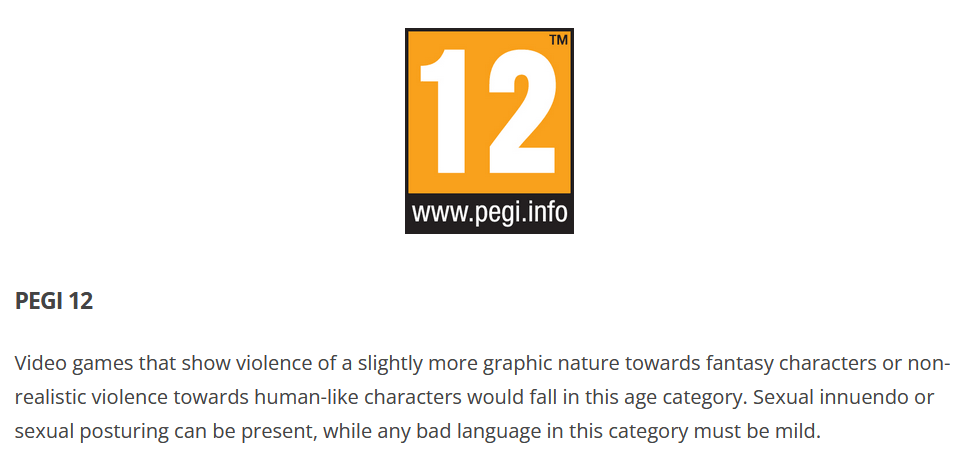
I looked into PEGI (Pan European Game Information) Orginisation and the way that they rate their games to get an idea of what age rating my game would be. Here is a full list of the PEGI Ratings and Warnings on a game:

After doing research on https://pegi.info/what-do-the-labels-mean, The PEGI 12 rating is what seems the most accurate for what I have planned for the game as it will involve violence towards humanoid character but in a very fantasy and not realistically graphic way with barely any bad language.
GUI and UI
Timers
Timers are a very important part of a lot of genres, but one of the main users of timers is the platformer genre, whether it be some challenge that you have to run between platforms before a certain amount of time runs out or it be that one player has to get from point A to point B within a certain amount of time – Timers are very important to keep track of it all for the player. A Hat in Time (AHIT) uses timers to keep track of when certain challenges give you a very strict time limit in the “Death Permit” DLC that unlocks customise options.
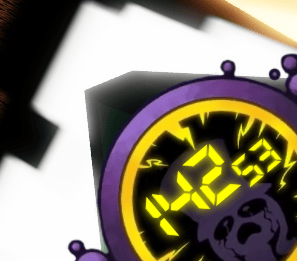
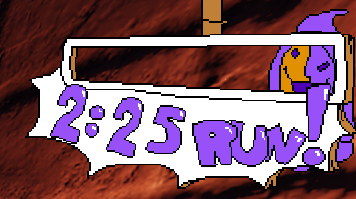
This is another timer in Grace, heavily inspired by the art style of Pizza Tower, a game that it takes a lot of heavy inspiration from in the first place.
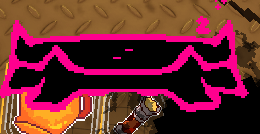
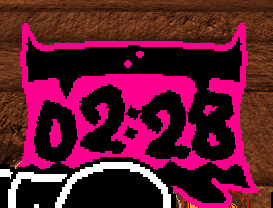
The original custom SNAP timer from Grace, fully animated with its own interactions depending on if the player survives between each saferoom and keeps track of the timer in the middle of the screen – one of the better placed timers, easy for the player to see.
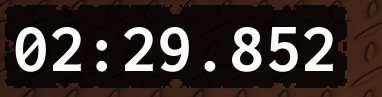
The original grace timer, placed in the bottom-left corner where most people don’t look, but its there and its really noticeable.
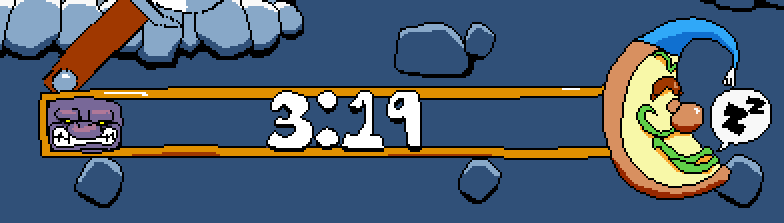
This is the timer that is used in Pizza Tower, used to signify a run sequence called a ‘Pizza Time’ where the player has to run back through the entire level they just did in order to escape.
Vignette
Vignette is an effect as a game overlay where the corners of the screen will darken a certain colour to accent the middle of the screen or two add other effects to imply a certain emotion or as a warning to the player. For example, the screen borders might turn a violent red to warn the player that they are on low health, it gets the message across to everyone, no matter where they are looking.
Artistic Vision and VFX
One of my favourite art styles in modern media games is the Pixel Art style where everything is a lot simplified, nostalgic almost for the older generation but very frequently seen in the indie game dev spaces. Most indie devs choose to make games in a lot more pixel art graphics where instead of hyper-realistic shining and ray-traced metals, there is just pixels, colours blending and very simplified imagery. I watched this video to learn a lot and to get a better perspective than to what I had about Pixel Art and how it affects the modern indie game dev market so much.
This is another incredible video that dives deep into Celeste’s art direction and the way that the pixel art within Celeste actually works on a very technical basis.
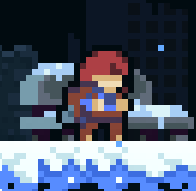
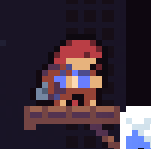
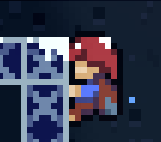
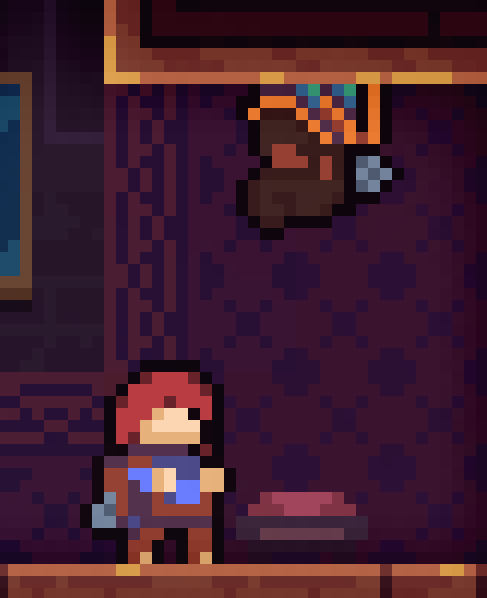
Celeste renders internally at 320×180 pixels, allowing for very clean scaling based off of computers native resolution. (720p (4x), 1080p (6x), 1440p (8x) and 2160 (12x)) The pixel consistency of all of the tiles being 8×8 pixels and the character art being 16×8 a.k.a 2 tiles tall and 1 tile wide.
Celeste is one of my favourite games of all time and I will be attempting to take parts of inspirations from it when looking into my own artistic visions for my game.
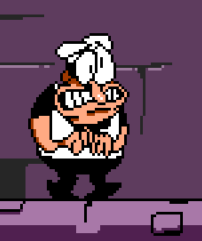
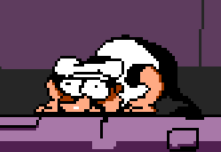
A lot of Pizza Tower’s artistic direction is derived from old 80s and 90s cartoons, with them also being pixel art as individual pixels are very prominent within both character and enviromental design, although being at a very much higher pixel consistency per tile than Celeste’s where the developers actually used scratchy, hand-drawn lines to simulate the similar art style of the 90s cartoons instead of restricting themselves to a single pixel count adherance, choosing to use techniques such as “shaping wet clay” where the characters stretch and shape themselves in very comedic ways which adds a comedic effect, an artistic flow and manages to simulate the 90s cartoons that its taking inspiration from.
Music and Sound directions
Breakcore is a genre of music that is very infamous for being extremely chaotic, having a very high bpm upwards of 180 to almost a bpm of 240 and well known for chopping up and heavily sampling the “amen break” which is a sample from “Amen Brother – The Winstons” 6 second drum solo. Very recently, I came across this video by Synthet which explains the history and uses of the amen break, briefly mentioning the genre Breakcore at around 1:42.
The reason as to why im talking about breakcore as it is very often used for very fast paced gameplay as is similar in the sound design for Pizza Tower which uses high bpm electronic and synthetic sounds as well as using electronic guitar for some moments. Another game that I am going to be taking inspiration from in terms of music and sound design will be Ultrakill. The music for all of these games just solidify their fast paced style by matching it and to create additional energy and adrenaline for the player and adds on dramatic effect.
Marzuku is one of the main producers for Ultrakill OST group “Heaven Pierce Her” who also creates their own music that is affiliated with the ULTRAKILL soundtrack. One of their songs “At Ends” uses a lot of the Amen Break and while being a slower and lower pitched song, it still can be counted as breakcore simply by how much chopping of the amen break.
War Without Reason is a slower track compared to the key notes of the breakcore genre however it still goes into its slower subgenre. The track in of itself has a lot of chopped drums as well as a dramatic and low lead that makes the player feel a sense of desperation, later going into a musical piece with an emergency alarm incorporated into the song itself as the track nears its end, similar to the machine on the cover.
Death of god’s will doesn’t really have anything to do with breakcore in of itself, however it is still a very energy packed song and I hope to add a song similar to it to my game. The genre for the song is Metal and its there as a means of serving a purpose.
Setting and Locale
I plan on setting the entire game in a very very big tower that would tower over entire countries. My main spiration of this tower comes from a Webtoon Original Comic “Soulwinder”, a comic set in the “City of Zale”, a massive steampunk / gearpunk city all about innovation and engineering where a massive clock-like skyscraper tower named “The Great Contraption” spins the gears and cogs needed to power the entire country-wide city.
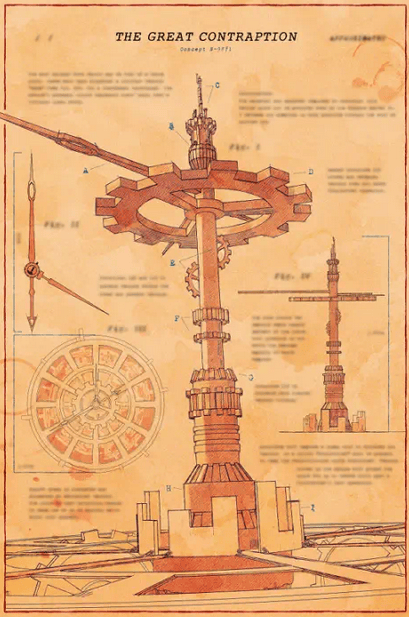
Official Soulwinder merch: The Great Contrapion Poster
https://soulwinder.shop/pages/about-forge-285
Soulwinder will be playing the biggest part of inspiration behind the setting as I love the design of the massive tower. I will be taking my liberties with the idea but the tower is a really cool idea for a setting of the game and it could work very well with how im planning on doing it.
Another one of my main inspirations behind the setting would be Splatoon 3: Side Order DLC, featuring the “Tower of Order” which is an expansive and random tower that the player has to get up through in an elavator going through the different rooms and picking up Colour Palletes as their main source of powerups.
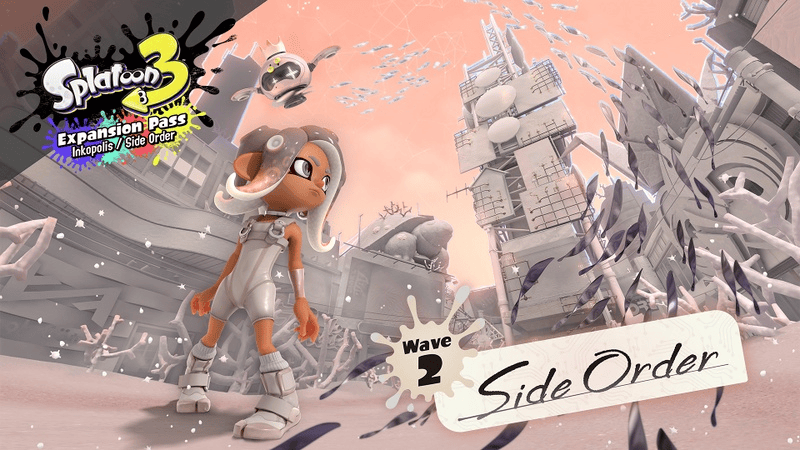
https://splatoonwiki.org/wiki/Side_Order
The levels would have to be smaller, shaped like rooms that could split off and give the player choice in going different routes similar to how this Framework for Analysis of 2D Platformer Levels by Gillian Smith, Mee Cha and Jim Whitehead studied mainly Sonic The Hedgehog but also touching on other games like Super Mario World or Yoshi Island DS.
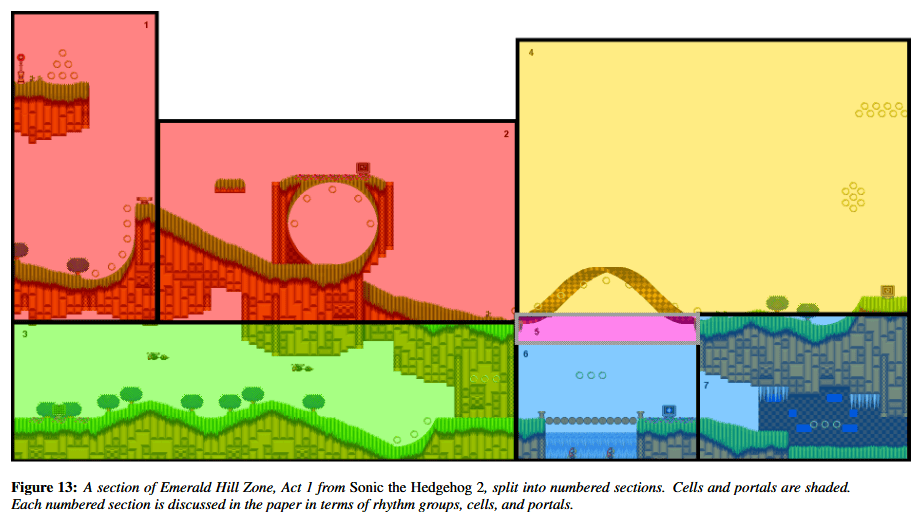
https://eis.ucsc.edu/papers/smith-sandbox-08.pdf
This study really goes in depth for what actually makes a good platformer and what every platformer needs, rewards, platforms, movement aids, obstacles for difficulty and different triggers that might make the level either easier or harder.
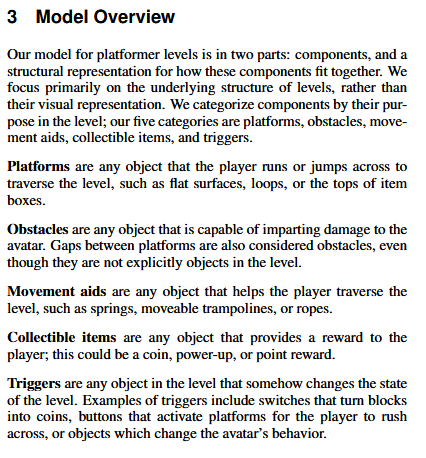
Linguistics and languages
In order to come up with city names as well as location names such as the tower, I researched several different old languages in order to get a root word that would describe the place it is used for.
The languages I researched are:
- German
- Slavic
- Old Norse
- Latin
- Greek
The reasons as to why I specifically researched these instead of other languages is because I have personal experience with the Slavic languages as they are generally similar across eachother (Polish, Czech, Russian, Ukrainian) as well as having a very old meaning which old versions as well as ancient languages interest me personally. The German language is deeply rooted into European history, a lot of the time being one of the leading languages in Europe being taught at almost all European schools. Old Norse has always interested me because of the mythology that is in ties with the language and also I really enjoy Scandinavia and its countries as a whole.
First, I wanted to get the name for the Upper City, one that is very angelic, a paradise, very frequently referred to as heavenly within the game’s lore. I had looked at the German, Norse and Slavic languages for the word for Heaven and Angel. In German, the word for heaven is ‘Himmel’ which I personally really liked and the word for heaven in the Slavic Languages is Raj (pronounced like Rai) which translates to paradise. Meanwhile the closest Norse word for heaven was ‘Himinn’ which sounds generally very similar to Himmel therefore I did not want to use it as well as the fact that in modern Norse the word still becomes ‘Himmel’ like German. Raj and Himmel sounded the best in my opinion as Latin and Greek were long and complicated, offering words such as Caelum (Latin) and Ouranos (Greek) therefore I went with the general name for the upper civilization being named ‘Rai’ (derived from the Slavic word Raj, however spelled in a way for the English to understand its phonetics and how to pronounce the actual word). The word for the actual city where the civilization is in will be called “City of Himmel”, named after a man named Himmel who was the first ever to successfully ascend the tower, the city’s name will roughly translate to the “City of Heaven”.
Second, I wanted to look at naming the actual tower in which the game will take place – I basically repeated what I did for naming the upper city where I looked at all of the languages and picked what I thought sounded good. For the name of the tower, I researched that the Old Norse name for tower would be Tarn which keeps it very simple and small but while looking at the Slavic words, I came across the Russian origin word “grad” meaning “fortified” or “reinforced” or “strong”, usually put at the end of a word to symbolize strength within a building. If you were to add the two names they would make Tarngrad, however after a lot of debating with some of my friends as I wanted their opinion on these names, I will be changing the name to Torngrad as it is easier to say and flows better etymologically.
Lastly, I wanted to get down the name of the dystopian and poor city – one with a lot of dysfunction and corruption as well as the sense of community and bartering focused economy based off of the sheer amount of poverty that is circulating around the entire city. This place is dirty, often rains and overcrowding is the absolute minimum. The first thing I did was look at the german words for lower class and poor – Armes and Unterschicht or Assi/Asi. I personally really liked the sound of Asi, it kept itself really short and actually rolled off the tongue well, however very quickly after I found the word I found out that its meaning is calling someone trashy, unpolished and lowerclass rather than to describe a place is that poor. I instead had a look at the Old Norse word for poor and lower class and came across Thrall, this however is the word for an enslaved person, and slavery is bad so I decided to keep looking and finally found the word þola (pronounced; Thola) which actually means to endure and to withstand. This meaning can actually reach really deep as it can hold meaning for the big city in of itself that no matter the challenges that the people must face – poverty and working day and night for the absolute minimum, they continue enduring and persevering – choosing to live and not accepting death and withstanding the challenges they face on a daily basis. The name of the city itself is telling the people living in it to keep going and encouraging them to keep living and do not give up. I think that the name itself fits into the entire situation as well as rolling off the tongue well. Therefore, the the lower city on the foot of Torngrad is called The City of Thola.
When it comes to trying to name the game, it took me quite a long time (writing this 16/4/26) and I was personally quite stumped on what the name of the game could be. Initially, I had come up with the potential name of ‘Tower Chaser’ however I was not pleased with it and after a lot of brainstorming and the new additions to the plot of adding 2 civiliations, a Dystopia and Utopia, I decided to name the game – “Tower of Heaven”.

